Abstract
Virtual Production (VP) has rapidly evolved through the convergence of real-time rendering, motion capture, camera tracking, and immersive media systems, expanding beyond film production toward broader applications in spatial media and interactive environments. However, despite the increasing adoption of VP technologies, existing workflows remain fragmented across domains such as computer vision, photogrammetry, motion capture, and audiovisual production, limiting interoperability, reproducibility, and methodological validation within academic research infrastructures.
This article proposes a conceptual and methodological framework for developing a calibrated virtual production infrastructure oriented toward spatial media research. Rather than focusing exclusively on cinematic production pipelines, the proposed approach integrates motion capture systems, spatial acquisition processes, camera calibration procedures, and real-time rendering environments within a unified experimental ecosystem.
The research adopts a practice-based and infrastructure-embedded methodology, combining preliminary calibration studies, interoperability testing, and experimental integration between optical tracking systems, calibrated camera workflows, and real-time media platforms. Initial tests highlight recurring challenges related to spatial alignment, optical distortion, synchronization, and cross-system consistency.
Rather than presenting a closed technical solution, the article positions calibrated infrastructure design as an emerging methodological problem within spatial media research, proposing a framework for future investigation into validation protocols, integrated workflows, and reproducible VP experimentation in decentralized academic environments.
Keywords: Virtual Production, Spatial Media, Motion Capture, Real-Time Rendering, Camera Calibration.
Introduction
Virtual Production (VP) has rapidly emerged as one of the most significant transformations in contemporary audiovisual production, integrating real-time rendering, motion capture, camera tracking, and immersive display systems into unified production environments (Epic Games 2019; Silva Jasaui et al. 2024). Initially consolidated within film and television industries through the adoption of LED volumes and real-time engines such as Unreal Engine, VP workflows increasingly extend beyond cinematic production toward broader applications in games, immersive media, interactive environments, and spatially mediated digital experiences.
This technological convergence has accelerated the collapse of traditional distinctions between pre-production, production, and post-production, enabling simultaneous visualization, capture, simulation, and interaction within real-time environments. At the same time, the expansion of real-time media systems has contributed to the emergence of new forms of spatial media, in which digital environments are no longer understood solely as representational spaces but as dynamic systems integrating embodiment, interaction, simulation, and environmental data (Giannachi 2004; Kenderdine 2021).
Despite the growing adoption of VP technologies, however, the methodological foundations supporting these environments remain distributed across heterogeneous technical and disciplinary domains. Camera calibration procedures are traditionally situated within computer vision and photogrammetry research (Brown 1971; Zhang 2000; Hartley and Zisserman 2004), while motion capture systems, real-time rendering pipelines, and audiovisual production workflows often evolve through isolated industrial practices with limited methodological standardization. As a result, many VP environments continue to operate through project-specific configurations that are difficult to reproduce, validate, or compare within academic research contexts.
This fragmentation becomes particularly evident in experimental environments where motion capture, spatial acquisition, real-time rendering, and calibrated audiovisual systems must operate simultaneously within interoperable workflows. Challenges related to optical distortion, spatial alignment, synchronization, latency, and cross-system consistency frequently arise during integration processes, yet these issues are rarely addressed through consolidated methodological frameworks designed for reproducible research infrastructures.
Recent discussions surrounding digital twins, immersive heritage environments, and spatial computing further reinforce the need for integrated infrastructures that articulate real-time media systems with spatial and embodied data (Batty 2018; Fuller et al. 2020; Whang et al. 2025; Zhang et al. 2025). Nevertheless, much of this research remains predominantly engineering-oriented or restricted to application-specific workflows, leaving a significant gap in the development of calibrated, methodologically validated VP infrastructures for spatial media research.
This article proposes a conceptual and methodological framework for the development of a calibrated virtual production infrastructure oriented toward spatial media experimentation. Rather than presenting a closed technical solution, the paper discusses VP infrastructure itself as an emerging methodological problem situated between audiovisual production, computer vision, motion capture, spatial acquisition, and practice-based media research.
The discussion is grounded in preliminary integration experiments involving optical tracking systems, calibrated camera workflows, real-time rendering platforms, and spatial acquisition processes currently being implemented within an academic research environment. Through this approach, the article argues for the importance of reproducible and interoperable infrastructures capable of supporting experimental workflows across immersive audiovisual production, games, interactive media, and geographically situated spatial experiences.
Virtual Production Beyond Cinematic Workflows
Virtual Production has traditionally been associated with contemporary transformations in film and television production, particularly through the integration of LED volumes, real-time rendering engines, virtual cinematography, and in-camera visual effects workflows. However, the rapid expansion of real-time media systems has progressively displaced VP beyond its initial cinematic applications, positioning it within a broader ecosystem of spatial media, interactive environments, immersive simulation, and embodied digital experiences (Kerbi et al 2026).
This transition reflects wider technological and cultural shifts associated with the convergence of game engines, immersive interfaces, spatial computing, and real-time interaction systems. Engines such as Unreal Engine increasingly operate not only as visualization platforms for audiovisual production, but also as infrastructural environments capable of integrating simulation, interaction, environmental data, and performative media within unified real-time ecosystems. In this context, VP becomes less a production technique restricted to cinema and more a dynamic framework for spatially mediated digital environments.
Recent developments in immersive media and XR systems further reinforce this transformation. Spatial media environments now incorporate multiple forms of interaction, including embodiment, motion capture, environmental sensing, spatial reconstruction, and real-time responsiveness (Kühnapfel et al. 2023; Song et al. 2025; Zuo et al. 2025). Such environments operate through continuous negotiation between physical and virtual space, where bodies, spatial data, audiovisual capture, and computational systems coexist within hybrid media ecologies.
This convergence has also intensified the relationship between virtual production and game technologies. Game engines increasingly function as central infrastructures not only for entertainment products, but also for architectural visualization, digital twins, immersive heritage environments, interactive storytelling, simulation systems, and spatial computing applications (Deloitte Insights 2024; Krüger et al 2024; Jia et al 2026). Therefore, distinctions between cinematic production, interactive media, and real-time simulation have become progressively unstable, producing workflows that combine characteristics of film production, computational visualization, and embodied interaction (Parikka and Strauven 2024; Sords and Wilment 2024).
At the same time, territorially grounded media practices have gained relevance within immersive and interactive environments. Drone-based spatial acquisition, photogrammetric reconstruction, volumetric capture, and environmental scanning technologies increasingly enable the incorporation of geographically situated data into real-time systems. These developments allow digital environments to function not merely as abstract simulations, but as spatially anchored media environments capable of supporting narrative, performative, and interactive experiences connected to real-world locations and cultural contexts (Li et al. 2026; Jamil and Brennan 2025).
Despite these advances, the infrastructure supporting such environments frequently remains fragmented. Real-time rendering systems, motion capture pipelines, spatial acquisition technologies, and calibrated audiovisual workflows are often implemented through isolated production solutions developed for specific projects or industrial applications. Consequently, many VP systems lack methodologically consistent frameworks that ensure reproducibility, validation, and long-term experimental consistency within research-oriented environments.
Within this scenario, spatial media emerges not simply as an application domain for virtual production technologies but as a conceptual field requiring integrated infrastructures capable of articulating embodiment, spatial acquisition, real-time simulation, and calibrated audiovisual systems. The development of such infrastructures, therefore, poses both technical and methodological challenges, particularly in academic contexts seeking to establish reproducible, experimentally grounded workflows.
Calibration and Interoperability Challenges
The increasing complexity of virtual production ecosystems has intensified the need for interoperable, methodologically consistent workflows that integrate camera systems, motion capture, real-time rendering engines, and spatial acquisition technologies within unified environments. While individual components of these systems have evolved significantly in recent decades, their integration often occurs through dispersed, project-specific configurations that limit reproducibility and experimental validation.
Camera calibration procedures are well established within photogrammetry and computer vision research, particularly in areas involving lens distortion modelling, intrinsic and extrinsic parameter estimation, and spatial registration (Luhman et al. 2016; Liao et al. 2025). These approaches provide robust mathematical foundations for optical measurement and spatial reconstruction. However, their application in contemporary virtual production environments introduces additional layers of complexity, including real-time interaction, heterogeneous tracking systems, audiovisual synchronization, and dynamic media workflows.
In VP environments, calibration extends beyond isolated optical correction processes. Real-time production systems require continuous alignment between physical and virtual spaces, involving camera tracking, motion capture synchronization, color consistency, spatial registration, latency management, and environmental correspondence across multiple computational layers. Small inconsistencies in any of these elements may propagate throughout the system, leading to instability in compositing, spatial displacement, tracking drift, or discrepancies between virtual and physical coordinates.
These challenges become more evident in hybrid environments where motion capture systems and calibrated camera workflows operate simultaneously inside real-time rendering ecosystems (Cho and Na 2024). Although motion capture technologies provide highly precise positional tracking, the workflow integration between optical tracking systems, virtual cameras, rendering engines, and spatial acquisition pipelines often depends on manually configured workflows with limited standardization. Therefore, many VP systems remain strongly dependent on local technical expertise and difficult to replicate across institutional contexts.
The growing adoption of game engines within virtual production further intensifies these cross-system integration challenges. Real-time engines simultaneously serve as rendering platforms, simulation environments, synchronization systems, and interaction frameworks, consolidating multiple layers of technical dependencies within a single workflow. This convergence creates highly flexible production ecosystems but also increases methodological instability when calibration procedures are insufficiently structured or inconsistently implemented.
In parallel, the incorporation of spatial acquisition technologies such as drone-based photogrammetry, volumetric reconstruction, and environmental scanning introduces additional calibration demands associated with scale consistency, coordinate alignment, and spatial integration between geographically acquired datasets and real-time virtual environments (Zhenghao et al 2024). Such processes require not only technical compatibility between systems, but also methodological consistency that supports reproducible experimental conditions.
Despite the centrality of calibration in VP workflows, existing practices often remain dispersed across industrial pipelines, software-specific solutions, or isolated technical procedures developed for specific production contexts. Consequently, the field still lacks integrated methodological frameworks that can articulate optical calibration, motion capture alignment, spatial acquisition, and real-time rendering within reproducible infrastructures for spatial media research.
Rather than treating calibration exclusively as a technical operation, this article argues that interoperability itself constitutes a methodological problem within contemporary virtual production environments. The development of calibrated infrastructures, therefore, requires not only technical precision but also systematic validation procedures that support stable, comparable, and reproducible workflows across different spatial media applications.
Toward an Integrated Infrastructure for Spatial Media
The growing convergence of virtual production, real-time rendering, motion capture, and spatial acquisition systems increasingly demands infrastructure capable of supporting integrated, reproducible workflows across heterogeneous media environments. Rather than functioning as isolated production pipelines, contemporary spatial media systems operate through continuous interaction between physical space, computational processes, audiovisual capture, environmental data, and embodied performance.
Within this context, the development of calibrated infrastructures becomes a central methodological challenge. Such infrastructures must simultaneously support optical precision, real-time responsiveness, spatial consistency, and workflow integration between systems operating at different temporal and computational scales. This requirement extends beyond technical compatibility, involving the construction of stable experimental environments capable of sustaining iterative testing, comparative validation, and reproducible media workflows, as is shown in Figure 1.
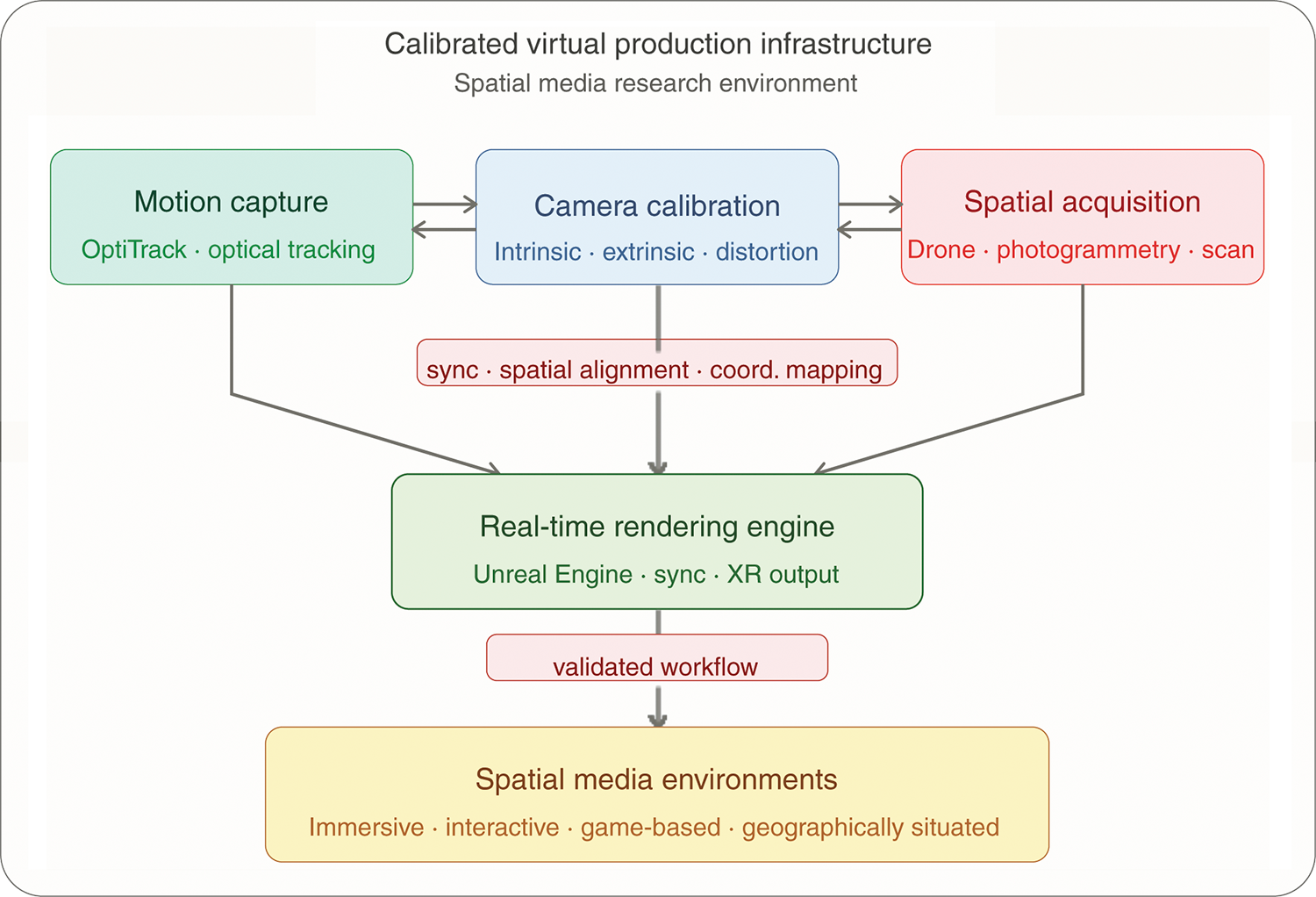
The approach proposed in this research is grounded in a practice-based, infrastructure-embedded methodology (Candy and Edmonds 2018; Rühse and Hoffman 2023), in which infrastructure itself functions not only as a technical support system but also as an epistemic environment for experimentation and methodological development. In this perspective, calibration procedures, workflow integration, spatial acquisition, and real-time simulation are understood as interconnected components of a broader experimental ecosystem.
Rather than proposing a closed production pipeline, the infrastructure under development adopts a modular integration strategy that can articulate motion capture systems, calibrated audiovisual workflows, drone-based spatial acquisition, real-time rendering platforms, and interactive media environments within a unified research framework. This modularity enables the progressive incorporation of additional workflows and media configurations while preserving cross-system integration.
At this stage of development, preliminary integration efforts focus on the relationships among optical tracking systems, calibrated camera environments, and spatially acquired datasets. Existing infrastructure includes motion capture systems, real-time rendering environments, audiovisual production equipment, and recently deployed high-performance computational resources that support distributed real-time media workflows, photogrammetric processing, and spatial simulation tasks.
Initial experimental procedures involve camera calibration studies, spatial alignment testing, interoperability validation between tracking systems and virtual environments, and exploratory integration between drone-based spatial acquisition and real-time rendering workflows. These processes aim not only to establish operational compatibility between systems but also to identify recurrent methodological challenges associated with synchronization, coordinate consistency, optical distortion, and cross-platform integration.
A central aspect of the proposed infrastructure is its orientation toward spatial media experimentation rather than exclusively toward cinematic production. In this context, spatially embedded datasets, embodied interaction, and real-time environmental simulation are treated as interconnected media processes that support immersive audiovisual experiences, interactive applications, game-based environments, and spatially situated digital narratives.
This infrastructural perspective also reinforces the importance of decentralized research environments capable of supporting advanced experimentation outside large metropolitan production hubs. By combining calibrated workflows, spatial acquisition processes, and real-time media systems within an academic context, the proposed framework seeks to contribute to the development of reproducible methodologies for spatial media research while expanding the role of virtual production beyond conventional industrial applications.
Preliminary Experimental Setup
Preliminary experimental activities currently focus on establishing an operational environment capable of supporting calibration studies, spatial acquisition, and real-time media integration within a unified workflow. Rather than implementing a fully consolidated production pipeline, the current stage of development emphasizes exploratory integration procedures to evaluate technical compatibility between systems and identify recurring operational constraints.
The experimental setup combines optical motion capture infrastructure, calibrated audiovisual capture systems, real-time rendering platforms, and spatial acquisition workflows. Existing resources include an OptiTrack motion capture environment, professional digital cinema cameras, real-time rendering engines, and recently deployed high-performance computational workstations configured for distributed media processing and real-time visualization tasks.
Current calibration studies primarily involve the evaluation of optical behaviour in digital cinema camera systems, including preliminary tests related to lens distortion profiling, focal consistency, colour response, and spatial correspondence between physical and virtual camera environments. These procedures are being conducted alongside exploratory synchronization tests between camera tracking, motion capture systems, and real-time rendering platforms.
In parallel, initial spatial acquisition experiments involve drone-based image capture and photogrammetric reconstruction processes intended to evaluate the integration of geographically situated datasets into real-time environments. These preliminary tests investigate issues related to scale consistency, coordinate alignment, environmental optimization, and compatibility between reconstructed spatial datasets and interactive rendering systems. The diagram of the experimental setup is shown in Figure 2.
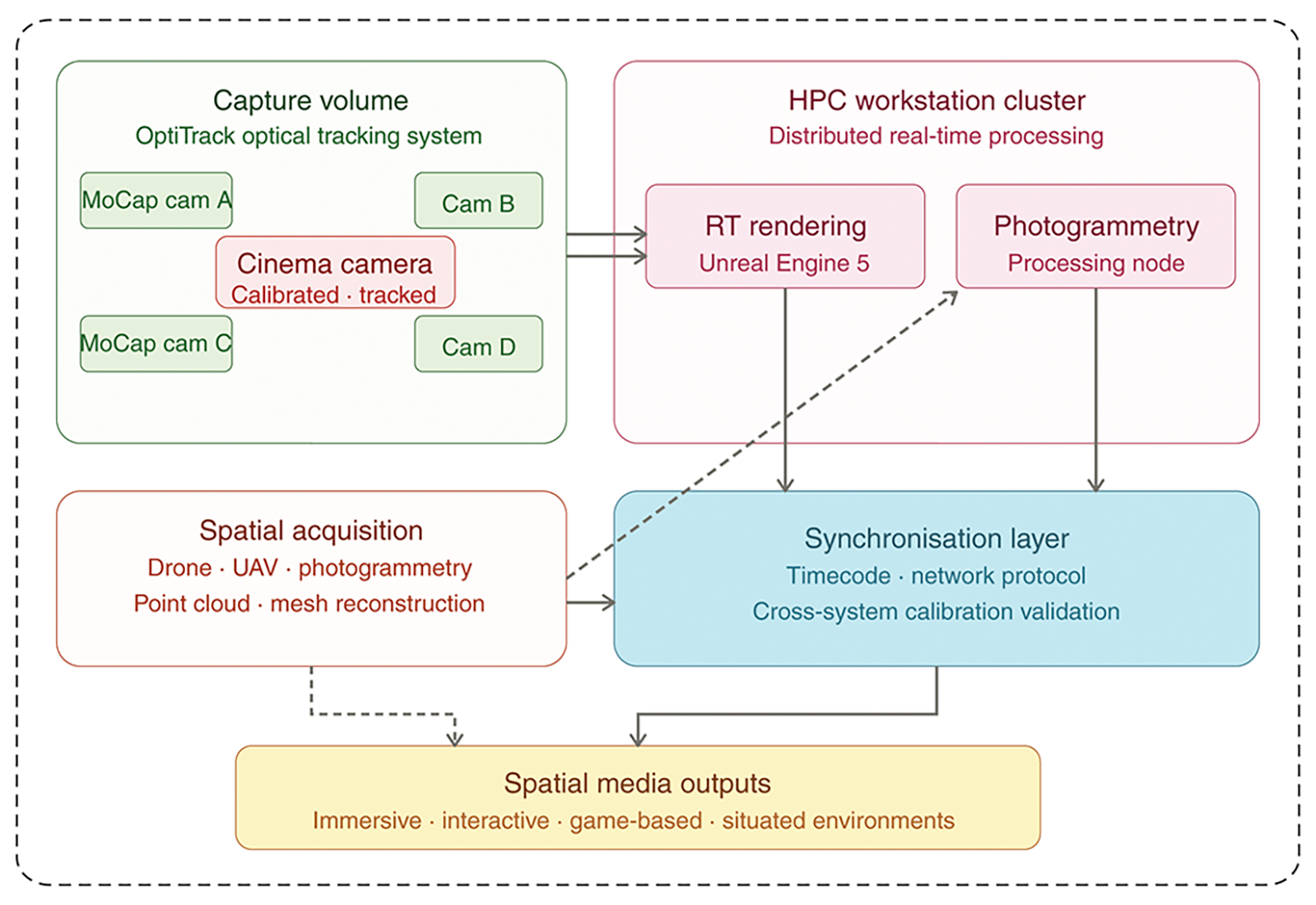
The recent deployment of high-performance computational infrastructure significantly expands the capacity for distributed, real-time experimentation, enabling parallel processing workflows for photogrammetry, spatial reconstruction, rendering, simulation, and media integration. This computational environment also supports multi-user experimentation and iterative testing procedures within real-time production scenarios.
Rather than aiming at immediate production deployment, the current experimental phase seeks to identify critical methodological variables associated with calibration stability, tracking consistency, synchronization behaviour, and system integration between heterogeneous systems. The resulting observations are intended to inform future protocol development and contribute to the establishment of reproducible workflows for spatial media experimentation.
At this stage, the infrastructure primarily serves as an experimental validation environment where technical integration processes can be progressively evaluated under controlled conditions. This approach enables systematic observation of interactions among optical tracking, spatial acquisition, real-time rendering, and embodied media systems without prematurely constraining the infrastructure to fixed production models or application-specific pipelines.
Discussion
The preliminary investigations presented in this study suggest that the development of virtual production environments for spatial media research involves challenges that extend beyond isolated technical implementation. As real-time systems increasingly combine motion capture, calibrated audiovisual capture, spatial acquisition, and interactive rendering within shared environments, the infrastructure itself becomes a central site of methodological negotiation.
In many contemporary VP workflows, operational stability frequently depends on tacit technical knowledge accumulated through local production practices rather than on systematically documented validation procedures. While such flexibility enables rapid experimentation and adaptive production strategies, it also creates environments that are difficult to replicate, compare, or evaluate across institutional contexts. This condition becomes particularly relevant within academic infrastructures, where long-term experimentation and methodological continuity require greater procedural consistency.
The integration of spatial acquisition workflows further intensifies this condition. Geographically situated datasets derived from drone-based photogrammetry or environmental reconstruction introduce additional dependencies associated with scale correspondence, coordinate systems, environmental optimization, and spatial continuity between physical and virtual environments. When combined with motion capture and real-time rendering systems, these processes produce highly dynamic media ecosystems in which small inconsistencies may affect the stability of the entire workflow.
At the same time, the expansion of game engines and real-time rendering platforms beyond entertainment production contributes to the emergence of infrastructures that simultaneously function as simulation systems, audiovisual environments, interaction frameworks, and research platforms. This convergence reinforces the need for experimental environments that support iterative validation rather than project-specific technical configurations focused solely on immediate production outputs.
Within this context, the notion of calibrated infrastructure proposed in this paper should not be understood merely as a set of technical correction procedures. Instead, calibration emerges as a broader methodological strategy through which heterogeneous systems become capable of operating within shared spatial and temporal conditions. The problem, therefore, shifts from isolated device configuration toward the establishment of coherent experimental environments capable of supporting stable relationships between optical tracking, embodied interaction, spatial reconstruction, and real-time simulation.
The discussion also highlights the relevance of decentralized academic infrastructures within the current landscape of virtual production research. Advanced VP environments remain strongly concentrated in large industrial and metropolitan centres, frequently limiting experimental access for smaller institutions or regionally situated research initiatives. The development of locally embedded infrastructures capable of integrating spatial datasets, immersive media workflows, and experimental real-time systems may therefore contribute not only to technical innovation but also to the diversification of spatial media research contexts.
Rather than proposing universal technical solutions, this study advocates the development of adaptable methodological frameworks that support future validation protocols, comparative experimentation, and cross-institutional collaboration. In this sense, calibrated infrastructures become less a fixed technological model and more an evolving research condition through which spatial media environments can be systematically investigated, tested, and expanded.
Conclusion
This article has discussed the development of calibrated virtual production infrastructures as an emerging methodological challenge within spatial media research. As real-time rendering systems, motion capture technologies, spatial acquisition processes, and immersive media environments increasingly converge, the need for integrated, experimentally consistent workflows becomes increasingly relevant in both academic and production-oriented contexts.
Rather than approaching calibration exclusively as a technical correction procedure, the paper has argued for its broader role in establishing coherent relationships between heterogeneous systems operating across physical and virtual environments. In this perspective, virtual production infrastructures function not only as production platforms but also as experimental ecosystems through which spatial media workflows can be systematically investigated, validated, and expanded.
The preliminary integration studies presented here suggest that integrating calibrated audiovisual capture, optical tracking, real-time rendering, and spatial acquisition requires methodological approaches that maintain stable experimental conditions while remaining adaptable to evolving media configurations. Such conditions become particularly significant in research environments combining immersive media, interactive systems, game-engine workflows, and spatially situated digital experiences.
The discussion also reinforces the importance of decentralized academic infrastructures capable of supporting advanced experimentation outside traditional industrial production centres. By integrating spatial acquisition, embodied interaction, and real-time media systems within an academic environment, the proposed framework contributes to ongoing discussions surrounding reproducibility, methodological validation, and infrastructural experimentation in contemporary virtual production research.
Future developments will include refining calibration procedures, expanding interoperability testing, and progressively implementing integrated workflows for spatial media applications. In this sense, the calibrated infrastructure proposed here should be understood not as a closed technical model, but as an evolving methodological framework for experimental virtual production research.
References
Batty, Michael. 2018. “Digital Twins.” Environment and Planning B: Urban Analytics and City Science 45 (5): 817–820. https://doi.org/10.1177/2399808318796416 accessed on May 05, 2026.
Brown, Duane C. 1971. “Close-Range Camera Calibration.” Photogrammetric Engineering 37 (8): 855–866, https://journals.sagepub.com/doi/pdf/10.1177/2399808318796416, accessed on May 05, 2026.
Candy, Linda, and Edmonds, Ernest. 2018. “Practice-Based Research in the Creative Arts: Foundations and Futures from the Front Line.” Leonardo 51 (1): 63–69. https://doi.org/10.1162/LEON_a_01471, accessed on May 05, 2026.
Cho, Yunsik, and Giri Na. 2024. “Application of Virtual Avatar Using Motion Capture in Immersive Virtual Environment.” International Journal of Human–Computer Interaction 40 (20): 6344–6358. https://doi.org/10.1080/10447318.2023.2254609, accessed on May 05, 2026.
Deloitte Insights. 2024. “Cinematic and Interactive Universes: Games and Studios Come Together to Bring the Biggest Stories to Life.” Technology, Media and Telecommunications Predictions 2024. Deloitte. https://www.deloitte.com/us/en/insights/industry/technology/technology-media-and-telecom-predictions/2024/blurring-the-lines-between-video-games-and-movies.html, accessed on May 05, 2026.
Epic Games. 2019. The Virtual Production Field Guide. Written by Noah Kadner. Version 1.2. Cary, NC: Epic Games. https://cdn2.unrealengine.com/vp-field-guide-v1-3-01-f0bce45b6319.pdf. Accessed on May 05, 2026.
Fuller, Aidan, Zhong Fan, Charles Day, and Chris Barlow. 2020. “Digital Twin: Enabling Technologies, Challenges and Open Research.” IEEE Access 8: 108952–108971. https://doi.org/10.1109/ACCESS.2020.2998358 , accessed on May 05, 2026.
Giannachi, Gabriella. 2004. Virtual Theatres: An Introduction. London: Routledge. Psychology Pres. ISBN 9780415283793.
Rühse, Viola, and Hoffmann, Philipp. 2023. “Infrastructures for Digital Arts Teaching and Research in Higher Education (LeFo).” Comunicação apresentada em EVA Berlin 2023, Rühse+et+al.,+Infrastructures+for+Digital+Arts+Teaching+and+Research+in+Higher+Education.pdf , accessed on May 05, 2026.
Hartley, Richard, and Andrew Zisserman. 2004. Multiple View Geometry in Computer Vision. 2nd ed. Cambridge: Cambridge University Press.
Jamil, Osama, and Brennan, AnnMarie. 2025. “Immersive Heritage through Gaussian Splatting: A New Visual Aesthetic for Reality Capture.” Frontiers in Computer Science 7: 1515609. https://www.frontiersin.org/journals/computer-science/articles/10.3389/fcomp.2025.1515609/full , accessed on May 05, 2026.
Jia, Xuguang, Adam Berry, and Andrew Johnston. 2026. “The Evolutionary Disruption: A Paradigm Shift in Film and Animation Industry Driven by Real-Time Rendering and Virtual Production.” Convergence (online first). https://doi.org/10.1177/13548565251356932 , accessed on May 05, 2026.
Kenderdine, Sarah. 2016. “Embodiment, Entanglement, and Immersion in Digital Cultural Heritage.” In A New Companion to Digital Humanities, edited by Susan Schreibman, Ray Siemens, and John Unsworth, 22–41, Chapter 2. Oxford: John Wiley and Sons.
Kerbl, Bernhard, Georgios Kopanas, Thomas Leimkühler, and George Drettakis. 2023. “3D Gaussian Splatting for Real-Time Radiance Field Rendering.” ACM Transactions on Graphics 42 (4). https://repo-sam.inria.fr/fungraph/3d-gaussian-splatting/ , accessed on May 05, 2026
Krüger, Marcel, David Gilbert, Torsten W. Kuhlen, and Tim Gerrits. 2024. “Game Engines for Immersive Visualization: Using Unreal Engine Beyond Entertainment.” PRESENCE: Virtual and Augmented Reality 33: 31–55. https://doi.org/10.1162/pres_a_00416 , accessed on May 05, 2026.
Kühnapfel, Corinna, Joerg Fingerhut, and Matthew Pelowski. 2023. “The Role of the Body in the Experience of Installation Art: A Case Study of Visitors’ Bodily, Emotional, and Transformative Experiences in Tomás Saraceno’s In Orbit.” Frontiers in Psychology 14: 1192689. https://doi.org/10.3389/fpsyg.2023.1192689 , accessed on May 05, 2026.
Li, Xiaoye, Wei Sheng, Yang Tang, Yingxuan Yu, and Yixuan Peng. 2026. “A UAV–3DGS–VR Workflow for Scenario-Comparable Immersive Review in Heritage Landscapes.” Drones 10 (6): 404. https://www.mdpi.com/2504-446X/10/6/404 , accessed on May 05, 2026.
Liao, Kang, Xiang Nie, Shengxi Zhou, Kun Hu, Zhigang Han, Yuehui Wang, Zhiyuan Ling, Jufeng An, and Yining Lin. 2025. “Deep Learning for Camera Calibration and Beyond: A Survey.” https://arxiv.org/abs/2303.10559, accessed on May 05, 2026.
Luhmann, Thomas, Clive Fraser, and Hans-Gerd Maas. 2016. “Sensor Modelling and Camera Calibration for Close-Range Photogrammetry.” ISPRS Journal of Photogrammetry and Remote Sensing 115: 37–46. https://doi.org/10.1016/j.isprsjprs.2015.10.006 , accessed on May 05, 2026
Parikka, Jussi, and Wanda Strauven (eds.). 2024. “Game Engines: Optimising VFX, Reshaping Visual Media.” NECSUS: European Journal of Media Studies 13 (1). https://necsus-ejms.org/game-engines-optimising-vfx-reshaping-visual-media/ accessed on May 25, 2026
Peng, Zhenghao, et al. 2024. “RTG-SLAM: Real-Time 3D Reconstruction at Scale Using Gaussian Splatting.” ACM SIGGRAPH 2024 Conference Papers. https://doi.org/10.1145/3641519.3657455, accessed on May 05, 2026.
Silva Jasaui, Daniel, Ana Martí-Testón, Adolfo Muñoz, Flavio Moriniello, J. Ernesto Solanes, and Luis Gracia. 2024. “Virtual Production: Real-Time Rendering Pipelines for Indie Studios and the Potential in Different Scenarios.” Applied Sciences 14 (6): 2530. https://doi.org/10.3390/app14062530 , accessed on May 05, 2026
Smith, Hazel, and Roger T. Dean, eds. 2009. Practice-Led Research, Research-Led Practice in the Creative Arts. Edinburgh: Edinburgh University Press.
Swords, Jon, and Willment, Nina. 2024. “The Emergence of Virtual Production: A Research Agenda.” Convergence: The International Journal of Research into New Media Technologies 30 (4). https://doi.org/10.1177/13548565241253903 , accessed on May 05, 2026.
Song, Junlin; Richard, Antoine; and Olivares-Mendez, Miguel 2024. “Joint Spatial-Temporal Calibration for Camera and Global Pose Sensor.” arXiv:2403.00976. https://arxiv.org/abs/2403.00976 , accessed on May 05, 2026.
Whang, Jinxia; Mo, Fani: Qiao, Sibo; Feng, Hailin; and Lyu, Zhihanet al. 2025. “Spatial Computing in Digital Twins.” Smart Cities and Society [online]. https://doi.org/10.1080/27525783.2025.2508268 , accessed on May 05, 2026.
Zhang, Ju; Ma, Fang; Pi, Yuke; Du, Hoyang; and Pan, Wueni. 2025. “Digital Twin Embodied Interactions Design: Synchronized and Aligned Physical Sensation in Location-Based Social VR.” Frontiers in Virtual Reality 6: 1499845. https://doi.org/10.3389/frvir.2025.1499845 , accessed on May 05, 2026.
Zhang, Zhengyou. 2000. “A Flexible New Technique for Camera Calibration.” IEEE Transactions on Pattern Analysis and Machine Intelligence 22 (11): 1330–1334. , accessed on May 05, 2026.