Abstract
This article analyzes the animated feature film City of Pirates as a case of verbal-visual adaptation based on the comic strips and cartoons of Laerte Coutinho. The study investigates how the adaptation from static drawing to animated image preserves and reconfigures the mocking, critical, and political dimensions of Laerte’s work through the expressive possibilities of animation. Focusing primarily on the character Azevedo — constructed as a synthesis of recurring male figures from Laerte’s strips — the article examines how themes such as authoritarianism, homophobia, violence and lack of empathy are translated from comics into audiovisual language. Grounded in adaptation theory and intermedial studies, particularly through reflections by Robert Stam, Linda Hutcheon, Marshall McLuhan, Tzvetan Todorov and Laurent Jullier, the analysis examines a corpus of comic strips produced between 2011 and 2018 alongside sequences from the film. The study argues that animation does not merely reproduce the original comics, but critically reinvents them by integrating movement, sound, performance, and cinematic framing into the narrative structure. While comics depend on the reader’s active participation to infer movement, sound, and emotional tone, animation materializes these elements audiovisually, intensifying the dramatic and symbolic dimensions of the characters and conflicts. The article concludes that the graphic affinity between comics and animation allows the preservation of visual identity, while the animated medium expands narrative complexity and sensory perception. In this process, the film maintains the satirical essence and socio-political critique characteristic of Laerte’s work while transforming its static insinuations into fully realized audiovisual experiences.
Keywords: Adaptation theory; Animation and comics; Animated documentary; Verbal-visual narrative.
Introduction
In the history of narrative arts, the relationship between animation and comics is one of the most significant technical and artistic partnerships. The first more consistent manifestations in the production of animated images, such as in the works of Émile Cohl and Winsor McCay, originated from their work as cartoonists in the early 20th century. Characters like McCay’s Little Nemo, George Herriman’s Krazy Kat, and Pat Sullivan’s famous Felix the Cat (animated by Otto Messmer) left the pages of newspapers for the screen and performed actions in motion. The simulation and understanding of the insinuated movement of static drawings became real and visible to the audience.
In such versions for each medium — this term is more appropriate since any type of changing media requires a transposition of media — one can clearly see the concern in transposing the dynamism based on the insinuation of movement presented by comics to the dynamism based on simulation, which is only possible through animation.
It is in this context that this article is presented, focusing on the animated feature film “City of Pirates” (Otto Guerra, 2018) as a case study, based on the characters from Laerte Coutinho’s cartoons and comic strips. The objective is to reflect on how this transposition was carried out while maintaining its mocking humor. For this procedure, some film sequences are considered, mostly those of “Azevedo,” a character who has a more political aspect. He represents a critical-reflective view of the prejudiced, homophobic, and sexist considerations of Brazilian society. Azevedo is a mix (Vicentini, 2018) of many other characters present in Laerte’s comic strips. These are male, white, unidentified characters who have Azevedo’s appearance, both in terms of aesthetics and personality. As art reflects the society that gives rise to it. Months after the release of the City of Pirates, a candidate with a very similar profile to Azevedo won the presidential election in Brazil. And here the importance of reflecting on this character is justified without ignoring other moments in the film.
In this work, the focus is on animation analysis in relation to the original strips, with the transposition process, which involves the character and the camera movement simulation, based on the insinuation of movement proposed in the comics. A process that, despite being constituted with different means, relies on the same technique used by Laerte and Guerra, drawing. Thus, the analysis frames this transposition both in terms of form and content.
In the first part of this article, a film overview, its filmmakers, and the socio-political context of Brazil at the time are presented to familiarize the reader with the ambience of its production. This interfered with the final result of the feature film. Further, continuing with a reflection on the work of transposing the static character into the animated one, considering the works of McCloud (2005) and Robert Stam (2006). In the third part, considering the studies of McLuhan (2005), Todorov (1970), and Jullier (2002), one analyzes Laerte’s narrative and discourse on comics.
We conclude that the graphic similarity between the two forms of representation, animated drawing and static drawing, allows for a more faithful permanence of the visuality of characters and scenarios because both are based on the representative art of drawing. However, the movement that in comics was only an insinuation becomes a simulation through animation drawing, making concrete what was previously only a mental image. Animation adds concreteness to the living aspect of the static character, and sound completes the sense of veracity of the actions presented. The film’s narrative complexity favored the various comic-narrative configurations, which corroborate Laerte’s work. What’s significant about the film version is that the mockery, as well as the essence of the intrigue, was maintained and presented dynamically through animation.
City of Pirates, the Film and Its Context
Otto Guerra’s feature film is a rare representative of Brazilian cinematography, not only because it is an animated documentary for adults, but because it captures a very specific moment in Brazilian society. Namely, with the political-ideological polarization between democracy and dictatorship, with the expression of groups considered minorities asserting themselves (blacks, Afro-Brazilian religions, LGBTs, indigenous ethnicities, among others), although, at the same time, they are repressed.
On the other hand, its director has a history of making films with controversial themes and inspiration. In his first feature film, Rocky & Hudson: The Gay Cowboys (1994), he stands out. Wood & Stock-Sex, Oregano and Rock ‘N Roll (2006) was his second film, also based on comic book stories, this time by cartoonist Angeli. Always faithful to his underground aesthetic and narrative, with the declared influence of figures such as Robert Crumb (1943-) and Gilbert Shelton (1940-) (Daehn, 2019), Guerra also directed Até que a Sbórnia Nos Separe (2014), based on the Rio Grande do Sul play Tangos & Tragédias (Hique Gomez and Nico Nicolaiewsky, 1984). The encounter of this historical political moment with the mind of this director resulted in A Cidade dos Piratas, as we will show below.
According to Otto Guerra, the script for City of Piratas was initially based on the characters of Laerte and Os Piratas o Tietê (1983), a comic strip published in the magazine Chiclete com Banana [Bubblegum with Banana] (Teixeira, 2018). However, due to the long pre-production and production time, 15 years, numerous changes occurred both in the country and in their own lives: the far-right rose strongly in Brazilian politics, Guerra was diagnosed with cancer, while Laerte decided to embrace her feminine side. Thus, she begins to deny her characters, considering them homophobic, sexist, and prejudiced. Assuming he was dying, Guerra decides to create “her film,” abandoning the original idea and focusing the script on Laerte’s life but using her characters to create a metalinguistic animated documentary.
The film is composed of four narrative axes (Gordeeff, 2021): (a) Laerte’s life, with live-action interviews and through some characters, (b) events from the film’s production and Guerra’s illness, (c) Laerte’s characters, (d) and an election, that of Azevedo. Who is a character who brings together the same characteristics as many others from Laerte’s comic strips: white, middle-aged men (without names that identify them), with Azevedo’s aesthetics and insecure personality, who secretly keeps a stockpile of hate.
What might seem like just a completely nonsensical film transforms into Otto Guerra’s masterpiece, and one of the most compelling cinematic representations of the social moment in which it was released. This occurred a few months before the presidency of Brazil was occupied by the far-right candidate, transforming society into the chaos depicted in the final scenes of City of Pirates. Its complexity is uncommon in animated works, especially in Brazil, being a source of multiple interpretations with several layers of meaning.
Its plot explores various aspects of Brazilian society, addressing themes such as ecology and prejudice, creating a dynamic that literally reflects a “narrative anarchy” (Daehn, 2019), a typical characteristic of Laerte’s comic books, which he collaborated on the elaboration of the final script.
The feature film received recognition, winning the awards for Best Screenplay and Best Direction at the Vitória Film Festival (2018), Honorable Mention at the 46th Gramado Film Festival, and Best Film at Múmia 2018. Internationally, it was acclaimed as Best Film at Anima Latina 2018 (Argentina), Cinanima 2019 (Portugal), and in 2019, at Havana International Festival of New Latin American Cinema (Cuba), in addition to receiving an Honorable Mention from the Student Jury at Ojo Loco, Latin American Film Festival (France).
The process of creating a film involves choosing the visual codes to be used, but what would happen if there were a mixture of languages? Based on the life and work of the artist Laerte Coutinho and directed by Otto Guerra, the feature film City of Pirates (2018) combines different forms of representation by employing, within the same work, the languages of animation, live-action, and comic books, using them as tools for narrative and aesthetic construction. Santos (2025) argues that analyzing the feature animation from the perspective of adaptation theory is a theoretical requirement imposed by its own narrative construction. By operating between fiction, autobiography, metalanguage, and documentary record, the film challenges the limits of cinema and demands an approach that articulates comic books and animation as languages.
The discussion of this 2D animated film is framed within the perspective of adaptation theory and animated documentary, not as a merely classificatory approach, but as a theoretical necessity imposed by the object of study itself. The film operates in a zone between fiction, autobiography, metalanguage, and documentary record, challenging the traditional boundaries of film genres. In this context, understanding comics and animation as languages, combined with concepts from adaptation theory and animated documentary, offers fundamental tools for understanding the ways in which the work articulates its graphic representation and discourse about reality.
From Static to Animated Images
As mentioned, although cartoons and animated drawings use the same form of representation, there is a need to transpose visual information from one medium to another. By problematizing the recurring comparison between comic book panels and film frames, Miodrag (2013) highlights that, although both languages share a visual linearity and verbo-visual narrative strategies, they differ fundamentally in their modes of reception and narrative construction. While cinema operates through a continuous flow of moving images, comics are structured in fixed units that require the reader to actively articulate between panels, valuing pauses, interpretative interaction, and control of the reading process. In this sense, adaptations of literary works into comics can be understood as forms of intersemiotic translation. Since they shift the focus from textual fidelity to the creative act of transposition between distinct sign systems. What is at stake is not only the permanence of content, but the way in which different media reconfigure the aesthetic and cognitive experience of the reader or viewer. Thus, intersemiotic translation ceases to be a secondary gesture and asserts itself as an autonomous instance of meaning production, in which literature, cinema, and comics intertwine to construct new forms of language and apprehension of the world.
According to Robert Stam (2006), adaptation constitutes an orchestration of discourses, talents, and trajectories, configuring itself as a hybrid construction in which media and languages intertwine reciprocally and inseparably. In dialogue with deconstruction, Stam destabilizes the hierarchy between original and copy by stating that “[...] The ‘original’ always reveals itself to be partially ‘copied’ from something prior.” (Stam, 2006, p.22, author’s translation). Thus, adaptation does not consist of mere repetition, but of a new audio-visual-verbal configuration that re-signifies and reinvents the work, preserving its narrative essence. When adapting a comic book into animation, there is no simple substitution of the verbal for the visual: the words remain as a mark, rhythm, and structure, while the animation reorganizes narrative time and space, incorporating and transforming features of the original medium according to its own expressive logic. The image in animation, therefore, does not erase the text, but folds it inward, welcoming it and translating it into new visual and temporal terms. In this process, the distinction between original and copy proves unstable, since adaptation is not an imperfect duplication, but an autonomous instance of meaning that houses, preserves, and redefines the narrative that precedes it.
Following this line of reasoning, Hutcheon (2006) states that “adaptation is repetition, but repetition without replication.” (Hutcheon, 2006, p.7), That is, a work that echoes the original, but recreates it through other semantic, visual, and sound resources. From this perspective, Stam (2006) criticizes the paradigm of fidelity for presupposing a hierarchical and methodologically reductionist relationship between the original work and the adaptation, even though he recognizes that: “complete originality is neither possible nor desirable. And if ‘originality’ in literature is devalued, the ‘offense’ of ‘betraying’ that originality through, for instance, an ‘unfaithful’ adaptation becomes far less severe.” (Stam, 2006, p.23, author’s translation). For the author, more important than evaluating the fidelity of the adapted works is understanding how this adaptation operated according to the specificities of its language, with intertextuality and intermediality as its main analytical axes. Thus, when transposing the verbal-visual repertoire of comics into animation, the adaptation demands its own expressive solutions to recreate rhythm, temporality, and space, revealing itself as a practice that is both creative and interpretive.
However, as means of communication, both are considered legal by McLuhan (1995, p.22), where “There is a basic principle that distinguishes a hot medium […] from a cool one […]. A hot medium is one that extends one single sense in ‘high definition’. High definition is the state of being well-filled with data1. A photograph is, visually.” So, it is a hot medium. The opposite are cartoons and comics. According to McLuhan (1995, p.22), “A cartoon is “low definition”, simply because very little visual information is provided” This classification between “Cold” and “Hot” is not inflexible, but depends on each situation and the elements involved. In the specific comparative case between comics and cartoons, although both are considered “cold,” it is clear that animation, simply by being an audiovisual element—that is, by presenting synchronized visual and auditory information—carries more information than comics. Therefore, it is “hotter” than the static drawings in magazines, which, in terms of human senses, stimulate only the sense of sight, while cartoons demand both sight and hearing simultaneously. This means access to a broader perception. As Jullier (2002, p.60) observes, “The human being approaches the film like the world, with an ‘embodied mind’ functioning according to an unbreakable ‘trinity’ of perception/cognition/emotions. [...] Emotional responses, these powerful engines of human behavior [...].” Jullier also explains the connection between sound and our memory:
It is understood that, cinema plays at all these [concepts]: understanding what we see presupposes already having an idea of the events described by the audiovisual data (semantic memory, declarative memory); interferes in terms of action presupposes a sensorimotor competence (prior memory, [...]); Identifying yourself, being sensitized, finally requires a minimum of life experience (episodic memory). (Jullier, 2002, p.30)
In other words, sound has a direct connection to our memory systems, activating the episodic memories associated with personal and emotional events. This cannot be avoided by separating it from the accompanying image, as they are not separate, individual pieces of information, but a single set of information perceived by human beings.
In the graphic realm of film production, the drawing is not self-sufficient: from the beginning, it is juxtaposed in sequence, configuring a narrated, commented, and directed image. Thus, the relationship between cinema and comic books should not be understood in comparative terms, because, although they share expressive operators such as time and movement, they do so from distinct discursive and perceptual logics. Adapting, therefore, is not about seeking formal correspondences or an illusory fidelity to the original, but about recognizing the singularity of each language and the way they communicate, rewriting and repositioning works in new historical and social contexts. In this sense, adapted animation does not passively reflect a previous language or work: it folds, shelters, and reconfigures it, enhancing aspects perhaps not previously contemplated (sensible sound is one element absent in comics but was indicated by graphic representations). Considering this reflection, we selected 15 comic strips from Laerte’s archive, from 2011 to 2018, and used them as a study on “Azevedos’” (plural) and the Narrative of an Insecure Man.
Azevedo’s” and the Narrative of an Insecure Man
The character Azevedo occupies an ambiguous and profoundly symbolic position in the film. More than a simple antagonist, we can interpret Azevedo as a fictional projection of Laerte in his pre-transition phase—not as a direct representation, but as a distorted reflection, an authorial shadow from the period of production of Piratas do Tietê [Tietê´s Pirates]. His character carries exaggerated traits of an archetypal masculinity: truculent, macho, foul-mouthed, and emotionally opaque. However, these characteristics, which could simply compose a caricature of a social type, are strained by the film’s own narrative and aesthetic context, which constantly calls its discourses into question. Azevedo thus emerges as a symbolic body in ruins, representing an identity that no longer holds up in the face of the transformations experienced by the author of her fictional universe. Azevedo was a character created for the film, as a fusion of several other similar, unnamed characters. These appear in Laerte’s comic strips, in compositions of a few panels and with messages that are mostly unique, but which together shape a defined personality - prejudiced, pessimistic, homophobic, macho, and self-centered.
In general, in these short narratives, it is possible to identify an intrigue between man and society, or, as Todorov (1970, p.88) calls it, the “social and the individual.” That is, the relationship of friction and the dispute of the character with the society in which he lives. Within this context, the adaptation of this set of characters from the comic strips, which Azevedo largely embodies, is analyzed, as well as the adaptation of these intrigues from the comic strips to the film. This analysis provides a basis for understanding the film narrative and, simultaneously, the processes addressed in the preceding part of this text.
For methodological purposes of analysis, these short narratives are described and grouped into main themes and keywords that, as a whole, also identify the Azevedo personality in the film Guerra (but that of other secondary characters). It is observed that these themes are not presented in the cartoons in isolation, but they are mixed, with a cartoon possibly presenting two or three at the same time. In animation, due to its inherently dynamic nature, this hybridity is presented in a more striking and impactful way by the presence of sound information.
It should be noted that the selection of Laerte’s cartoons was the result of research conducted from 2024 to 2026 through the publication on the website, Manual do Minotauro: blog das tiras diárias da Laerte [Minotaur’s Manual: Laerte’s daily comic strip blog]. All the selected strips were produced between 2011 and 2018, while City of Pirates was released in 2018. The keywords, strips, and film sequences are presented below, along with their corresponding analyses.
The white man, the “good citizen”
Following Azevedo’s line of analysis of the psyche, we can observe that in Laerte’s comic strips (as well as in the animation of the film City of Pirates), there is the construction of a political figure who demonstrates indifference and even disdain for the consequences of his own actions—especially in relation to his “target audience”2—and always placing himself in a superior position. To address this aspect, three of Laerte’s comic strips and two animated sequences from the film are studied. The comic strip presented in Figure 1A exemplifies and satirizes the character’s self-aggrandizement, who sniffs toilet disinfectant and declares, “I am a man, I am white, I am Christian, I am the epitome of normality.” Laerte’s mockery is evident and profound in presenting a “white man” of such value as an addict to aromas to minimize unpleasant smells. In terms of framing, it is a close-up shot that, through the panels, guides the reader to the overall message in a medium shot. It is an example of the cool side of cartoons, which really need to be “completed” by the reader for they understand the information, as McLuhan (1995) observes.
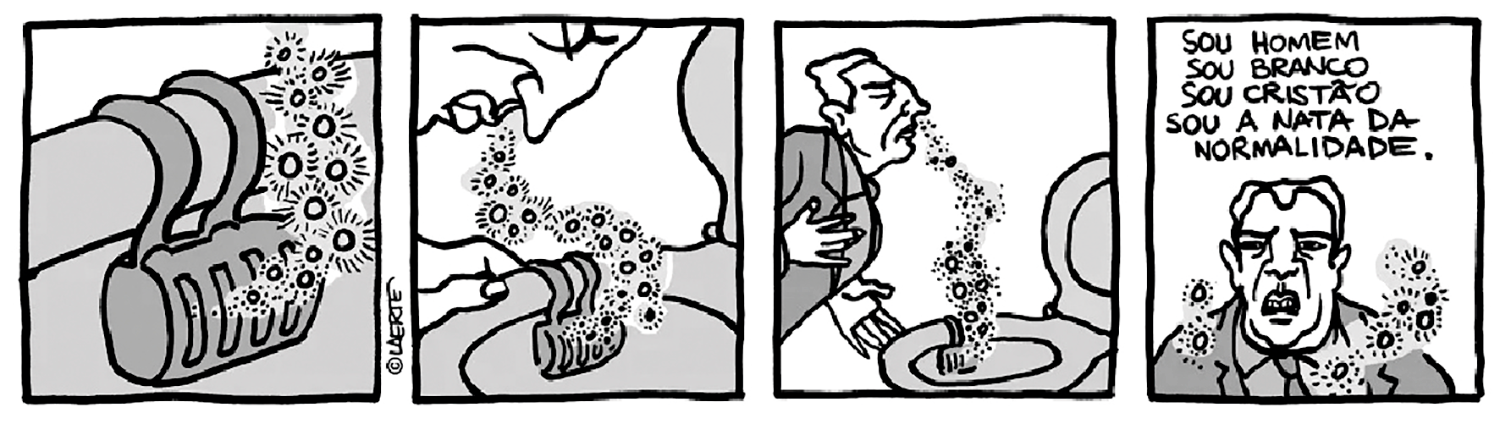
Source: Manual do Minotauro: blog das tiras diárias da Laerte. https://manualdominotauro.blogspot.com/2012/01/14-08-11.html
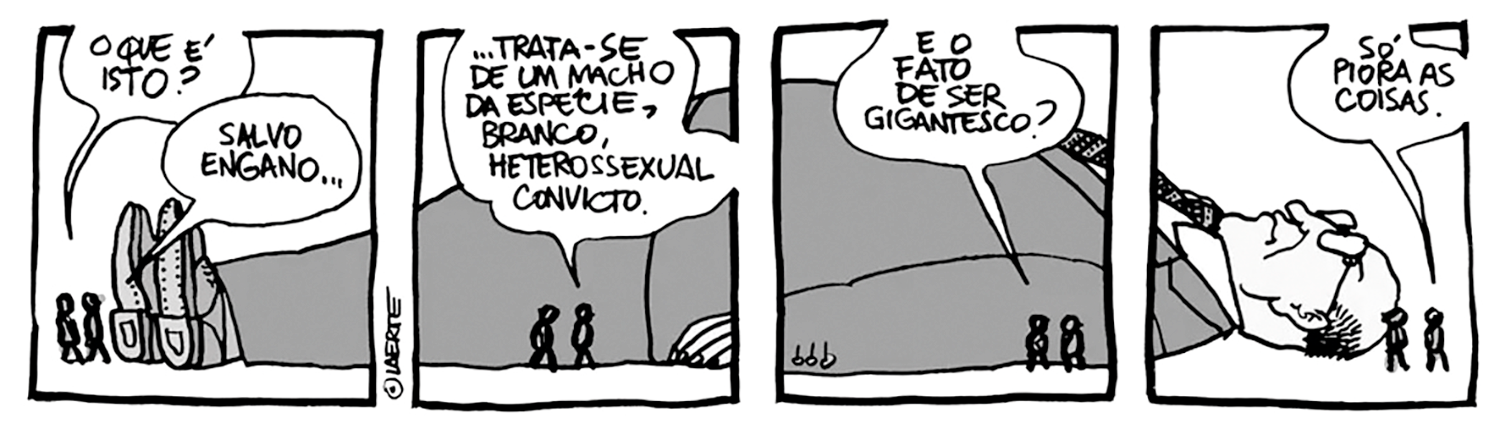
Source: Manual do Minotauro: blog das tiras diárias da Laerte. https://manualdominotauro.blogspot.com/2013/03/03-02-2013.html
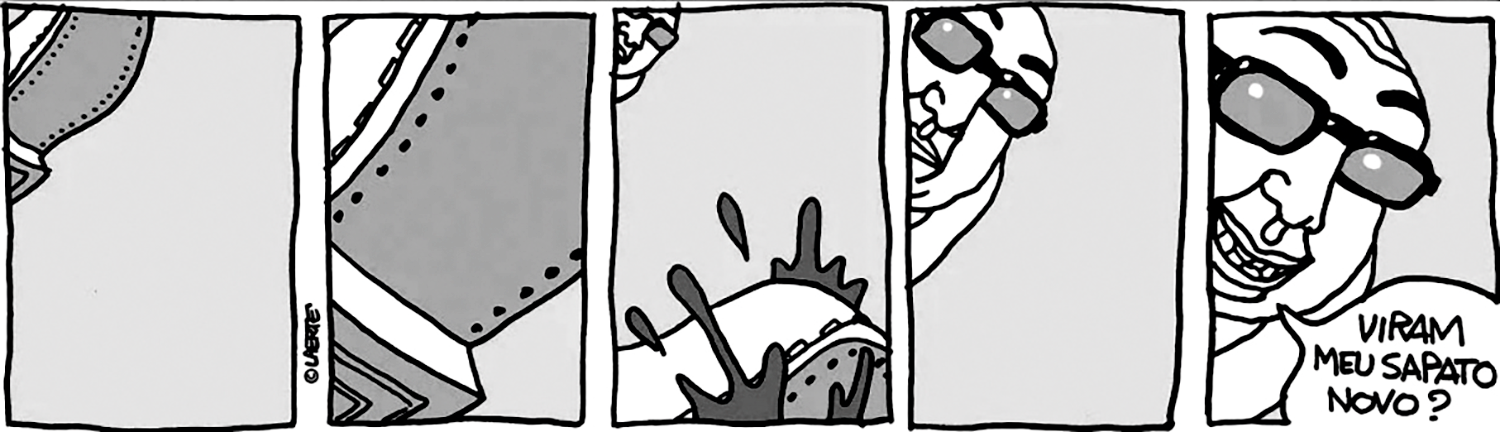
Source: Manual do Minotauro: blog das tiras diárias da Laerte. https://manualdominotauro.blogspot.com/2019/06/20-06-2018.html
In Figure 1B, the cartoonist caricatures the “male of the species,” white, heterosexual, and self-assured—as the characters point out in a dialogue. The body stretched out on the ground, depicted in gigantic proportions relative to the small observers, establishes not only a physical disparity but also an obvious metaphor for structural privilege. This contrast is represented by dividing his body into multiple panels, graphically presenting his gigantism. Such “greatness” is enough to “make things worse,” as the last line ironically states, summarizing that the oppressive, inert presence affects the social space.
In image 1C, the middle-aged man appears to be stepping3 on someone, and asks the reader: “Did you see my new shoe?” The cruelty represented is not only physical but also symbolic, so that the graphic result in the comics displays so disproportionately that it does not respect the panel frame. Furthermore, in the comic strip, the act of crushing is marked by the total absence of empathy (another keyword) of the aggressor character, by the concealment of the victims’ bodies, and by the conversion of violence into banality. In both panels (1B and 1C), the “man vs. society” conflict is also identified, of characters who do not adapt and assault those around them.
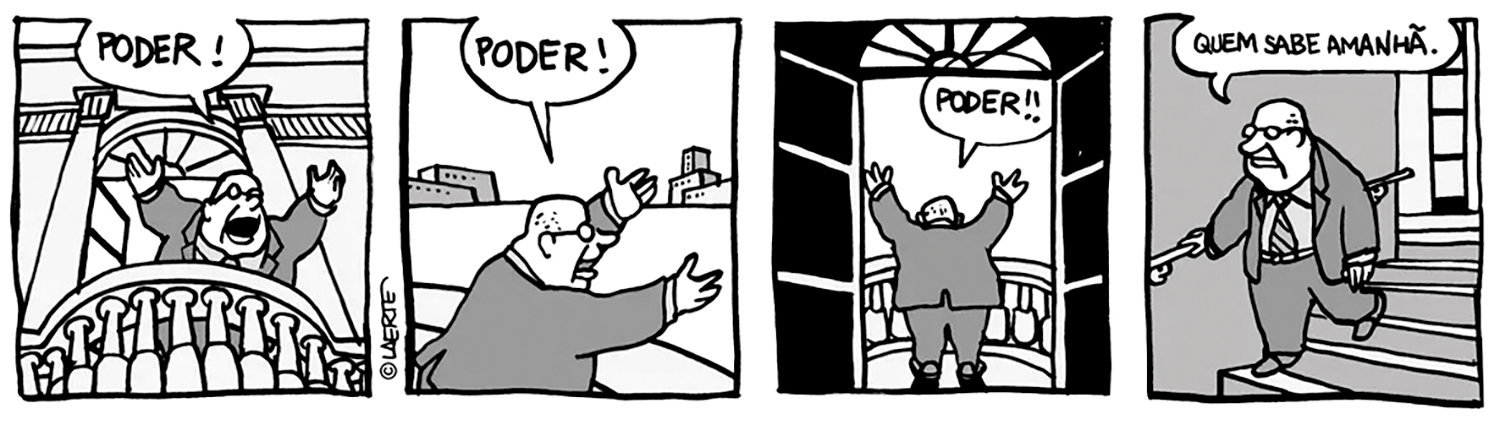
City of Pirates presents this same status, of “white, good man” with power, in Azevedo (Figure 2: Sequence 1). Guerra also presents the same irony and mockery by showing Azevedo without his underwear, arriving in a limousine and walking down the red carpet to appear at a political rally, and nobody notices or is scandalized. This is reminiscent of Hans Christian Andersen’s tale, “The Emperor’s New Clothes”. Here, Guerra places the character in a similar situation, except that he (Azevedo) is the one who feels naked. He says in his speech, “There’s someone in the audience who can’t stop thinking about my genitals” (Guerra 2018, 0:11:25). Immediately afterwards, he apologizes and leaves. And he is dressed. Here, the attitude resembles the cartoon in image 4A, where the man, after shouting for power and not finding it, resigns himself and says, “Maybe tomorrow.” 4
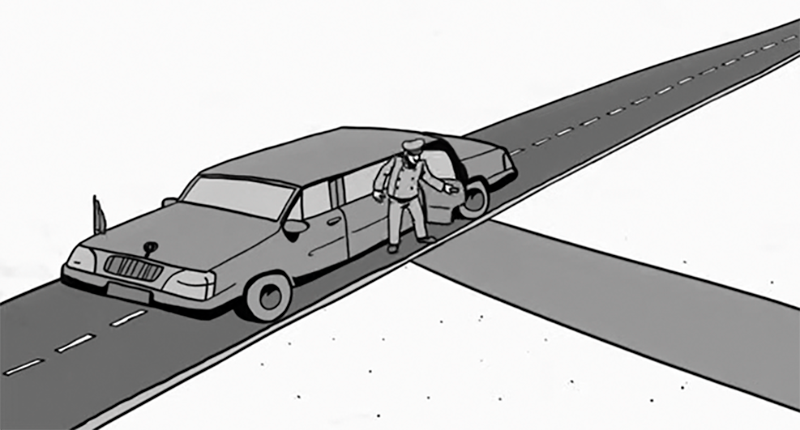
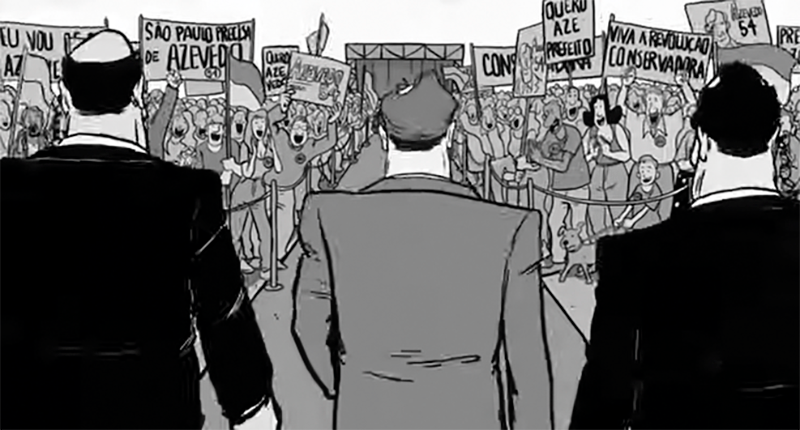
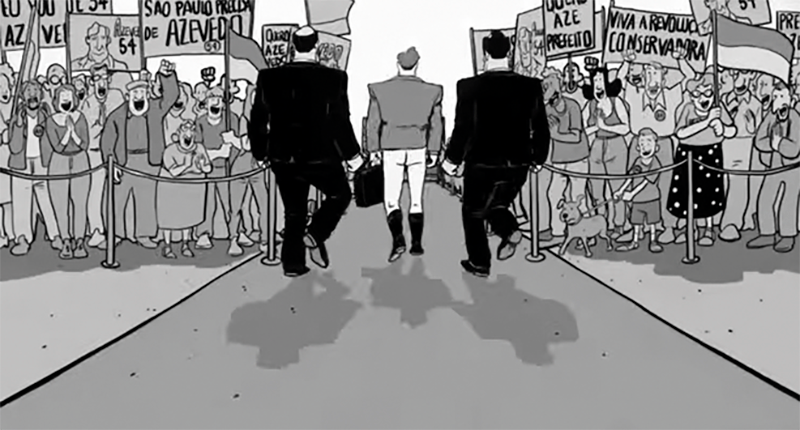
Source: Stills of City of Pirates (2018)
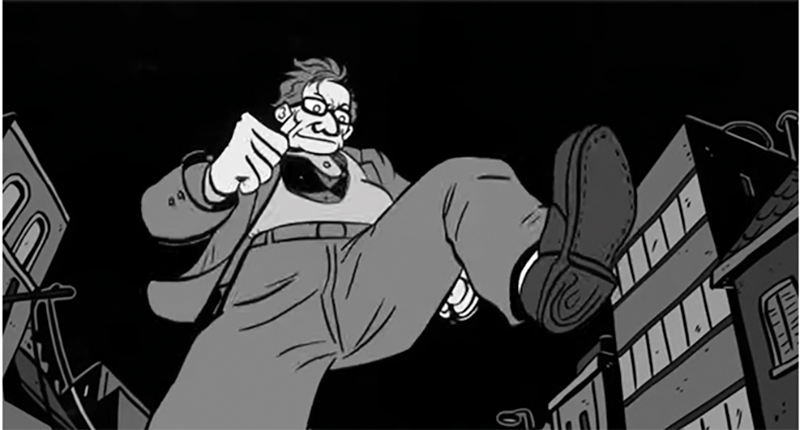
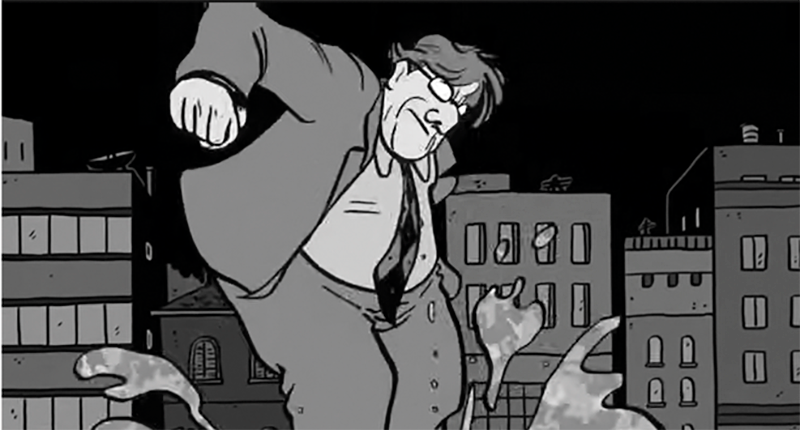
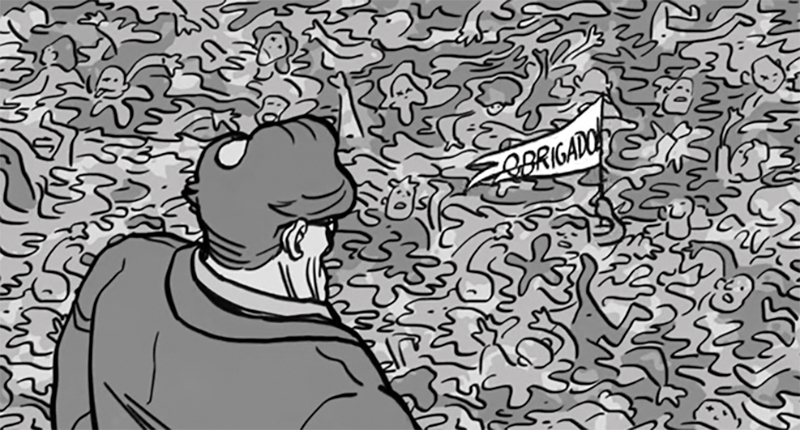
At another point (Fig. 3), the animation presents Azevedo in a low-angle shot – a recurring angle that visually reinforces the character’s grandeur in contrast to other elements around him. It’s quite similar to the cartoon in image 1C, but this one is more legal medium than the animated sequence. The monumental scale of him is accompanied by an ambiguous expression, oscillating between satisfaction, determination, and aggression. This ambiguity contributes to a complex reading: there is no one-dimensional villain there, but a figure who acts within a perverse logic of power representation. In the sequence, we can observe a crowd that, in collective ecstasy, holds signs with sayings like “Kill us!”, “Crush us!”, “Trample us!”, in a logic of servile adoration, of political masochism. It is an allegory of voluntary servitude, when the people celebrate their own oppression. The verbal sound information in this case contributes to and reinforces the grotesqueness of the situation. The bloodied mass and the entire sequence find a parallel in the cartoon of image 1C with the powerful image of the white man, his insensitivity towards others, and his valuing of what is his, his shoe, while, in Guerra’s film, it is his own power to transform the “mass” into a red broth, which still thanks him. Another critical irony of Guerra’s portrayal of the majority is a self-destructive collective impulse.
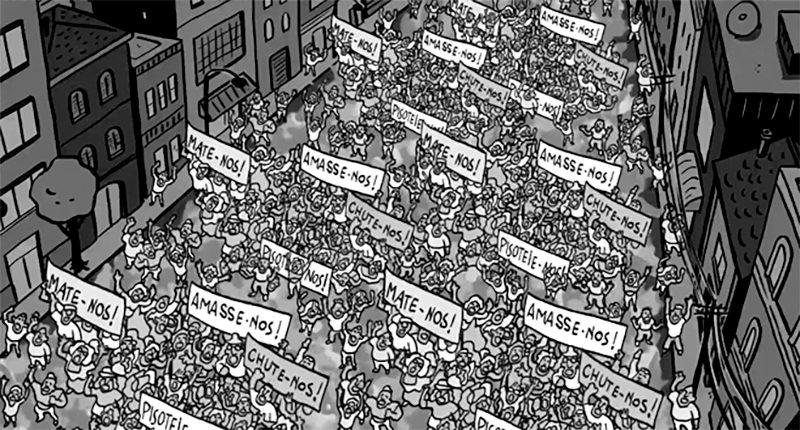
Source: Stills of City of Pirates (2018)
Thirst for “Power”
The three “thirst for power” comic strips portray the “good man,” his thoughts, megalomaniacal attitudes, and ambitions. Fig. 4B shows a man in a suit and tie, without a human head, but with a wind-up denture that serves this purpose, but requires winding to make him speak. There is a connotative message about the automatization of this citizen’s manipulated discourse, and all that this represents. While in Fig. 4A, the character shouts “Power,” in 4B, he wants to build a statue of himself larger than Christ the Redeemer, and in 4C, he plans the “destruction” of someone and makes a film about it, and even receives an award for it. Of the three sets of images, the first is the most cinematic, like a graphic breakdown of how the character should be presented. The other two resemble more drawings of the character in keyframes, ready to be animated. And through the insinuation of the movements, the character guides the reader to imagine these motions mentally. It is the demand generated by legal media, as observed by McLuhan.
Source: Manual do Minotauro: blog das tiras diárias da Laerte. https://manualdominotauro.blogspot.com/2012/02/06-12-11.html
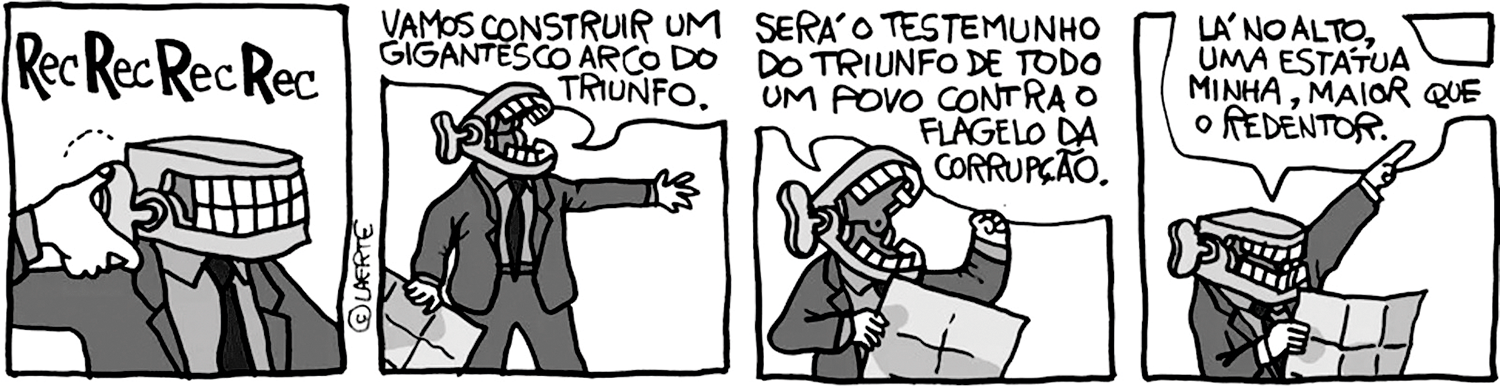
Source: Manual do Minotauro: blog das tiras diárias da Laerte. https://manualdominotauro.blogspot.com/2016/12/06-07-2016.html
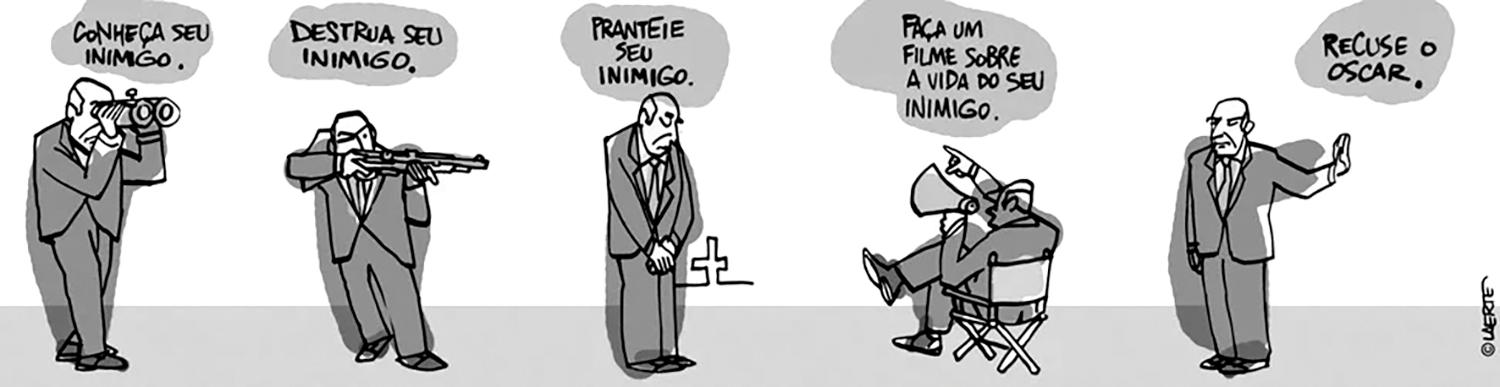
Source: Manual do Minotauro: blog das tiras diárias da Laerte. https://manualdominotauro.blogspot.com/2013/11/18-11-2013.html.
In the animation, the position of power that Azevedo assumes in Sequences 1 and 2 is evident. Both as a political figure who arrives at an event in a limousine with two bodyguards, and with his gigantic size, stomping on the crowd with relish. However, there is another sequence (Figure 5: Sequence 3) in which, disturbed by his dreams of the Minotaur, Azevedo asks an assistant, “So, what does it take to end the world?”, and receives the answer: “Two things, a Nobel Prize, and an insidious virus.” And after obtaining a missile made of hatred, he throws it over São Paulo, shouting, “My special thanks to everyone who helped me get here.” This moment shows Azevedo in a high-angle shot, climbing a huge staircase, until he reaches its top above the city, where he then appears in a low-angle shot. In other words, he goes from being oppressed throughout the journey he had to travel, and even through the hatred he carries (literally), to a moment of superiority, above the city, dropping the missile loaded with hatred. In terms of “power” in the animation, the opposite of Fig. 4A occurs, as he reaches maximum power by destroying a city, and “from up there,” as Fig. 4B says, he carries out the plan of Fig. 4C, destroying what bothers him (the Minotaur and society itself, recalling the theme addressed by Todorov, man vs. society).
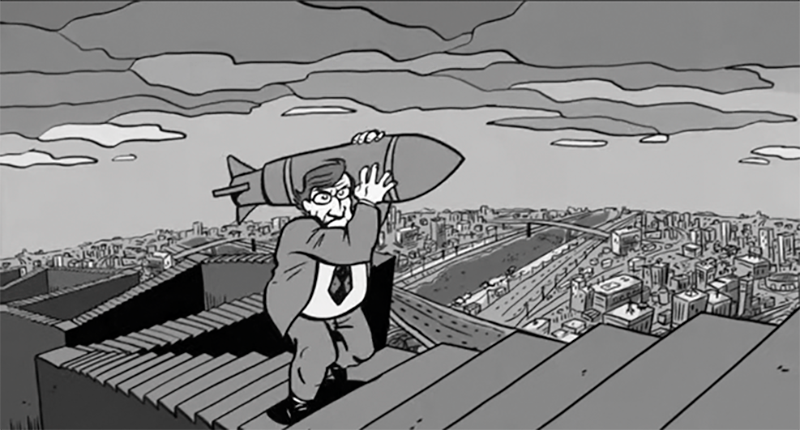
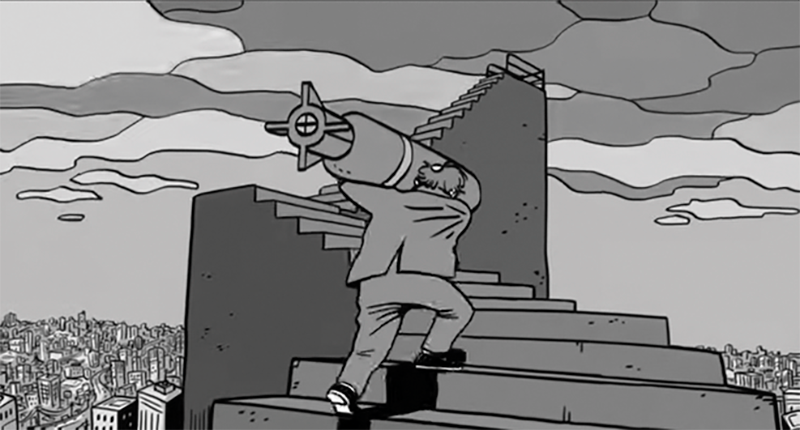
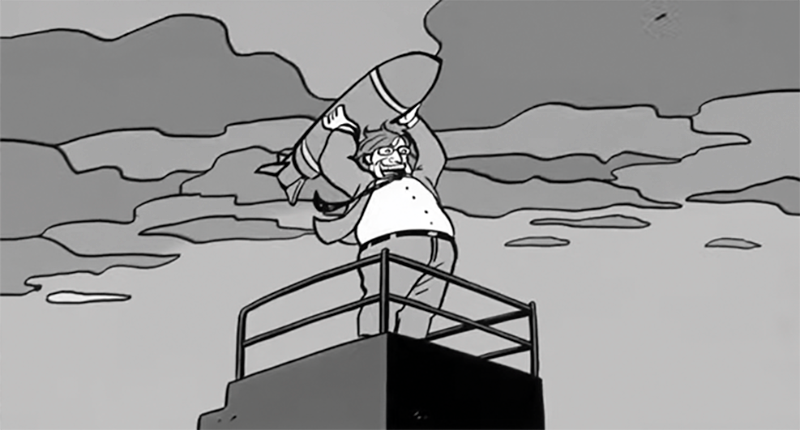
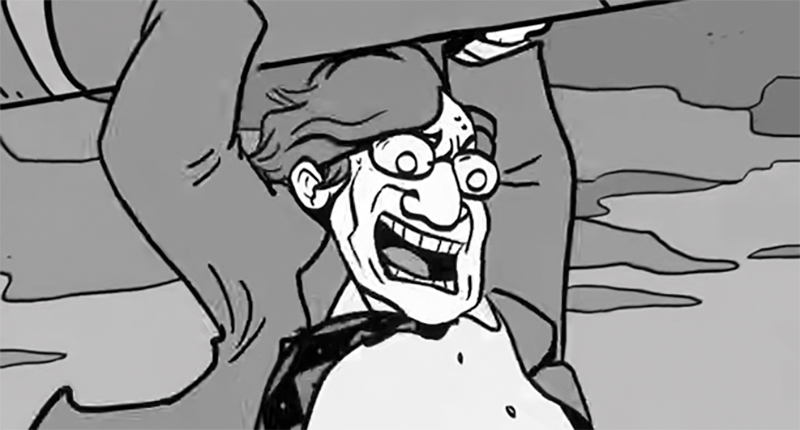
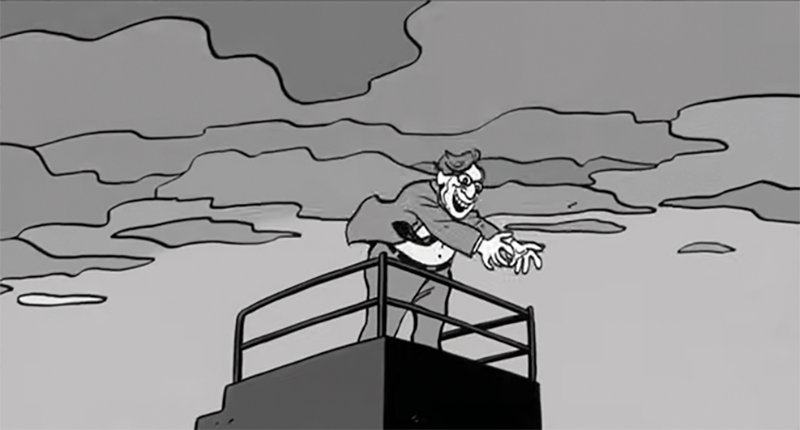
Source: Stills of City of Pirates (2018)
Homophobia
Another aspect present in Laerte’s “heterosexual men” is declared homophobia.
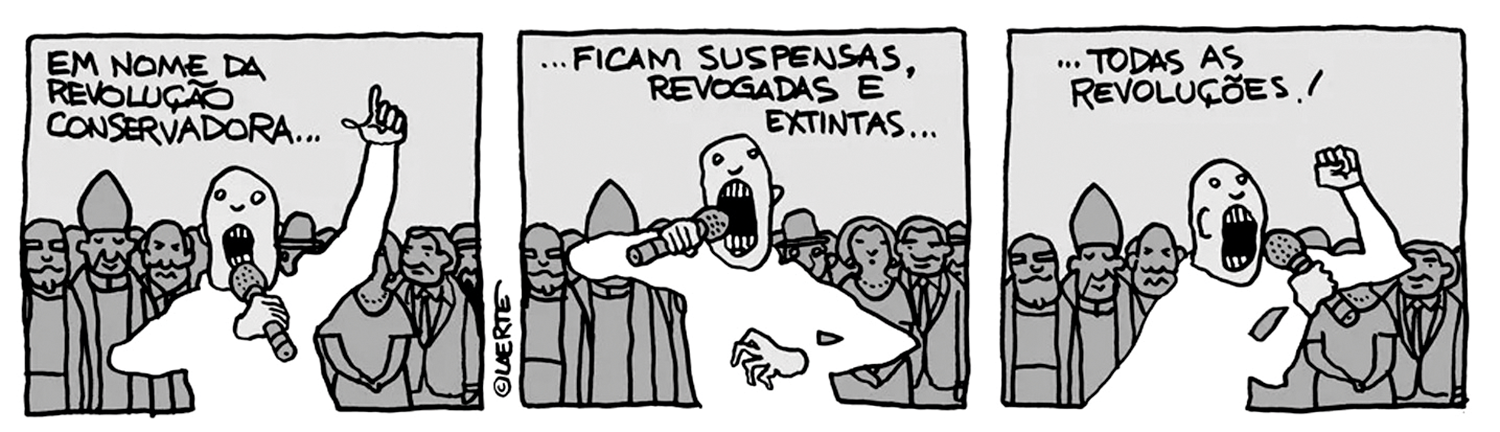
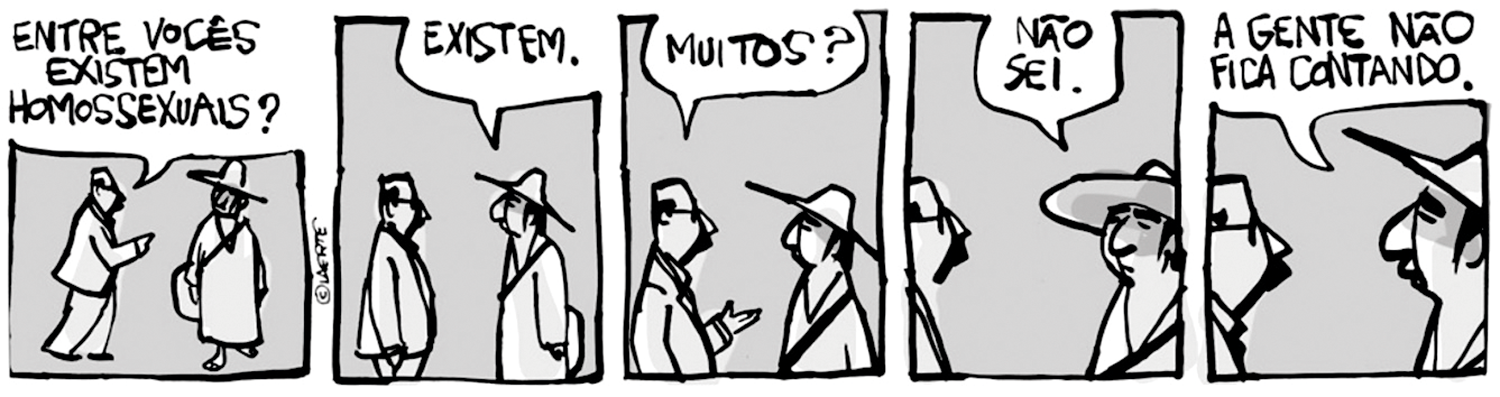
The three examples (6A, 6B, and 6C) address this theme in a discourse form. “Reactionary” discourse is a strong characteristic of these characters, who are always concerned with the “well-being” of society, based on homosexuality as something harmful. They present the characters articulating their ideas to an interviewer (6A), with the public (6B), and with another person, notably a stranger to their society (6C). In the first two, the framing is “American,” showing the character speaking directly to the reader. In the third example, the framing changes from medium shot to close-up, creating a kind of zoom, in through the five panels that compose it. In all three examples, the aesthetic organization of the drawing reinforces a structure that intensifies attention to the established dialogue. Such as the presence of an abstract background, absence of scenery, and focus on the character’s restrained facial expression, whose rigidity is gradually destabilized.
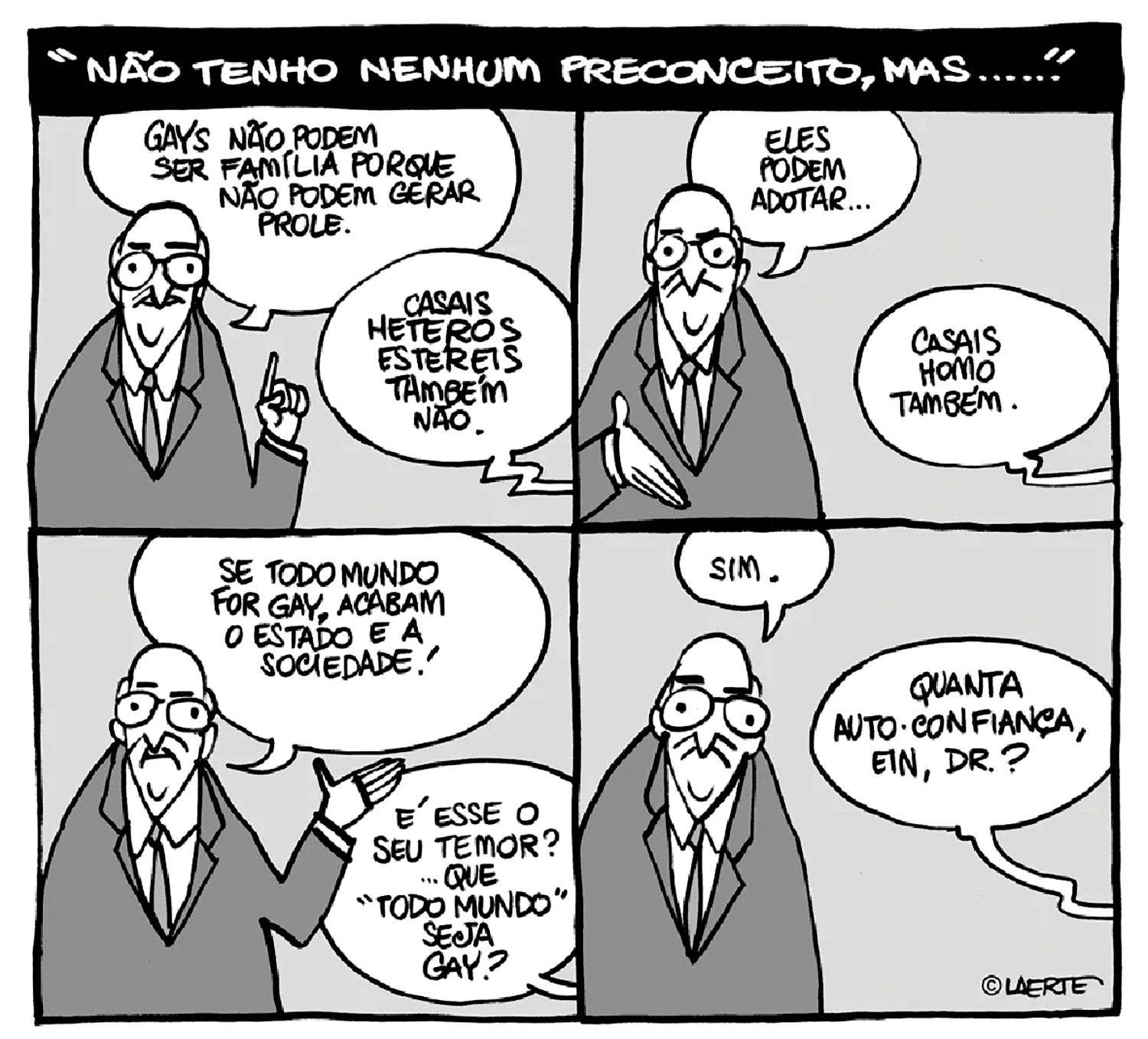
Source: Manual do Minotauro: blog das tiras diárias da Laerte. https://manualdominotauro.blogspot.com/2011/10/laertevisao-29-10-11.html
Source: Manual do Minotauro: blog das tiras diárias da Laerte. https://manualdominotauro.blogspot.com/2013/05/03-04-2013.html
Source: Manual do Minotauro: blog das tiras diárias da Laerte. https://manualdominotauro.blogspot.com/2017/06/16-11-2016.html
In the first one, a white man in a suit delivers a series of fallacious arguments against the possibility of same-sex families, culminating in the admission of his true fear: that “everyone is gay.” The ironic response from the invisible interlocutor—”How self-confident, huh, Doctor?”—dismantles the supposedly rational discourse, revealing its paranoid and self-referential undertones. In Fig. 6B, the character declares: “In the name of the conservative revolution, all revolutions are suspended, revoked, and extinct!” It is understood that, among other possible revolutions, the sexual revolution, the freedom to exercise one’s own sexuality, is also considered extinct. While in Fig. 6C, the Western white character’s concern with the number of gay people in society—who have a sexual orientation different from his—is explicit.
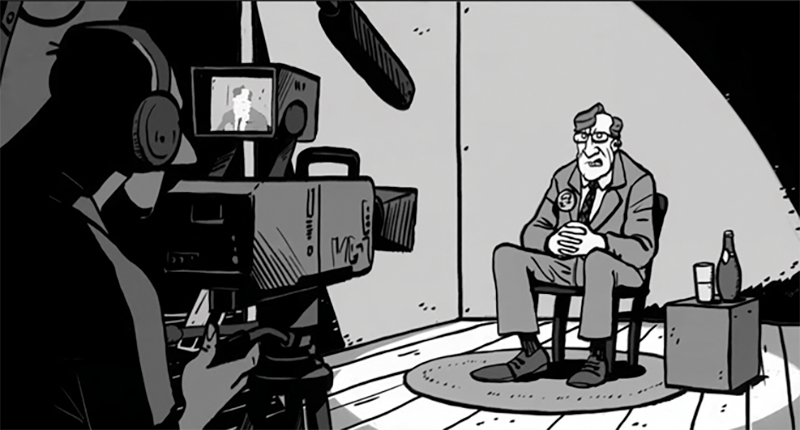
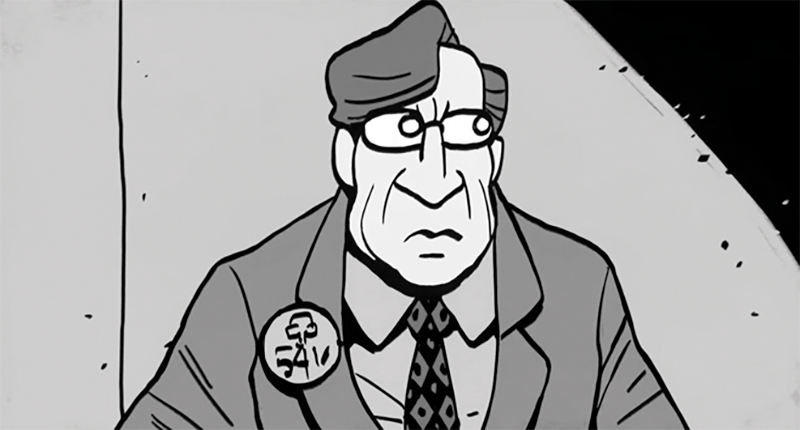
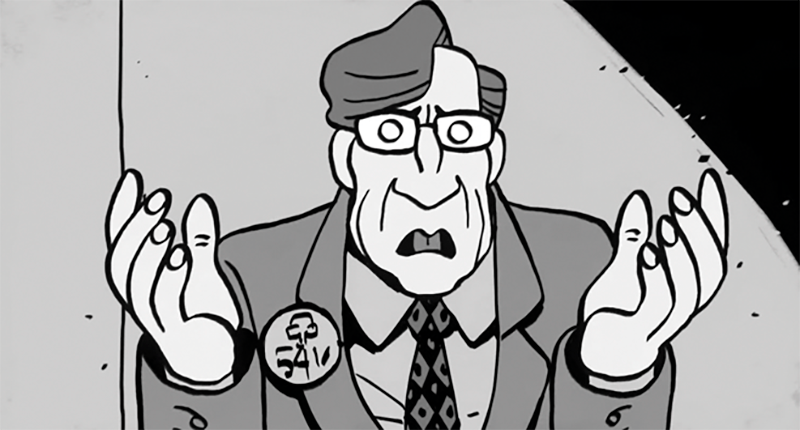
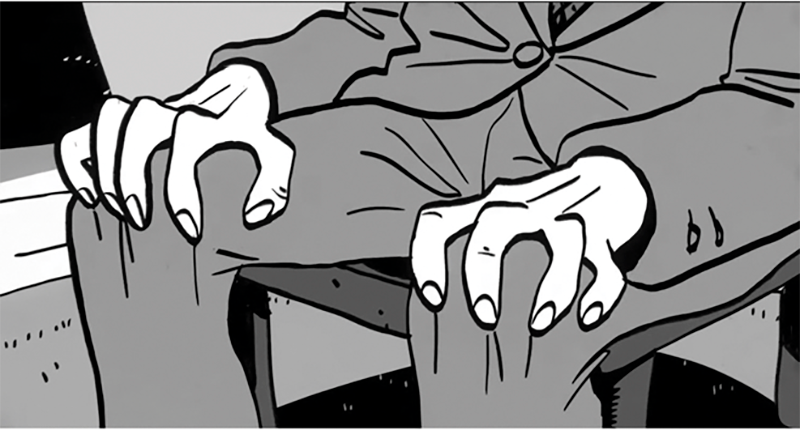
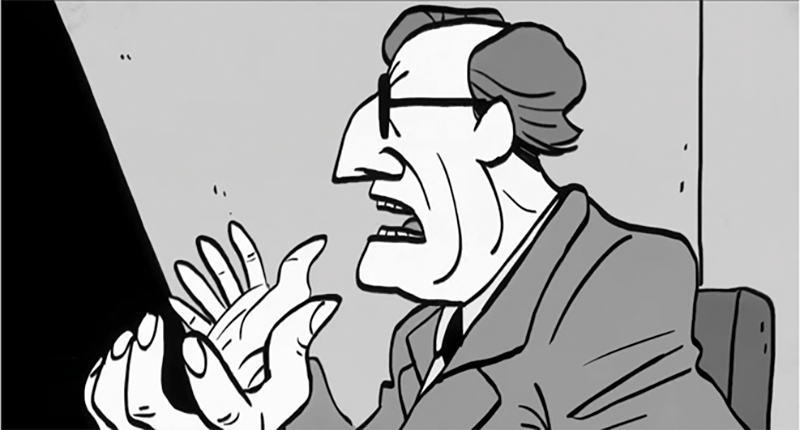
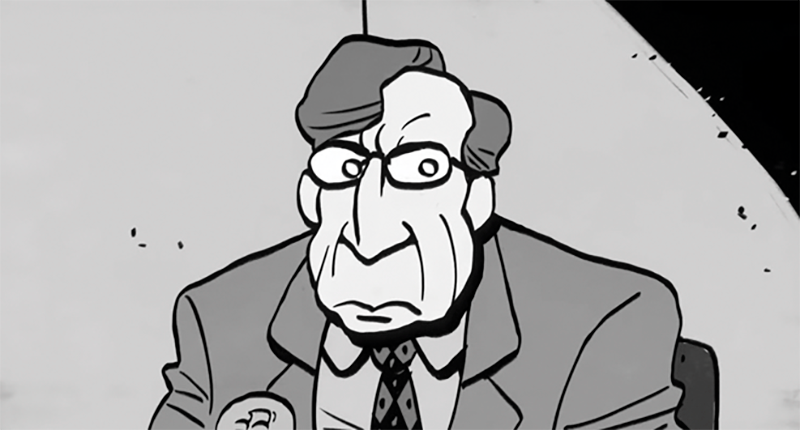
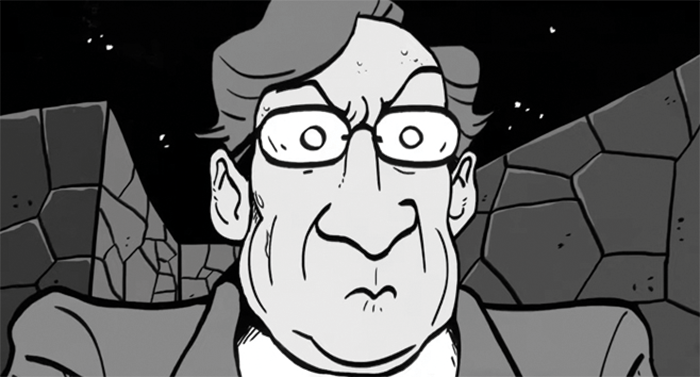
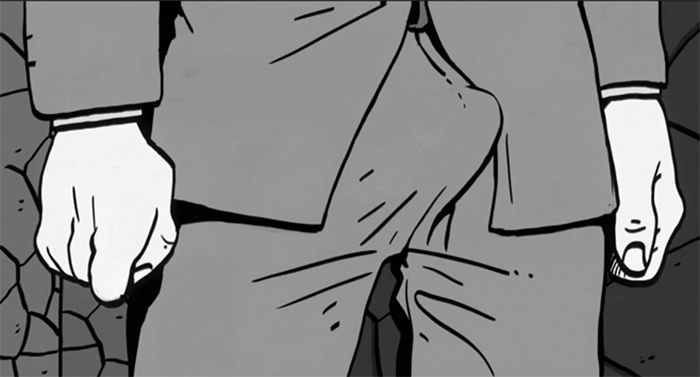
Drawing a parallel with City of Pirates, some of its scenes about this keyword are indeed verbal applications of the same content from the comic strips. Fig. 6A is adapted with creative freedom and other additions typical of the language of animation. The film sequence (Figure 7: Sequence 4) replaces the comic ending, redirecting its critical function to the visual, sound, and gestural elements of the mise-en-scène and audience interpretation. In this scenario, Azevedo appears illuminated by a direct spotlight, in an interview setting, under the inquisitive gaze of a TV camera. This plastic composition of exposure and judgment is intensified by the presence of an off-screen voice (presumably female, journalistic) that punctuates and rebuts his words firmly. The dramatic tension emerges from the contrast between Azevedo’s trembling voice and the invisible interlocutor’s confidence, establishing an asymmetrical power dynamic.
The shot breakdown is fundamental, with the alternations between framing (medium, frontal, lateral shots, and his hands’ details) highlighting the character’s growing internal tension. The framing also operates as a narrative instrument of moral and visual judgment. Azevedo is positioned under a direct beam of light, reminiscent of the aesthetics of interrogations or public confessions, a dramatic mechanism of exposure where Azevedo is simultaneously interviewed and judged. The phrase “if everyone is gay, the State, society, everything will end...” is uttered by him with growing anxiety. When asked if this is his fear, he tries to answer, but silence ensues. At this moment, the animation surpasses the literalness of the comic strip without contradicting it, because, by making the discomfort visible and exploring the performance of the prejudiced speech in its argumentative emptiness, the animated language deepens the critical sense of the original work. Where the dismantling of the discourse occurs through the text, the fragility of the script is dramatized in Azevedo’s body and voice, reorganizing him as an animated symbol of embarrassment, incoherence, and hesitation.
Source: Stills of City of Pirates (2018)
Source: Stills of City of Pirates (2018)
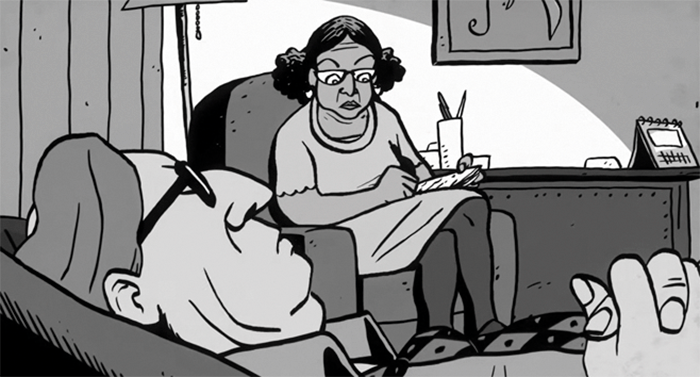
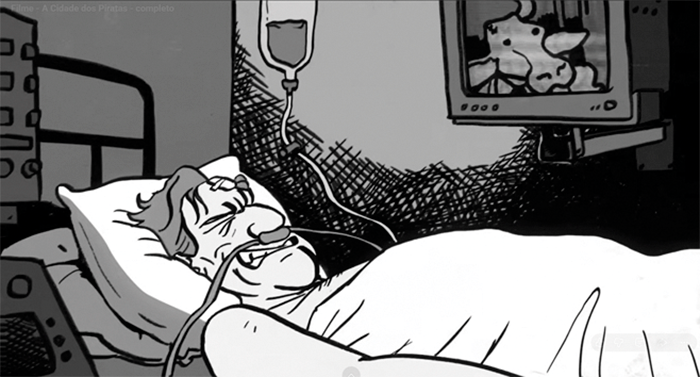
Source: Stills of City of Pirates (2018).
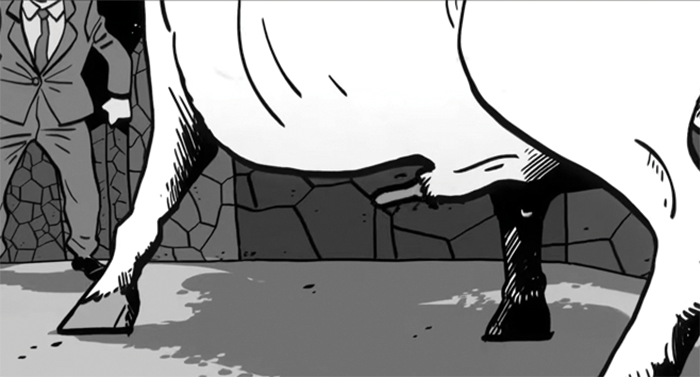
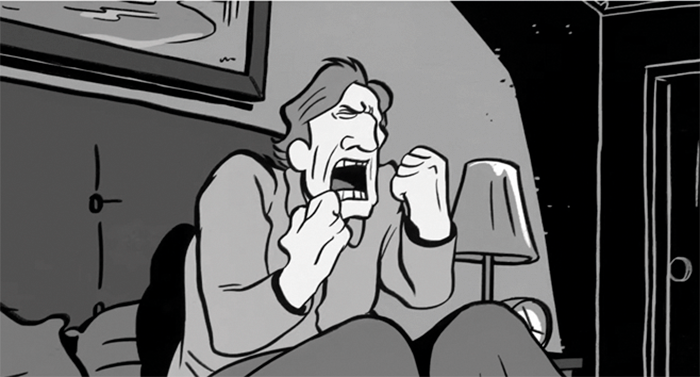
There are many scenes in the film where Azevedo’s fear of homosexuality is explicit. His erotic dreams with the Minotaur (which in the film personifies Laerte’s issues and insecurities). This confronts Azevedo’s existential fears. Through animation, these issues, which are discursive in the comics, reach another level, presenting dynamic, dramatized complexities with multi-layered connotative messages, as they are inserted into a larger narrative, that of the feature film itself. Some examples are: when he dreams of the labyrinth and, upon encountering a bull, it excites him (Figure 8: Sequence 5); the moment when Azevedo wakes up from a nightmare and shouts: “Silva Helena, I can’t stand these dreams about the gay dictatorship anymore!” (Fig. 9, Still 1); When Azevedo talks to his psychologist, “I’ve been having gay dreams” (Fig. 9, Still 2); and in the hospital, after the missile explosion, Azevedo says with satisfaction: “I finished off the Minotaur” (Fig. 9, Still 3). In all four moments, the character exposes his insecurity and fear of his own impulses. The need to encapsulate any hint of homoeroticism leads him to radical actions, such as ending the world to kill the Minotaur. For him, violence (another keyword) is always the easiest answer.
Again, it is noted that the message expressed in the comics demands more interpretation from the reader than in the animated sequences. By comparison, they are more interesting. Another point is that in these comics, the verbal message is fundamental, as mentioned, it is based on a reactionary discourse. There are no major actions. In the animated images, the discourse adaptation is made using the tools of cinematographic language, combined with the simulation of movements typical of animation. Providing the audience with a more complex and complete image, since the verbal discourse is sonorous and with the intonations and rhythms typical of a dialogue. Which, in itself, also carries emotional information that corroborates the expressiveness of the images.
Violence as expression
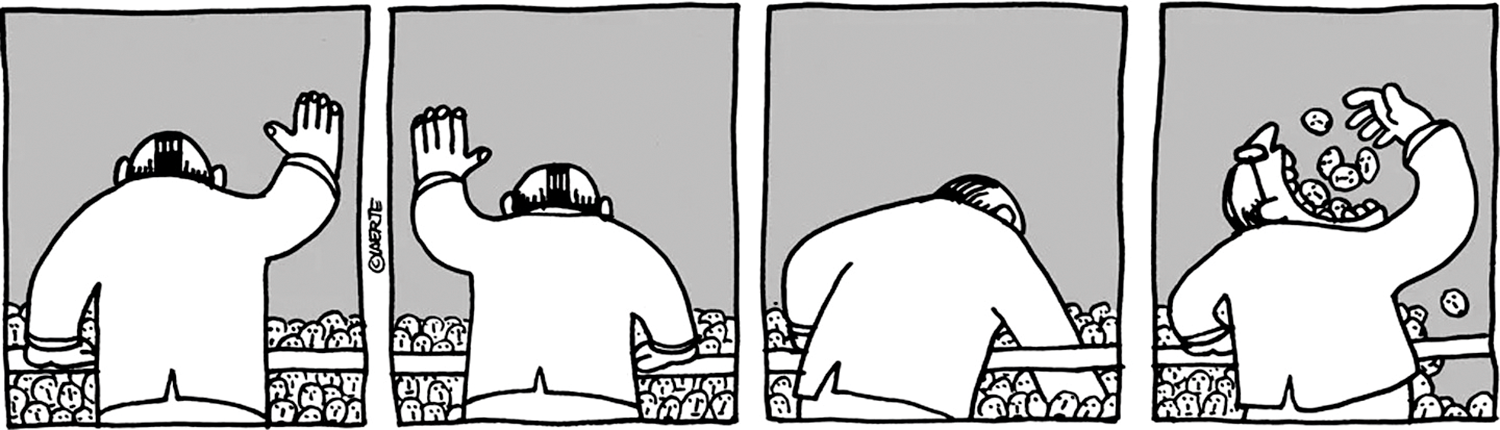
Criticism of violence is a recurring theme in Laerte’s cartoons, generally presented as a common characteristic of middle-aged, heterosexual white men. This violence is presented in various forms, including explicit (Fig. 10B), implicit (Fig. 10A), and graphic (Fig. 10C). The last two images follow the traditional construction of comics, where each represents a fixed graphic stage of the narrative that concludes in the last. In both, the background is neutral, with cooler, less saturated colors, which helps to balance and contrast with the violence of the actions5. The framing is in medium shot and is surprising for its stark depiction of social and political reality. Fig. 10B shows a clash between two white men who look at each other, which is the reason they shoot each other. In the last panel, the verbal message is ironic and mocking, alluding to the name of an Olympic gymnastics element as something legitimate according to the standards of the characters in question. In Fig. 10C, a man who appears to be a politician waves with his right hand, then with his left. Further, he removes the heads of the people with his right hand and eats them. The first image is much more sophisticated, with three levels of narrative. In the first, five panels with a white background, without gutters between them, show a character with a pre-Columbian type—that is, an allusion to the indigenous peoples. The character is choosing a type of hat, an allegory of a head, and decides on the one that can break the mirror. Considering that “mirrors” were distributed among the colonizers when they arrived in the Americas as a seductive gift to the indigenous peoples, there is a strong message of breaking the colonizer’s “spell”. On the second level, it shows four panels (there is a clear progression, both quantitative and formal) with a white background, a man choosing a weapon. When he does so, looking at himself in the mirror with the weapon pointed at his own head. In the last panel, he says to the other white man on the other side of the counter: “This one.” And on the third level, a single panel presents a summary message in a colored “wide frame” with warm colors. The white man, a Laerte standard, in the reverse shot, is hailing a taxi on the street. But all the taxis that pass are revolvers. That is, it summarizes the normalization of violence, and this can be used to achieve an end, and is everywhere at anyone’s disposal.
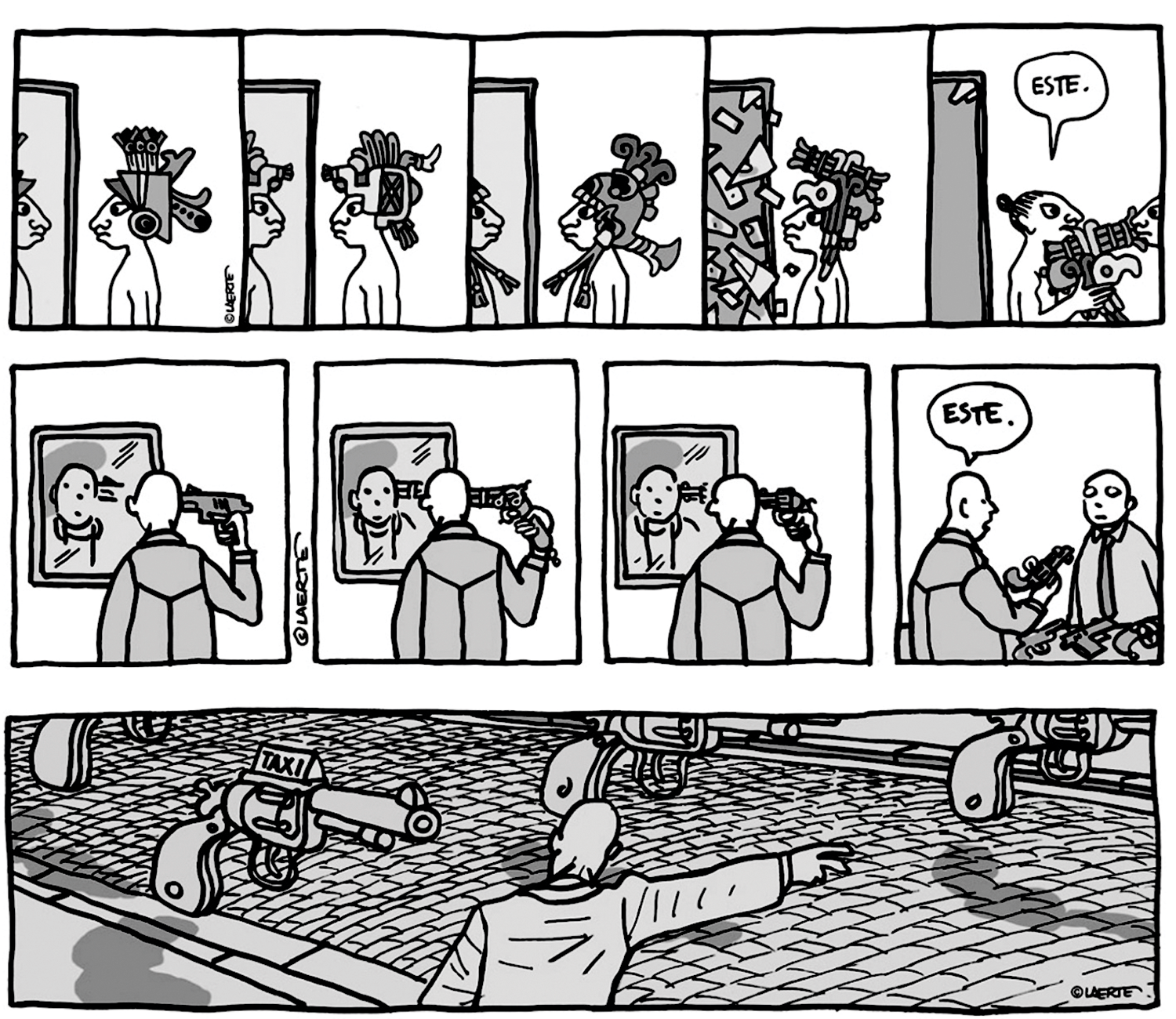
Source: Manual do Minotauro: blog das tiras diárias da Laerte. https://manualdominotauro.blogspot.com/2012/10/22-23-24-08-12.html
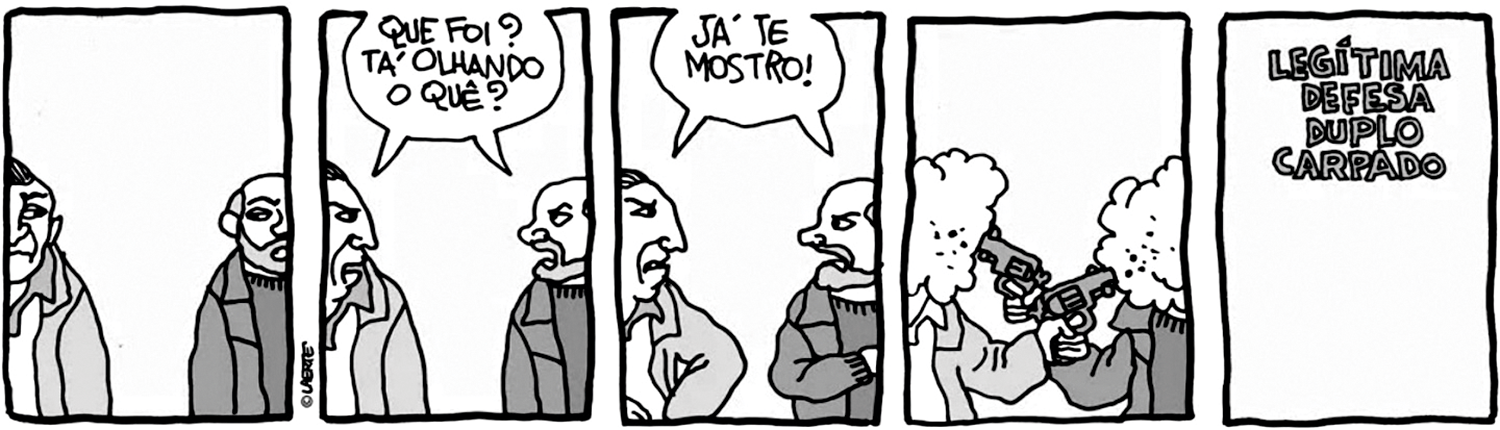
Source: Manual do Minotauro: blog das tiras diárias da Laerte. https://manualdominotauro.blogspot.com/2020/02/06-12-2018.html
Source: Manual do Minotauro: blog das tiras diárias da Laerte. https://manualdominotauro.blogspot.com/2018/06/14-10-2017.html
Regarding the film, sequences 2 and 3 demonstrate this violence dynamically. The audience does not need to fill in their imagination what is insinuated in the static images, because on the screen, the movement is seen and identified as violent: stepping on people and throwing a missile at a city. In Fig. 10C, the politician eats people’s heads. In sequence 2, he stomps on them, with the framing variations already analyzed. Fig. 10B shows two men killing each other for no reason, while Sequence 6 (Figure 11), in a very comic aesthetic (static American shot), introduces other characters besides Azevedo. One neighbor says to another in the morning, “Did you see the newspaper today? You and I are now enemies.” And the neighbor on this side of the fence replies: “Seriously? Wow, I can hardly believe it…” The other continues walking and exits the frame, saying, “We need to be careful.” However, the neighbor with the newspaper in his hand pulls a gun from his robe, points it at the neighbor, and shoots. It’s the same logic of gratuitous violence, except that in the film, the shock for the viewer is greater. It’s not necessary to imagine the act of shooting or the sound of the gunshot. Movement and sound are explicit, and they make a difference in constructing the kinetic (not implied) moving image. The audience’s perception, heightened by the sound of the gunshot, cannot be replicated in comics, since the sound is heard rather than imagined. This once again demonstrates that comics allow for a greater degree of “coldness” than animation.
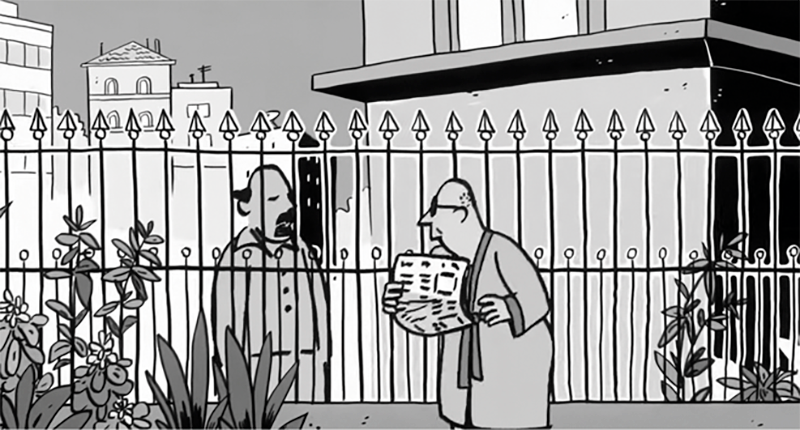
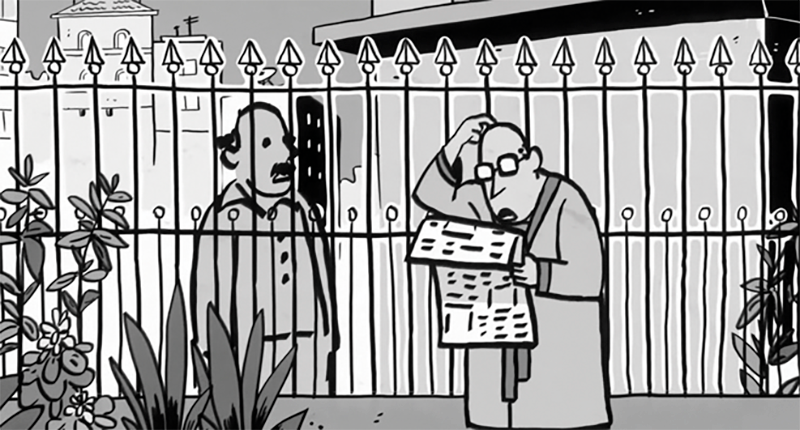
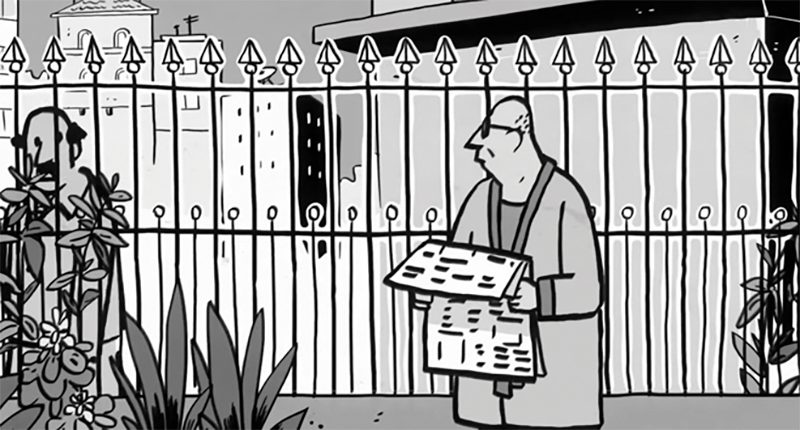
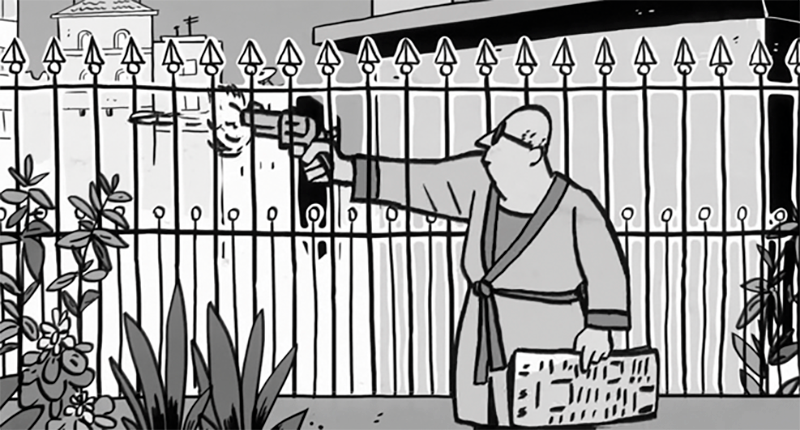
Source: Stills of City of Pirates (2018)
Lack of Empathy
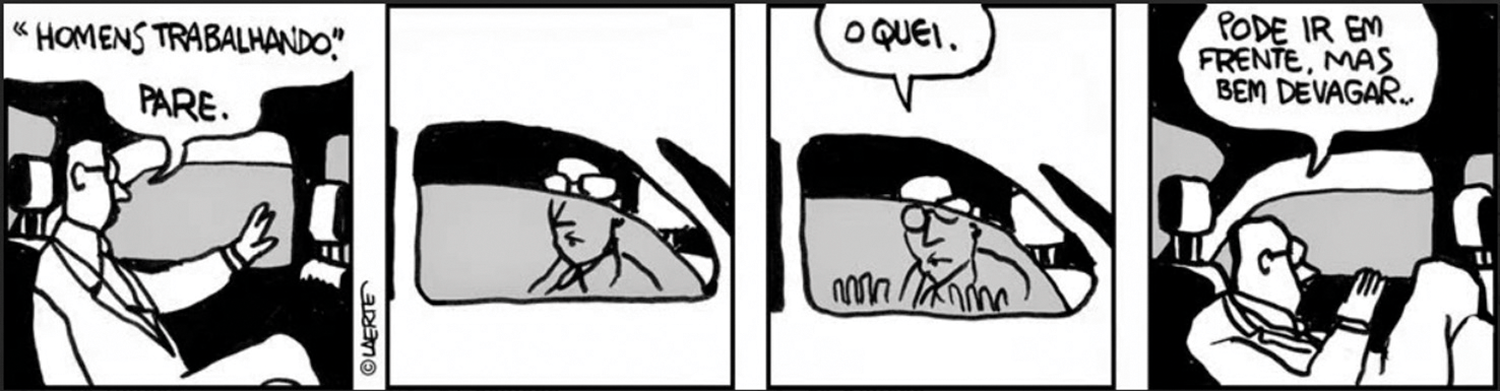
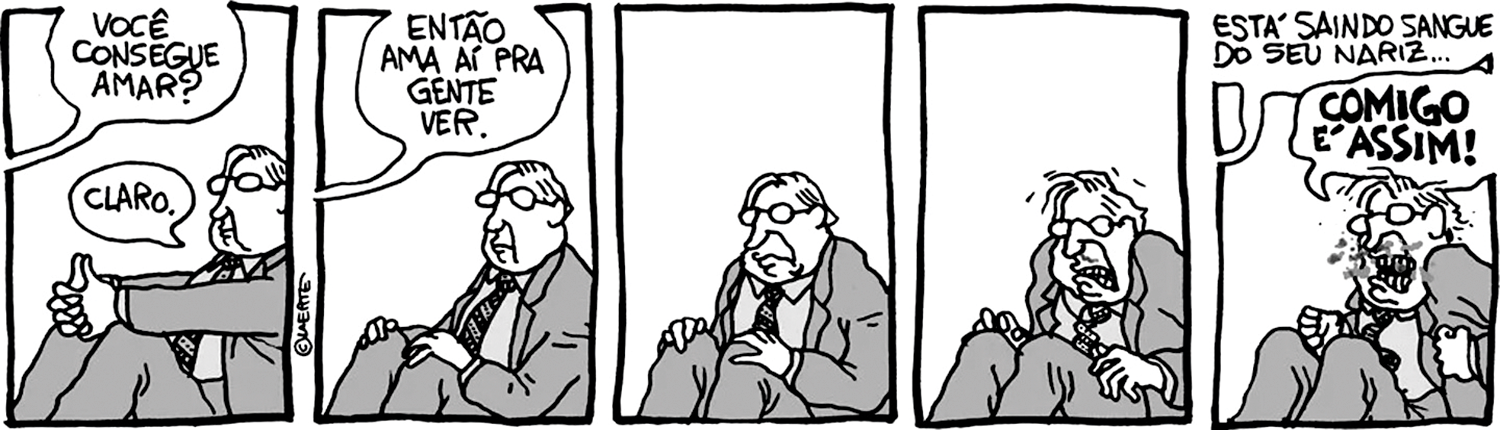
This keyword is perhaps the basis of all others: “lack of empathy.” Figure 5A, 5B, and 5C present some examples. All use color in a minimalist way. In the first, a white man is in a car with a chauffeur, where only the glass is colored (blue). The “boss” asks him to stop, upon reading “men working” (a sign that doesn’t appear, but is something implied by the reader, that is, completed by him). In the next frame, he says “okay”; and then, huddled in the seat, still looking out the window, he orders, “You can go ahead, but very slowly.” In the second, in five frames, the man is confronted with the question, “Can you love?” The seated man, seemingly leaning on the right edge of the frame, with his hands clasped together forming the “like” sign on his knees, replies: “Of course.” But the off-screen interlocutor insists: “Then, love so we can see.” In the next two frames, the man struggles as if expelling something from within, with his hands on his knees. And in the final frame, with an expression of hatred, clenched hands, and blood splattered on the panel, as if breaking the fourth wall, the interlocutor observes, “Your nose is bleeding!”, and the man replies, “That’s how it is with me.”
Source: Manual do Minotauro: blog das tiras diárias da Laerte. https://manualdominotauro.blogspot.com/2015/02/23-11-2014.html
Source: Manual do Minotauro: blog das tiras diárias da Laerte. https://manualdominotauro.blogspot.com/2018/08/01-12-2017.html
Source: Manual do Minotauro: blog das tiras diárias da Laerte. https://manualdominotauro.blogspot.com/2020/02/30-11-2018.html
This keyword is perhaps the basis of all others: “lack of empathy.” Images 12A, 12B, and 12C present some examples. All use color in a minimalist way. In the first, a white man is in a car with a chauffeur, where only the glass is colored (blue). The “boss” asks him to stop, upon reading “men working” (a sign that doesn’t appear, but is something implied by the reader, that is, completed by him). In the next frame, he says “okay”; and then, huddled in the seat, still looking out the window, he orders, “You can go ahead, but very slowly.” In the second, in five frames, the man is confronted with the question, “Can you love?” The seated man, seemingly leaning on the right edge of the frame, with his hands clasped together forming the “like” sign on his knees, replies: “Of course.” But the off-screen interlocutor insists: “Then, love so we can see.” In the next two frames, the man struggles as if expelling something from within, with his hands on his knees. And in the final frame, with an expression of hatred, clenched hands, and blood splattered on the panel, as if breaking the fourth wall, the interlocutor observes, “Your nose is bleeding!”, and the man replies, “That’s how it is with me.”
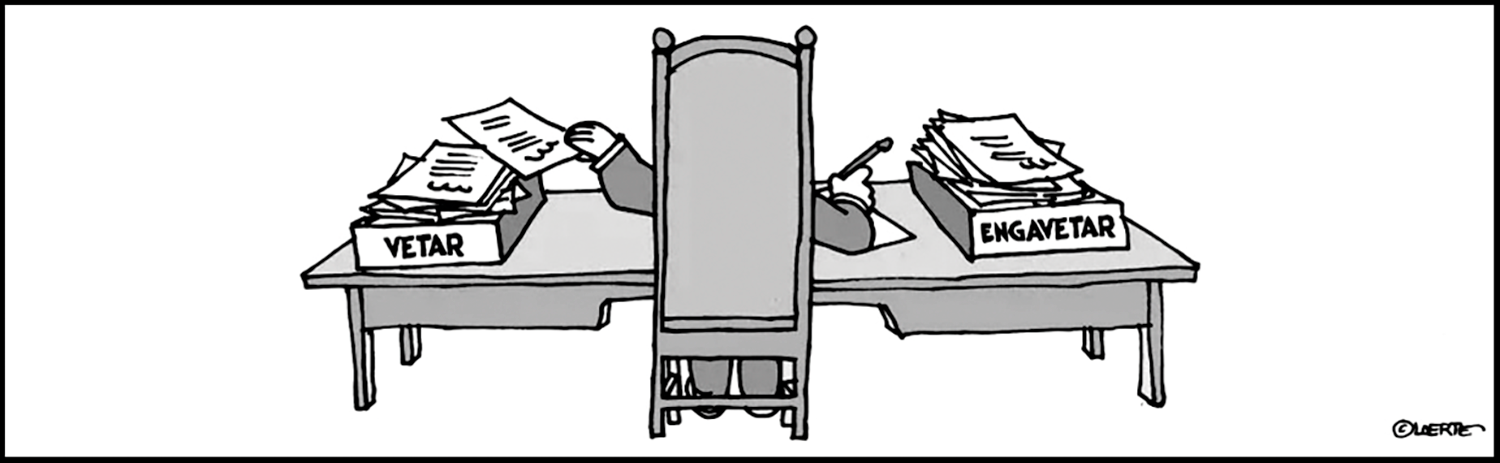
And in the third example, a widescreen shot, a man sits in a high-backed chair, in reverse shot, separating documents into two boxes on the table. These are labeled, on the left “veto,” and on the right “file away.” That is, there is no positive option for what the person had requested. The lack of empathy is clear.
In the Guerra film, in addition to the sequences already discussed, the lack of characters’ empathy is also embedded; other very significant ones reflect, almost directly, the examples in images 12A, B, and C.
Fonte: Stills of City of Pirates (2018)
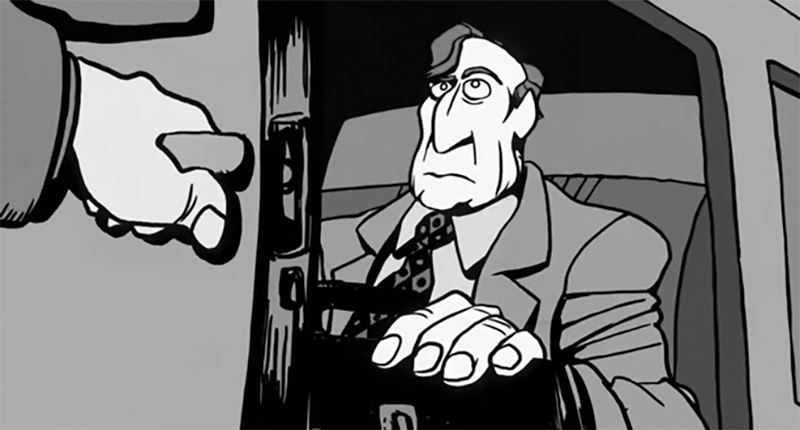
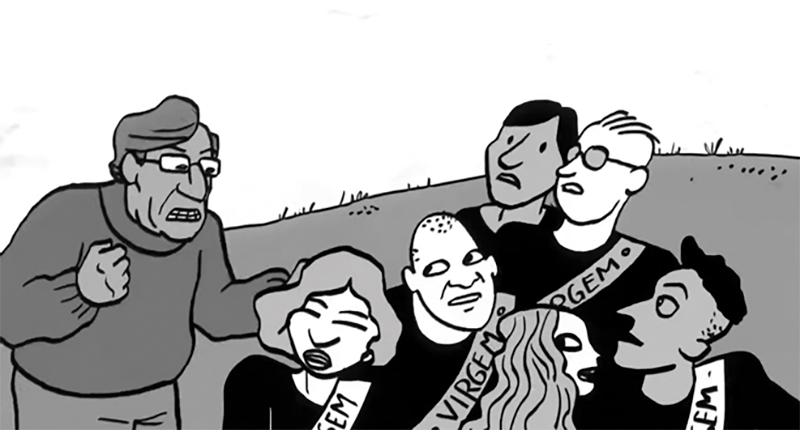
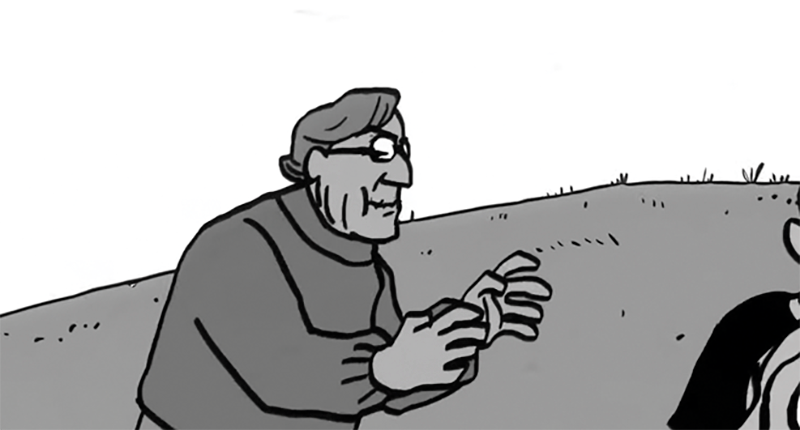
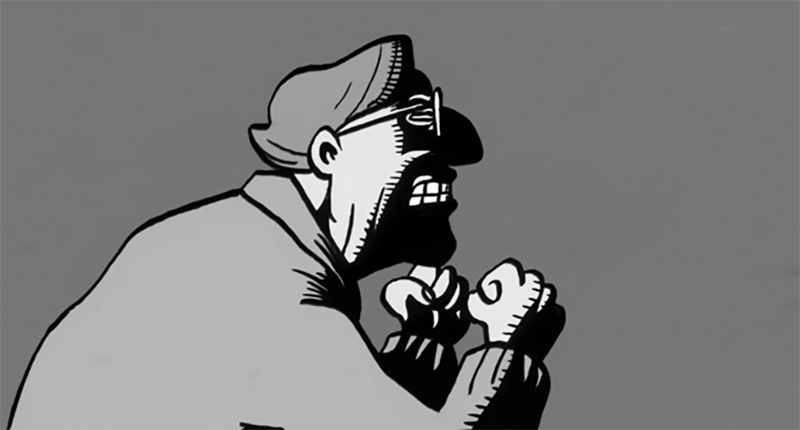
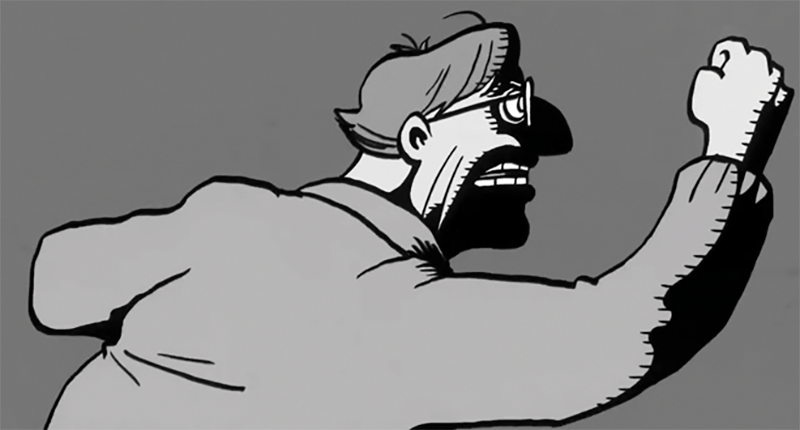
In sequence 7 (Fig. 13), Azevedo tries to convince the young virgins to renounce the ceremony with the Minotaur. It begins with a medium shot, in high-angle. Then, it zooms in on the character’s direction, framing him to highlight his expression. Initially, he is advisory and concerned over a white background, but he becomes violent and angry, showing his teeth and fists, against a burgundy background. It parallels strip 12B, as he is incapable of loving or caring, but only of expressing his own hatred.
Fonte: Stills of City of Pirates (2018)
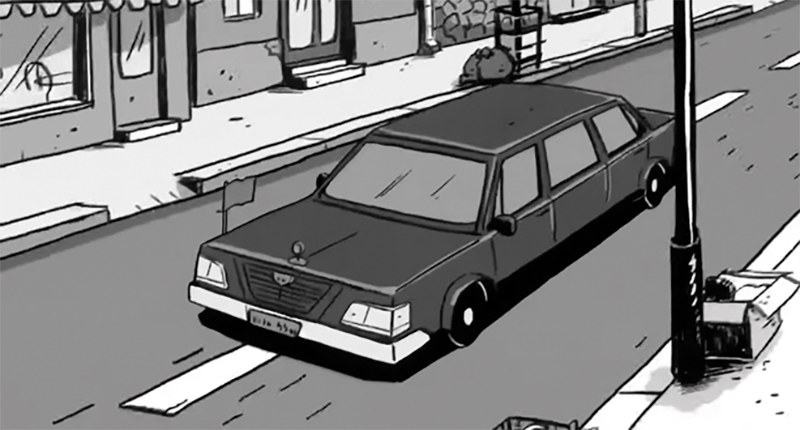
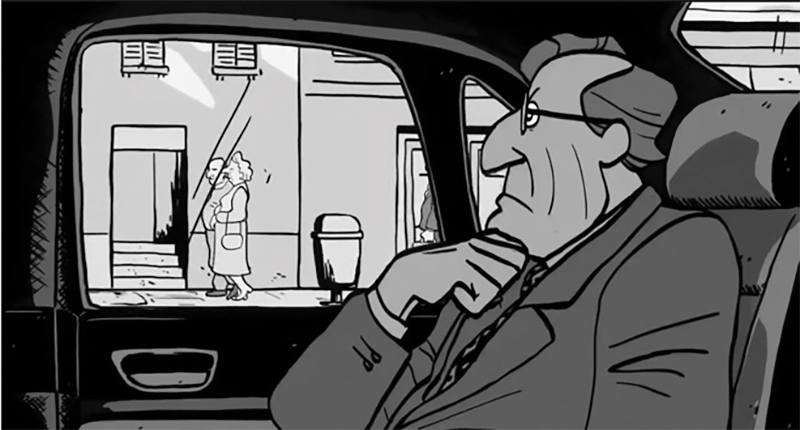
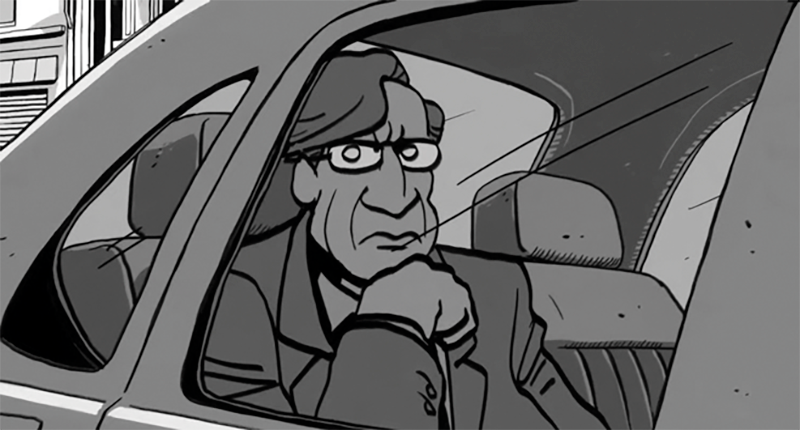
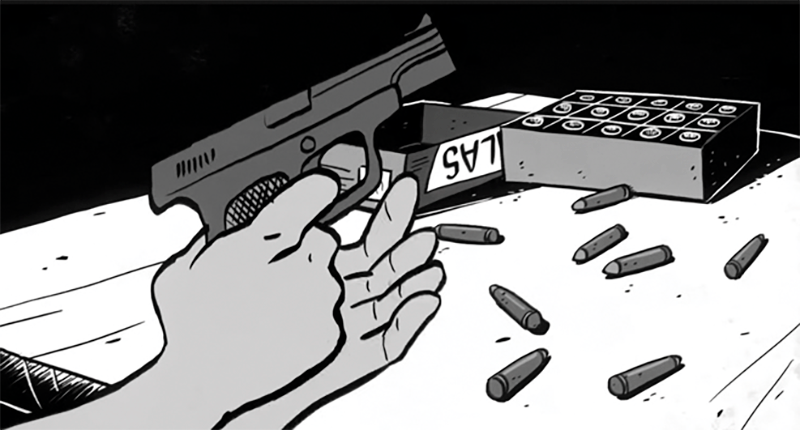
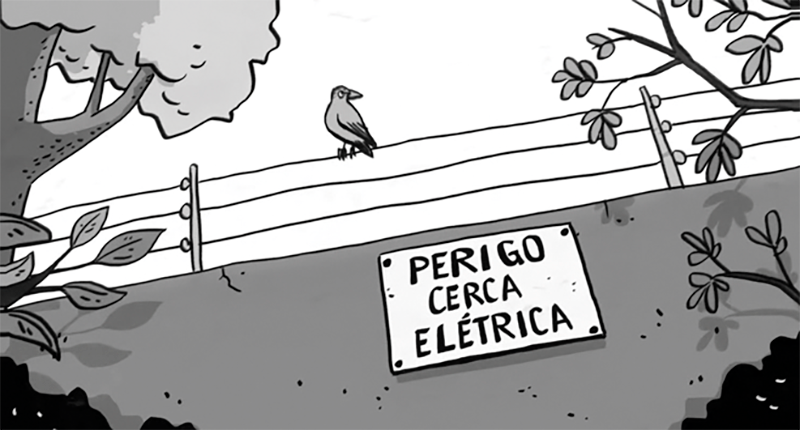
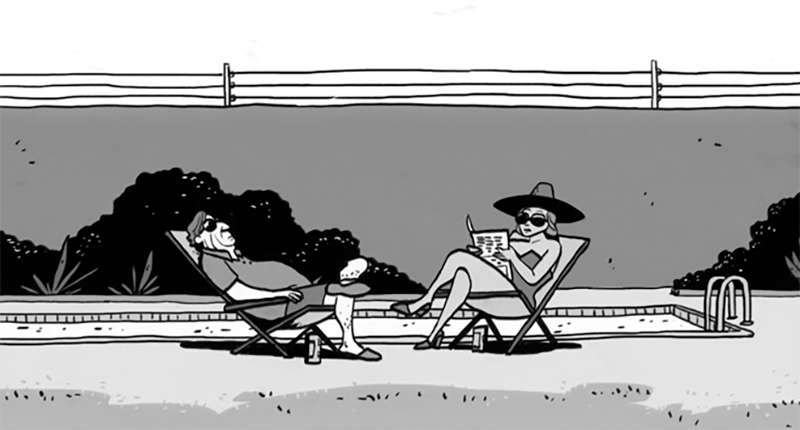
In sequence 8 (Fig. 14), in a medium shot, at a high angle, Azevedo’s car drives through the streets of São Paulo. Similar to Fig. 12A, he looks out the window at the streets and people passing by, sighs, and thinks, “Before, everything was so simple.” Already seen from outside the car, he continues the thought: “Armor yourself...” There is a cut to a succession of images. First: someone holding a gun and preparing to shoot, with Azevedo’s thought off-screen, “Arm yourself...”. Then, a tall electrified wall, with a warning sign, and a bird flying out of the frame; “arm yourself,” and then Azevedo with his wife sitting by the pool, with the wall in the background, and the thought “and enjoy life.”
In this sequence, as in Fig. 12A, there is a normalization of reality with a desirable and, in a way, pleasing social apartheid for the middle-aged white man. The animated form message, once again, allows for the layered complexity that Guerra takes advantage of and uses, going beyond the comics in this case.
While in comics, the character’s thoughts are not explicit. So, readers need to deduce them from the images and the little that is expressed verbally; in animation, they are conveyed through sound. Again, sound, through a background soundtrack, a funk beat6. It is an element that demonstrates and denotes the environment and context in which this white man lives, his social isolation, without any connection to his surroundings.
Conclusão
From these analyses, we can conclude that although the languages share verbal-visual narrative strategies, the experience of reading comics depends on distinct cognitive processes. Which values pause and interpretive interaction. The reader controls the process; they are an active receiver, whose coolest meaning, according to McLuhan, seduces them into participating in the fluid understanding of the visual narrative, interpreting, and concluding certain actions and morals from these short stories. Unlike animation, in which the viewer is a more passive receiver, who watches and listens to the audiovisual image in action in a synchronized way.
In this comparative analysis of the two media, when comics are transposed directly or adapted to the animated medium, it was confirmed that it is an adaptation, and not a simple transposition. A scene that exemplifies this situation, Azevedo’s interview, shows how the adaptation of the comic strips to animation can not only reproduce but also critically reinvent the gesture articulated in the original work. The mise-en-scène of the animation re-presents the comic strip in a visual and sound interrogation, revealing homophobia not as an isolated ideological position, but as a performative and fragile symptom in its inconsistency.
The scene not only exposes Azevedo but also collapses him, and this occurs in the dialogue text, which was maintained in the adaptation process, integrated with the character’s performance, now in motion, and with the very silence that concludes the speech.
This affinity between media analyzes the feature film City of Pirates (directed by Otto Guerra, 2018) as a case of verbo-visual adaptation, in which the codes of comic books are reworked and reconfigured in the animated medium. The investigation prioritizes the zones of friction and contiguity between image and word, fixity and movement, paper and screen, aiming to understand how animated language assumes, transforms, and comments on graphic and narrative procedures of comics. From the analysis of Azevedo’s appearances in comic books and animation, it becomes evident that verbo-visual adaptation between these languages can be understood as a field of aesthetic and critical study marked not by hierarchies but by the circulation of forms, temporalities, and modes of elaboration of the works.
Thus, we can conclude that each medium must respect its own characteristics and take advantage of them during the adaptation process. Animation, by simultaneously articulating image and sound, mobilizes different forms of perception, enabling discursive constructions of its own nature. However, the information in comics, which uses visual means to represent sound, by its nature is different from animation, where sound is perceptible. By demanding greater participation from the reader, it can awaken various levels of interpretation, depending on the reader’s cognitive development level.
Endnotes
1 Which does not mean image resolution as it currently is.
2 The less fortunate, women, Black people, LGBTQ+ people, etc.
3 Almost on the reader, considering the low-angle shot.
4 This sequence, in fact, expresses and synthesizes almost all the keywords presented here.
5 It can be considered a representation of the normalization of violence by society.
6 A musical style that in Brazil gained prominence from the 2000s onwards, from artists on the outskirts of large cities.
References
Books by one author
Hutcheon, Linda. 2006. A Theory of Adaptation. New York: Routledge.
Jullier. Laurent. 2002. Cinéma et Cognition [Cinema and Cognition]. Paris: L’Harmattan.
McCloud, Scott. 1993. Understanding comics: the invisible art. New York: Kitchen Sink Press.
McLuhan, Marshall. 1995. Understanding Media, 3rd Ed. Massachusetts: MIT Press.
Miodrag, Hannah. 2013. Comics and Language: Reimagining Critical Discourse on the Form. Jackson: University Press of Mississippi.
Translated books with author indication.
Todorov, Todorov. 1970. As Estruturas Narrativas [Por une Theoie du Recit], translated by Moysés Baumstein. São Paulo: Editora Perspectiva S.A.
Theses and Dissertations
Santos, David. 2025. Tensões nas fronteiras entre animação e quadrinhos: análise do documentário animado A Cidade dos Piratas [Intermedial tensions between Animation and Comics: analysis of the animated documentary City of Pirates]. Dissertation (Master’s degree in Cinema and Audiovisual). Niterói: Universidade Federal Fluminense.
Webgrafia
Daehn, Ricardo. 2019. “Animação ‘A Cidade dos Piratas’ Imprime Perspectivas e Valores de Laerte.” Correio Braziliense/Diversão e Arte. Available on: https://www.correiobraziliense.com.br/app/noticia/diversao-e-arte/2019/11/10/interna_diversao_arte,804952/animacao-a-cidade-dos-piratas-imprime-perspectivas-e-valores-de-laer.shtml. Accessed on May 12, 2026.
Manual do Minotauro: blog das tiras diárias da Laerte. [Minotaur’s Manual: Laerte’s daily comic strip blog]. Available on: https://manualdominotauro.blogspot.com/. Accessed on May 14, 2026.
Stam, Robert. 2006. Teoria e prática da adaptação: da fidelidade à intertextualidade. Ilha do Desterro [Theory and practice of adaptation: from fidelity to intertextuality. Ilha do Desterro]. A Journal of English Language, Literatures in English and Cultural Studies, p.19-53. Available on: https://www.redalyc.org/articulo.oa?id=478348689002. Accessed on April, 2026.
Teixeira, Paulo César. 2018. “O rei da animação: Otto Guerra finaliza novo longa e lança autobiografia” [The king of animation: Otto Guerra finishes new feature film and releases autobiography]. Available on: https://www.jornaldocomercio.com/_conteudo/cultura/2018/06/630939-o-rei-da-animacao-otto-guerra-finaliza-novo-longa-e-lanca-autobiografia.html. Accessed on May, 2026.
Vicentini, Rodolfo. 2018. “Cartunista Laerte critica Bolsonaro e prevê nova ditadura no Brasil” [Cartoonist Laerte criticizes Bolsonaro and predicts a new dictatorship in Brazil]. Available on: https://www.bol.uol.com.br/entretenimento/2018/10/21/cartunista-laerte-critica-bolsonaro-e-preve-nova-ditadura-no-brasil.htm. Accessed on May, 2026.
Presentation in Congress
Gordeeff, Eliane. 2021. The City of Pirates, A Laerte’s Expression [Online lecture]. Rising of Lusitania, AnimaDoc Conference, Gdansk/Poland. Presented in Set 25, 2021.
Filmograph
A Cidade dos Piratas. 2018. Directed by Otto Guerra. Brasil: Otto Desenhos Animados.