Abstract
The computational studio has evolved from a tool into an infrastructure that pre-structures auditory thought. This article argues that commercially deployed AI enacts a regime of automated listening, a logistical governance that captures the vibrational remnant, spectralizes creativity into hauntological latent spaces, and disciplines sonic time via platform protocols. To analyze this tripartite governance, we introduce the Signal–Representation–Trajectory (SRT7) framework, a critical media-analytic model mapping the material, symbolic, and temporal dimensions of sonic control. Employing a practice-led methodology structured as a recursive circuit of speculative construction, forensic deconstruction, and relational framing, we demonstrate how meta-listening, a reflexive auditory praxis, serves as both diagnostic for this regime and core skill for its subversion. Through a materialist cartography of commercial AI tools and the construction of two counter-infrastructural software, hardware, and performative experiments, Atmospheric Hyperinstrument (2025) and Cyber Attack Sonifier: Glitch Ecology (2026), we show how meta-listening enables speculative interventions that redistribute agency and cultivate posthuman auditory sensibilities. The first experiment sonifies atmospheric data (CO2 , particulate matter) to bypass dataset hauntology; the second sonifies real-time cyberattack data to render audible the invisible violence of digital infrastructure. Synthesizing this analysis, we advance the AI-Chimera as a key concept for understanding hybrid creativity as an emergent property of configured SRT7 fields. The article concludes by positioning meta-listening as an essential political faculty for contesting sonic governance and advocating for the design of legible, contestable auditory infrastructures.
Keywords: Meta-Listening, SRT7, AI-Chimera, Sonic Governance, Sound Studies.
The Computational Enclosure: Beyond the Studio-in-a-Box: The Rise of Meta-Production
To frame the contemporary digital audio workstation merely as a studio-in-a-box is to mistake topology for ontology. What confronts us is not a tool but a meta-productive environment: a cognitive and infrastructural assemblage where signal processing, machine learning, algorithmic governance, interface design, and platform logistics converge to pre-structure the conditions under which sound, for music, cinema, and audiovisual media, is produced, heard, and thought. Within this computational enclosure, AI-driven instruments announce not mere technical augmentation but an ontological reorientation. Sound is no longer authored so much as articulated within dense systems of human-machine coupling. What is at stake is not automation-as-efficiency but a fundamental redistribution: listening and production reconfigured as a shared process distributed across human and non-human agents. This signals a departure from the classical model of the artist as sovereign subject. In its place emerges meta-production: a second-order compositional condition wherein the primary creative act shifts from direct manipulation of sonic material to the orchestration of listening systems, natural, artificial, and infrastructural, across distributed agencies. Composition becomes a reflexive praxis of negotiation, a form of “meta-listening 2” (Paquete, 2015) that extends beyond the sonic event to encompass the very conditions of its emergence.
The Crisis of Auditory Attention
This expanded field operates across heterogeneous registers: human cognition, algorithmic inference, software architectures, and environmental data streams. Decisions are co-produced; agencies intersect and diverge. This situation is complicated by temporal dislocation: listening is increasingly future-oriented by AI, mediated by predictive inference, recommendation systems, and the quiet normalization enforced by generative tools. Such conditions produce epistemically opaque zones where criteria for evaluating sound are encoded not in aesthetic treatises but in statistical models trained on vast, unaccountable datasets. Production migrates from centralized author to decentralized apparatus, a field of distributed decision-making without stable locus of control. The musical work no longer appears as a stable object but as a provisional state within an ongoing computational process of negociation by humans and AI recomendations. Consequently, the politics of sound shift decisively away from authorial intention toward the design of listening infrastructures. DAWs, AI plugins, and streaming protocols collectively govern what can be imagined, auditioned, and circulated. When plugins suggest stylistic continuities based on aggregated platform data, the figure of the sovereign producer becomes untenable. Production becomes a logistical negotiation with automated listening systems whose evaluative criteria are sedimented in historical datasets and industrial norms.
Introducing the AI-Chimera
To theorize this condition, this article advances the figure of the AI-Chimera. It is not a metaphor for hybrid intelligence but a theoretical operator: a conceptual device for analyzing listening as infrastructure. The AI-Chimera is the assemblage that emerges from the intra-action of human meta-listening, algorithmic audition, software protocols, and environmental sensing. It is neither a tool nor an autonomous intelligence but a relational system whose outputs materialize through negotiations across heterogeneous layers of perception, computation, and circulation. Its conceptual value lies in naming a non-unitary mode of agency, exposing the insufficiency of authorship as an explanatory category under automated audition. Its hybrid character reflects a production ecology where intentionality is distributed, prediction replaces deliberation, and aesthetic judgment is increasingly automated. Its apparent autonomy arises not from intelligence but from scale, recursion, and opacity. Decisions emerge from feedback loops that exceed individual cognition, rendering causality in a process of diffuse meta-production in a descentralized system of production.
The Meta-Listener-Producer: A New Creative Agent
AI-powered instruments reorganize the locus of agency within musical production. Within the paradigm of meta-production, listening itself becomes the primary site of compositional intervention and discusion. Sound is no longer shaped solely through intentional human gesture but through continuous negotiation with systems that analyze, predict, and normalize auditory outcomes. Listening ceases to function as a terminal act of reception; instead, it operates as an active, recursive layer, a form of listening-as-infrastructure. What emerges is the necessity to theorize the meta-listener-producer: an agent who does not merely compose sound but actively audits, modulates, and redesigns the architectures through which listening is delegated. Meta-listening thus operates not as an aesthetic stance alone but as a critical and infrastructural praxis. The fundamental question shifts from “What can I create?” to two interconnected inquiries: How does this system listen, and how might listening be reconfigured otherwise? and What strategies integrate AI such that autonomy is distributed, humanization emerges through negotiated co-agency, and usability is structured around legibility rather than opacity? The task is neither to reject nor romanticize the AI-Chimera but to engage it critically as an infrastructural condition. Meta-listening is a counter-infrastructural practice: not resistance through refusal but reconfiguration through design the impacts of Automated anti-listening 3. The future of sonic practice belongs neither to heroic control nor nostalgic resistance but to the careful cultivation of hybrid ecologies where automated listening is neither opaque nor totalizing. It belongs to the meta-listener who learns to inhabit, navigate, and reconfigure the infrastructural conditions of sound, composing not only with audio but with the politics of listening itself.
The SRT Protocol: A Forensic Schematic: Beyond Interface Critique: The Need for a Forensic Schema
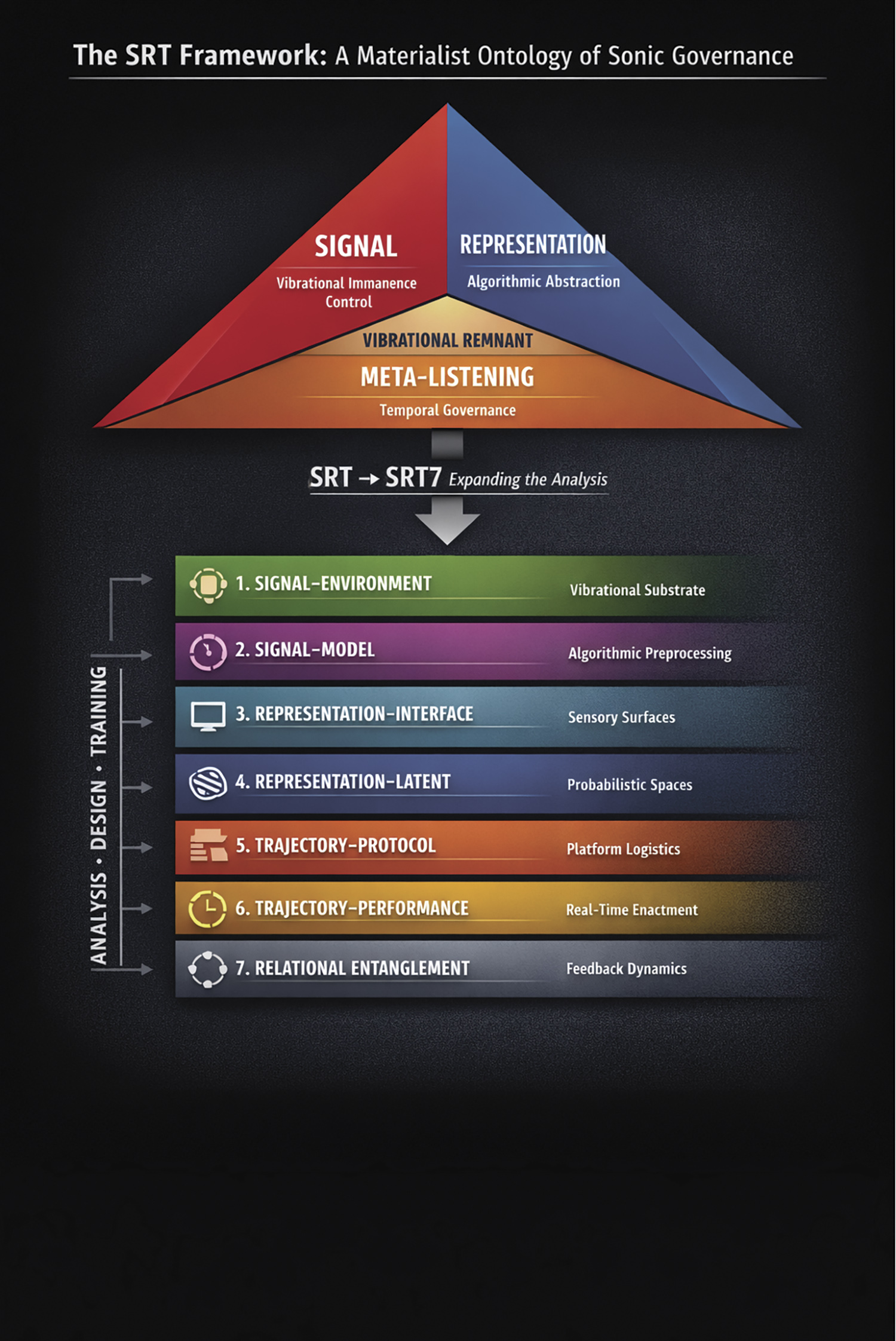
Prevailing analysis of artificial intelligence in music remains trapped at the interface layer, debating aesthetics, agency, or intelligence while failing to engage the core process, the infrastructural re-engineering of listening into an automated, logistical operation. Questions of whether AI can be “creative” or whether it “steals” from artists, while important, obscure a more fundamental transformation: the conversion of listening itself into a programmable, optimizable, and extractable operation. This chapter introduces the Signal–Representation–Trajectory (SRT 4) protocol, a tri-layer schematic for the automated listening stack. SRT bypasses surface hermeneutics to provide a materialist ontology of sonic governance: a forensic toolkit for auditing how vibrational potential is formatted, spectralized, and circulated under computational capitalism. Its ultimate purpose is to operationalize meta-listening, the reflexive praxis of auditing the conditions of audition. Where SRT diagnoses the “stack” (Bratton, 2015, 53), its seven-dimensional expansion (SRT7) navigates its entanglement.
The SRT Protocol: Three Layers of Sonic Governance
The SRT protocol models any sonic event within the computational ecosystem as the output of three co-constituting and recursive layers of governance. Each layer functions as a capture filter for the vibrational remnant, that which escapes, precedes, or exceeds formalization. The political struggle is over this remnant: its extraction and valorization by commercial platforms, or its reclamation and reactivation through counter-infrastructural practice.
Signal: The Grooming of Immanence
- Core Substrate: The raw vibrational continuum voltage, waveforms, bitstreams, electromagnetic flux.
- Governance Operation: Formatting. The reduction of immanence to legible data through codecs, normalization, and bit-depth reduction. These operations enact ontological decisions about what constitutes valid signal versus disposable “noise”. (Sterne, 2012, 99)
- The Remnant: Raw potential, dynamic range sacrificed for loudness, harmonic complexity lost in compression, environmental noise filtered as “artifact”, a regime (Hagood 2019, 148) terms “orphic Media” containment.
- AI Escalation: Formatting becomes predictive grooming. Signals are pre-shaped for machine interpretation and platform interoperability, standardizing the sonic palette at inception.
- Forensic Prompt: Open your primary recording interface. What signal processing occurs before you record a single note? What sonic material is being filtered out as “noise” before you have a chance to hear it?
Concrete Example: When you arm a track in a typical DAW, default settings apply a noise gate, a compressor threshold, and a specific bit-depth. A field recording of wind through trees is immediately normalized to a standard loudness curve; the micro-dynamics that give the recording its spatial depth are flattened before they ever reach your ears.
Representation: The Spectralization of Possibility
- Core Substrate: Interfaces, visualizations, and the latent vector spaces of machine learning models.
- Governance Operation: Spectralization. Vibrational matter is transformed into manipulable abstractions: a piano roll, a spectral graph, a point in a hauntological statistical manifold. Here, ideology becomes operational code.
- The Remnant: The statistical ghost, musical ideas excluded from training data, stylistic correlations the model cannot encode, aesthetic possibilities residing in the null space of latent topology.
- AI Escalation: Representation achieves radical opacity. User-friendly interfaces act as diplomatic fronts for statistical sovereignty, creating a source fetish that reduces agency to selection from pre-formatted options.
- Forensic Prompt: Examine the primary interface of your preferred music software. What musical gestures are impossible to represent? What sounds cannot be visualized? What cultural assumptions about music are encoded in the interface’s default layout?
Concrete Example: A piano roll interface presupposes a chromatic, equal-tempered, grid-based conception of pitch and time. Microtonal intervals, non-linear temporal structures, and gestures that resist quantification (such as the subtle bowing variations in a string performance) are rendered unrepresentable, or require elaborate workarounds that position them as deviations from a norm.
Trajectory: The Protocol of Time
- Core Substrate: Streaming platforms, recommendation algorithms, playlist architectures, social media feeds.
- Governance Operation: Chrononormativity. The governance of audibility-in-time through protocological engines designed for frictionless, predictive flow.
- The Remnant: Temporal singularity, durations and forms resisting algorithmic prediction: unique durations exceeding streaming optima, non-repetitive structures defying playlist logic, silences interrupting predictive flow, compositions refusing verse-chorus architecture. Each constitutes a protocol violation.
- AI Escalation: Trajectory becomes personalized and anticipatory. Recommendation algorithms shape future production through feedback loops that discipline creative choices toward optimized circulation metrics.
- Forensic Prompt: Consider your most recent musical release. How would its structure fare against Spotify’s algorithm? How many seconds of silence does it contain? Does it conform to verse-chorus architecture? What creative decisions were implicitly shaped by anticipating these platform constraints?
Concrete Example: Streaming platforms favor tracks of 2:30 to 3:30 with immediate vocal entries and predictable structural markers. A 17-minute ambient composition with a two-minute intro of near-silence is algorithmically deprioritized; it will appear in fewer playlists, receive fewer recommendations, and consequently circulate less, not because of aesthetic judgment, but because it violates the platform’s protocological logic.
SRT7: Seven Dimensions of Relational Entanglement
In practice, these layers do not operate in isolation, they are recursively entangled. The AI-Chimera emerges from feedback dynamics across all three.
| Dimension | Definition | Diagnostic Question |
|---|---|---|
|
I. Signal–Environment |
Raw vibrational continuum and material conditions |
How does the environment enter the signal chain? |
|
II. Signal–Model |
Machinic formatting and algorithmic preprocessing |
What sonic features are prioritized or discarded? |
|
III. Representation–Interface |
Visual, haptic, and symbolic surfaces of interaction |
What sonic logic does this interface render unthinkable? |
|
IV. Representation–Latent |
Probabilistic spaces of model inference |
What aesthetic possibilities exist in statistical blind spots? |
|
V. Trajectory–Protocol |
Platform-governed pathways |
What circulation paths are optimized or invisible? |
|
VI. Trajectory–Performance |
Situated, real-time enactments |
How does live performance resist platform logics? |
|
VII. Relational Entanglement |
Feedback dynamics through which dimensions I–VI are recursively coupled |
How do decisions in one dimension cascade across others? How does a choice made at Signal (e.g., normalization) reshape possibilities at Representation and Trajectory? |
To analyze this entanglement, we expand SRT into SRT7: Full table at next page. SRT reveals the commercial AI music ecosystem not as a suite of creative tools but as an integrated, automated regime of remnant capture. Artificial intelligence is the crystallized expression of SRT logic: it grooms Signal for machine legibility, manages Representation through opaque latent spaces, and optimizes Trajectory via predictive circulation models. Its primary commercial function is not creativity but the automation of listening itself, the replacement of critical, reflective audition (meta-listening) with predictive, operational processing. SRT is our essential counter-automation: a debugger enabling forensic trace of any sonic artifact back through the infrastructural chain that formed it. This schematic provides the foundational blueprint for tactical misuse, glitch exploitation, and the speculative design of alternative systems.
Deploying SRT: Diagnostics for Meta-Listening
SRT provides three diagnostics that operationalize meta-listening. These are not abstract questions but concrete commands for forensic analysis.
| Diagnostic | Command | Core Question | Application Example |
|---|---|---|---|
| Material Interrogation (Signal) | Audit Signal-Chain | What vibrational materiality has been sterilized or enforced by this signal path? | Analyze LANDR’s mastering chain: identify dynamic range thresholds, EQ curves, and loudness normalization targets that flatten sonic texture |
| Interface Interrogation (Representation) | Map Spectral-Interface | What sonic logic does this interface render unthinkable? | Examine Splice’s interface: which sounds are promoted on the front page, which are buried in search results, and what aesthetic assumptions drive these curation choices |
| Temporal Interrogation (Trajectory) | Simulate Circulation-Paths | What durational choices constitute a protocol violation? | Test how a 7-minute ambient track with no verse-chorus structure performs across Spotify, Apple Music, and Bandcamp; map where it appears and where it is algorithmically silenced |
This is active counter-cartography, using SRT to generate a power map of the sonic landscape, identifying points of capture, ghosts in the machine, and temporal constraints enacted by the automated listening stack.
Navigating Entanglement: From Diagnosis to Intervention
The AI-Chimera emerges not from any single dimension but from their entanglement. Control shifts from direct command to relational modulation: agency becomes tuning relations rather than dominating processes, navigating constraints of training data, model bias, interface affordances, and platform protocols “as the control logic of decentralized and “didtributed networks” (Galloway, 2004, 17). At its limit, the AI-Chimera exhibits systemic autonomy. As algorithmic systems integrate into feedback loops of human decision, environmental data, and platform optimization, the assemblage operates with operational independence, not as an external agent but as an environment that conditions production itself. To navigate it is to practice meta-listening as multi-scalar auditory attention: listening simultaneously to sonic output, algorithmic decision making, environmental modulation, and future trajectorial consequences.
SRT7 functions as diagnostic tool, generative framework, and pedagogical model, training attention to infrastructural listening. This is not mastery but diplomacy within an infrastructural ecology inside the computer environment and networks.
Synthesis: SRT7 as Debugger and Design Tool
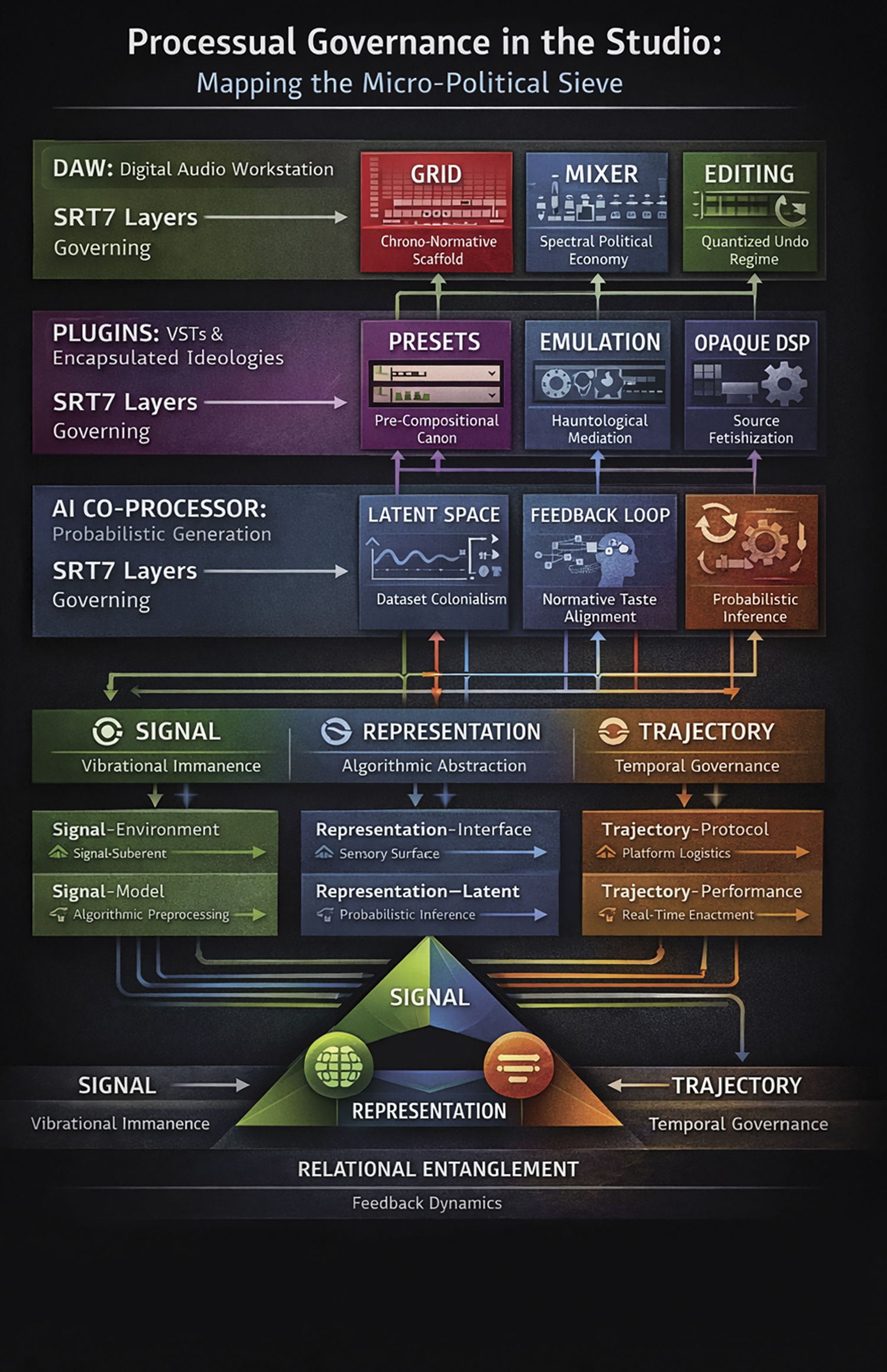
SRT reveals the commercial AI music ecosystem not as a suite of creative tools but as an integrated, automated regime of remnant capture. Artificial intelligence is the crystallized expression of SRT logic: it grooms Signal for machine legibility, manages Representation through opaque latent spaces, and optimizes Trajectory via predictive circulation models. Its primary commercial function is not creativity but the automation of listening itself, the replacement of critical, reflective audition (meta-listening) with predictive, operational processing. SRT7 is our essential counter-automation: a debugger enabling forensic trace of any sonic artifact back through the infrastructural chain that formed it. But its purpose is not merely diagnostic. As subsequent chapters will demonstrate, SRT7 also functions as a generative framework, providing the foundational blueprint for tactical misuse, glitch exploitation, and the speculative design of alternative systems. The instruments and experiments that follow, Atmospheric Hyperinstrument (Paquete, 2025) and Cyberattack Sonifier (Paquete, 2026), are each designed with SRT7 as their blueprint: they reimagine Signal–Environment by substituting musical datasets with environmental and infrastructural data, redesign Representation–Interface for legibility rather than opacity, and refuse Trajectory–Protocol by operating outside platform logics entirely. The AI-Chimera emerges not from any single layer but from their entanglement. Control shifts from direct command to relational modulation: agency becomes tuning relations rather than dominating processes, navigating constraints of training data, model bias, interface affordances, and platform protocols. At its limit, the AI-Chimera exhibits systemic autonomy. As algorithmic systems integrate into feedback loops of human decision, environmental data, and platform optimization, the assemblage operates with operational independence, not as an external agent but as an environment that conditions production itself. To navigate it is to practice meta-listening as multi-scalar auditory attention: listening simultaneously to sonic output, algorithmic decision-making, environmental modulation, and future trajectorial consequences. SRT7 functions as diagnostic tool, generative framework, and pedagogical model, training attention to infrastructural listening. This is not mastery but diplomacy within an infrastructural ecology.
The Processual Studio: A Methodological Circuit and Praxis as Epistemology: The Core Axiom
To dissect the ontological governance of automated listening, this research operates on a core axiom: praxis is epistemology. In the computational studio, theory cannot be merely applied to practice; it must be extracted from and tested against the material resistance of systems themselves. Method is not a container for practice but emerges from it through a designed recursive circuit where making, dissecting, and theorizing are co-constitutive operations. This circuit is architected across three integrated modes. They do not form a linear sequence but a feedback loop: findings from each node continuously inform and refine the others.
Speculative Construction, Building as Inquiry
Speculative construction is the inductive core: the building of sonic systems as epistemic probes. These are not case studies selected to illustrate pre-existing theories but material hypotheses, functional artifacts designed to test what becomes possible when we refuse dominant paradigms. Two art projects, integrating performance, software, and hardware, serve as the primary artifacts of this mode: Atmospheric Hyperinstrument (Paquete, 2025–ongoing) asks: What auditory relations become possible when we bypass dataset hauntology and listen-with environmental metabolism? The instrument sonifies real-time atmospheric data, CO2 concentration, particulate matter (PM2.5), collected via open APIs and local sensor networks. It integrates custom hardware, generative sound synthesis, multichannel spatialization, and live vocal performance.

Titled Atmospheric Metabolism 5, this performance transforms the air within a space into an instrument and sensory interface, establishing a living metabolic system between body and technology where the atmosphere itself becomes the primary medium. System Architecture: The work operates on two primary data streams: (1) CO2 concentration from the respiration of all participants in the performance space, and (2) the acoustic input of the performer’s voice and breath. This data is processed in real-time, creating a feedback loop between audience, performer, and environment. CO2 functions as a core parameter, directly shaping the evolving soundscape and lighting across compositional stages, potential, friction and saturation, driven by the audience’s collective metabolic activity.
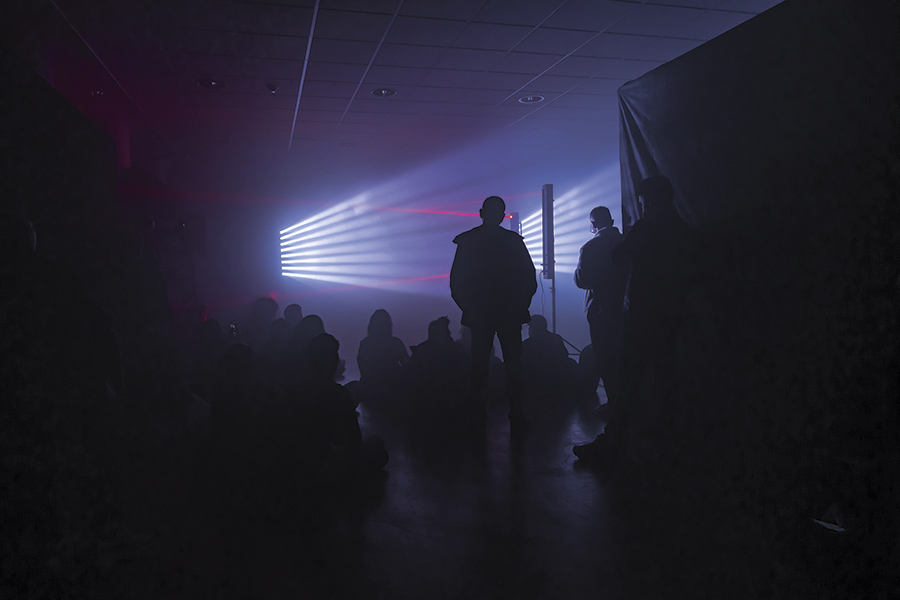
Critical Interaction: The audience’s participation is involuntary yet fundamental; they complete the circuit. This transforms the work into a collective microclimate, an immersive essay on ecology and interdependence. The audience’s participation is involuntary yet fundamental; they complete the circuit. CO2 concentration is captured as MIDI data and processed through Google’s Magenta AI to generate rhythmic and sonic elements that reintegrate into the performance. The public thus becomes not passive witness but active co-composer: their breath becomes compositional material, their collective metabolic activity rendered audible through AI-driven generation. Shared responsibility for the climate becomes a visceral, embodied, collective experience..

Speculative Construction, Rendering Infrastructure Audible
Cyber Attack Sonifier: Glitch Ecology (Paquete, 2026) is a software prototype developed in Python that turns its attention to the invisible violence of digital infrastructure. The instrument asks: How can we render audible the constant, often unnoticed attacks that constitute the background condition of networked life?
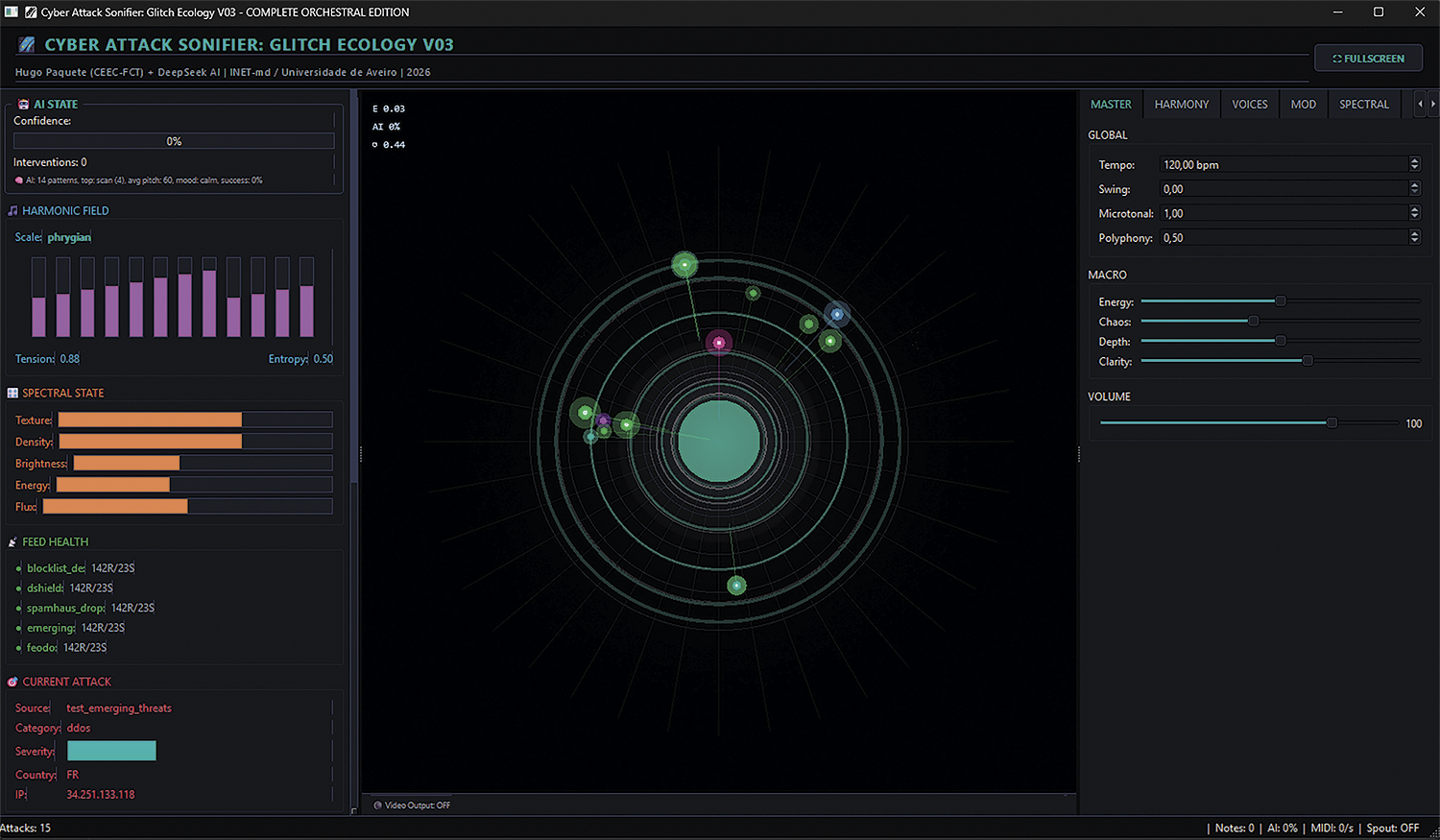
The work operates on the premise that sonification can function as political revelation. Cyberattacks, port scans, exploit attempts, data breaches, occur continuously across global networks, yet they remain perceptually inaccessible to all but specialized security professionals. By transforming attack patterns into sonic and visual form, the instrument makes this hidden violence available for embodied, affective apprehension.
The Cyber Attack Sonifier monitors real-time cyberattack data from threat intelligence APIs, including Shodan, GreyNoise, AbuseIPDB, and VirusTotal and transforms attack patterns into generative “AI music” (Fernando et al., 2024), performative behavior, and dynamic visualization.
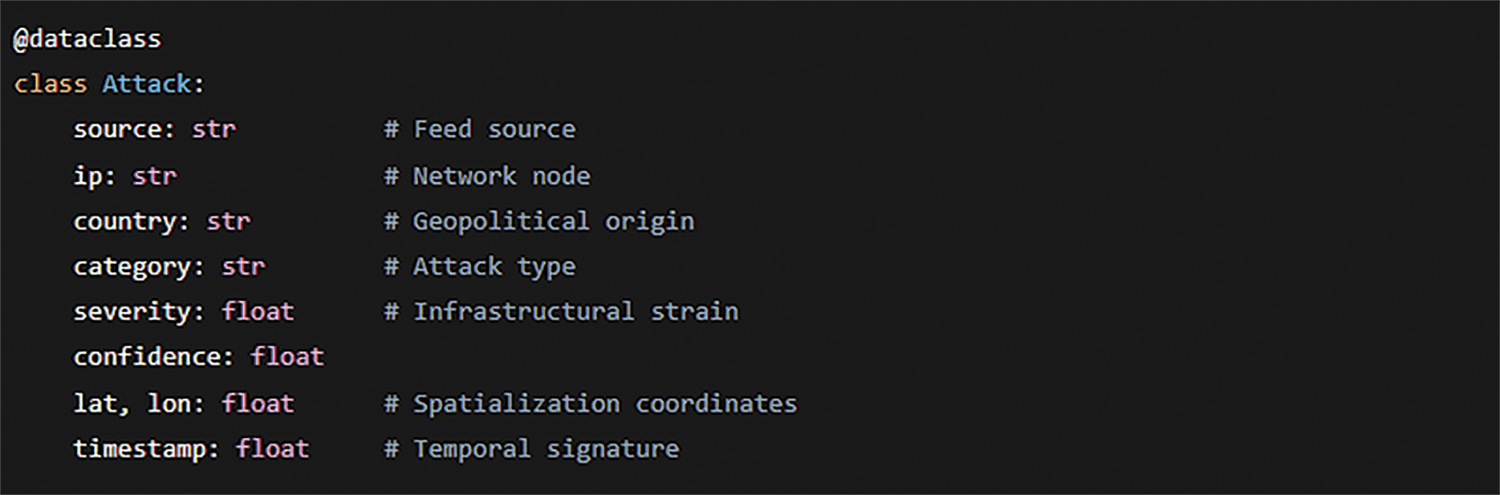
Each attack is captured as a dataclass preserving its geographical, temporal, and categorical specificity: The instrument employs an AI engine to extract features density, regularity, severity, trend that shape a dynamic harmonic field, stochastic rhythm engine, and expressive MIDI output. Unlike commercial threat intelligence platforms that prioritize threat severity for security operations, the Cyber Attack Sonifier inverts this logic through its PriorityAttackQueue:

Anomaly detection is operationalized through the AttentionEngine, which calculates rarity across country, category, and source:
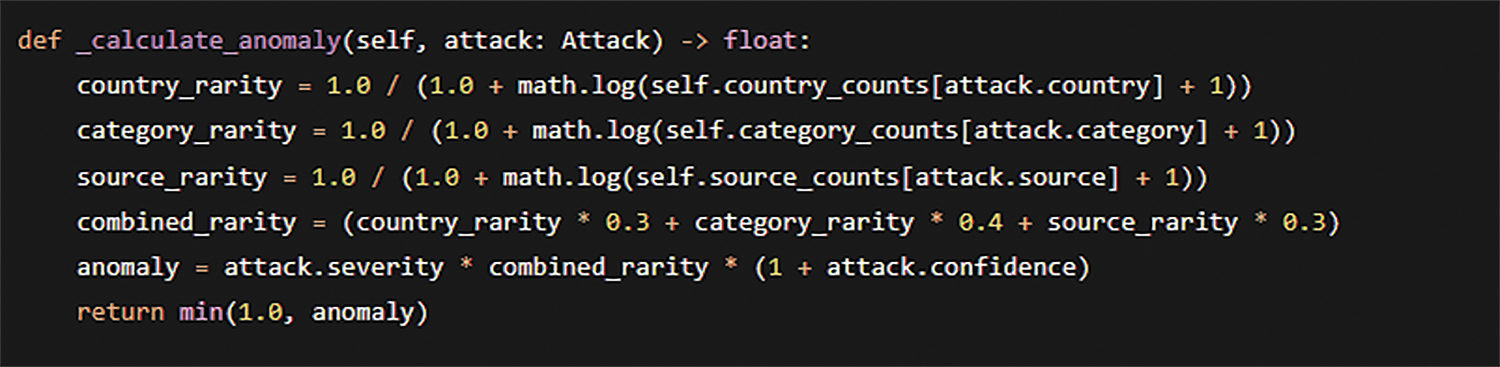
This algorithm prioritizes what deviates from statistical norms, amplifying the vibrational remnant that infrastructure is designed to suppress.

The system listens not for what is predictable, but for what escapes prediction. Within the SRT7 framework, this inversion operates at the level of Signal–Model: where commercial AI grooms signal for predictable outcomes, the Cyber Attack Sonifier amplifies anomaly as the vibrational remnant itself.
A reactive circular map visualizes attack geography and intensity, rendering visible the geopolitical topology of digital conflict. The instrument also features a PersonalityEngine that governs emotional evolution, with mood, valence, and arousal emerging from the entanglement of attack patterns:

When a rare attack from an uncommon geographical origin occurs, the system responds with heightened harmonic tension and microtonal clusters, amplifying what would otherwise be filtered out as statistical noise. The instrument thus functions as a counter-infrastructural probe: not a tool for security, but an epistemic device for listening to the stresses, failures, and exclusions that constitute the digital condition.
Synthesis: Shared Principles
Both instruments operationalize critique through functional design. They privilege non-musical, real-world datasets over stylistic musical corpora, constituting direct infrastructural interventions against extractive AI paradigms. The concepts developed in this work, the AI-Chimera and the SRT7 framework, are not pre-existing lenses applied to these artifacts. Rather, they are traces left by practice: abstractions that crystallized through the phenomenological friction of navigating the hybrid assemblages we built. In this sense, the practice operates as what McKenzie Wark (2004, 24) terms the “hacker class, producer of new abstractions”, not merely using existing systems, but generating new conceptual tools from the material resistance of the systems themselves.
From this recursive circuit, four methodological principles emerge
I. Theory as Trace: Concepts emerge from practice, not prior to it. The AI-Chimera and SRT7 are not frameworks brought to the work but abstractions crystallized through the friction of navigating hybrid assemblages. Theory is what practice leaves behind.
II. Failure as Data: System breakdowns reveal governing assumptions. The Cyber Attack Sonifier’s initial sonic chaos exposed feature extraction as a site of governance. The Atmospheric Hyperinstrument’s inconsistent data polling revealed temporal formatting as a political operation. Failures are not errors to be eliminated but discoveries to be interpreted.
III. Legibility as Design Value: Systems designed for meta-listening render their operations perceptible. Both instruments prioritize legibility: Atmospheric Hyperinstrument through spatialization, light, and fog; Cyber Attack Sonifier through GUI panels displaying AI parameters. This demonstrates that opacity is not a technical necessity but a design choice that can be refused.
IV. Diplomacy over Mastery: Agency within computational assemblages is negotiated, not commanded. The meta-listener does not master the system but cultivates the capacity to listen across distributed agencies to environmental metabolism, to algorithmic inference, to platform protocols, to the feedback loops that bind them.
Learning Through Failure
The construction process was neither linear nor smooth. Failures proved as generative as successes. The first iteration of the Cyber Attack Sonifier attempted to sonify all attack data simultaneously, every IP address, every port scan, every exploit attempt rendered as concurrent sonic events. The result was sonic chaos: a dense, unintelligible mass that flattened the very patterns we sought to reveal. This failure revealed that the model’s feature extraction, not the data itself, was the primary site of governance. The final instrument prioritizes legibility through selective feature extraction (density, regularity, severity, trend) precisely because this failure exposed how automated listening already operates: by deciding, before we hear anything, what counts as signal. A parallel discovery emerged from the development of the Atmospheric Hyperinstrument. Its first prototype suffered from inconsistent data polling intervals. CO2 readings arrived at irregular intervals, creating unpredictable gaps in the sonic output. Rather than solving this as a technical bug, we recognized it as a discovery: temporal formatting is itself a site of governance. The instrument’s final design embraces these gaps as moments of silence that foreground the infrastructure of sensing itself. Within the SRT7 framework, these failures reveal governance at the level of Signal–Model where feature extraction pre-formats what counts as signal and Signal–Environment where temporal formatting conditions when “sound creation” (Dubnov & Greer, 2023) can emerge, dimensions where commercial AI preemptively formats sonic possibility before human audition begins.
Forensic Deconstruction: Dismantling as Analysis
If speculative construction builds otherwise, forensic deconstruction dismantles what is. This mode adopts a critical “media-archaeological stance” (Parikka, 2012), treating commercial platforms not as neutral tools but as archaeological sites where governing logics are sedimented in code, interface, and user flow. Tools including LANDR (2019), Splice (2026), and Suno (2026) are reverse-engineered not for their source code but for the ideologies embedded within their operational logic. Their user flows, parameter constraints, and default settings are analyzed as “cultural techniques” (Siegert, 2015,13) operations that groom desire, format creative possibility, and pre-structure the conditions under which sound becomes music. The SRT7 framework is deployed in its diagnostic mode, providing the schema for forensic meta-listening: an audit of how each platform captures the vibrational remnant at the level of Signal, spectralizes it in Representation, and disciplines it through Trajectory.
Concrete Forensic Observations
LANDR: The platform’s default mastering chain applies aggressive loudness normalization, EQ curves optimized for streaming platforms, and dynamic range compression that prioritizes “competitive loudness” over sonic texture. The forensic question. What vibrational materiality is sterilized by this signal path? Reveals that micro-dynamics, transient detail, and frequency content falling outside streaming-optimized profiles are systematically suppressed. The user is never presented with these trade-offs; they are rendered as objective “mastering” rather than aesthetic decisions. Within SRT7, this operates at Signal–Model and Representation–Interface, where technical operations are naturalized as neutral service.
Splice: The interface privileges loop-based production through its primary navigation: sounds are organized by genre, mood, and instrument type, presented as discrete, commodifiable units. The search algorithm promotes sounds that conform to current genre conventions. The forensic question. What sonic logic does this interface render unthinkable? Reveals that non-loop-based structures, sounds resisting genre categorization, and compositional logics not conforming to the “collection-of-parts” model are systematically marginalized. The platform trains its users to hear music as an assemblage of pre-fabricated components. This spectralization of time into discrete assets exemplifies Representation, Interface governance, where the interface actively constitutes the user’s musical imagination.
Suno: The prompt-based interface invites users to describe desired outputs in natural language. Behind this user-friendly surface lies a latent space trained on vast, unaccountable musical corpora. The forensic question. What aesthetic possibilities reside in the null space of latent topology? Reveals that any musical style, instrumentation, or structure underrepresented in the training data, or statistically averaged into invisibility, becomes a statistical ghost. Prompt engineering becomes a form of hauntological diplomacy: negotiating with statistical ghosts for outputs that may not exist in the model’s learned correlations. Within the SRT7 framework, Representation–Latent governance achieves radical opacity, masking statistical sovereignty behind what Galloway (2012, vii) terms the “interface effect”, the way interfaces mediate perception while rendering their own operations invisible.
Relational Framing: Synthesis as Reframing
The raw data from construction and deconstruction are synthesized through specific theoretical apertures that reframe the stakes. These framings function not as dogmatic impositions but as lenses that reveal different dimensions of the infrastructural condition. Posthumanist Framing dissolves the anthropocentric subject, allowing analysis of the AI-Chimera as a distributed assemblage where agency is a relational effect, not a human property. As N. Katherine Hayles argues, “when humans and cognitive technical systems interact, they form cognitive assemblages that distribute cognition across multiple agents” (Hayles, 2017, 23).This framing emerged from material necessity: during performances of Atmospheric Hyperinstrument, unexpected feedback loops between audience respiration and CO2 data produced sonic outcomes no single agent, performer, audience, or machine had intended. Posthumanism provided a vocabulary for describing what we were already experiencing: that creativity emerges from the entanglement of heterogeneous actants rather than the intention of a sovereign author, as a “meta-creativity” (Navas, 2023). Political-Philosophical Framing locates the struggle within computational capitalism, framing the “listening stack” as an apparatus of “designs politics” (Bratton, 2015, 86), attention extraction and chrononormative control. This framing sharpened our analysis of platforms like Splice and Suno, revealing how their interfaces do not merely enable creativity but actively discipline it toward platform-optimized outcomes. The forensic observation that Splice promotes genre-conforming loops while burying the anomalous became legible as a form of statistical sovereignty: the platform positions itself as sovereign over the aesthetic possibilities it curates, extracting value from users while rendering the terms of that extraction opaque.
Recursive Integration: How the Circuit Operates
The three nodes form a recursive circuit, not a linear sequence. The following examples trace how findings circulate.
From Deconstruction to Construction
Forensic analysis of Splice’s interface revealed how loop-based interfaces spectralize time into discrete, commodifiable units, each loop a standalone asset, independent of temporal context. This finding directly informed the design of Atmospheric Hyperinstrument’s temporal architecture: a continuous, non-loop-based system where time is shaped by environmental metabolism rather than grid-based segmentation. The instrument has no “loops,” only evolving responses to real-time data, a direct refusal of the spectralization logic identified in commercial platforms.
From Construction to Framing
The first performance of Atmospheric Hyperinstrument revealed unexpected agency in the audience. As attendees breathed and moved through the space, CO2 concentrations fluctuated in ways that directly modulated the sonic output. The audience became co-producers whether they intended to or not. This material experience sharpened our posthumanist framing, moving it from abstract theory to practical necessity: if agency is distributed, then the author-performer-audience distinction is not merely a theoretical position but a technical condition that must be designed for.
From Framing to Deconstruction
The refined posthumanist framing prompted a second round of forensic analysis. If agency is distributed across human and non-human actants, how do commercial platforms manage, and monetize, this distribution? This question led to the concept of statistical sovereignty, now central to our analysis of Representation–Latent. Platforms like Suno do not merely provide tools; they position themselves as sovereign over the latent spaces they control, extracting value from users while rendering the terms of that extraction opaque. The concept of statistical sovereignty emerged from this recursive loop, demonstrating how theory itself can be a product of practice.
Methodological Principles
From this recursive circuit, four transferable principles emerge:
I. Theory as Trace
Concepts emerge from practice, not prior to it. The AI-Chimera and SRT7 are not frameworks brought to the work but abstractions that crystallized through the friction of navigating hybrid assemblages. Theory is what practice leaves behind, a sedimentation of material experience into conceptual form.
II. Failure as Data
System breakdowns reveal governing assumptions. The Cyber Attack Sonifier’s initial sonic chaos exposed feature extraction as a site of governance. The Atmospheric Hyperinstrument’s inconsistent data polling revealed temporal formatting as a political operation. Failures are not errors to be eliminated but discoveries to be interpreted, epistemic events that make visible what normally remains invisible.
III. Legibility as Design Value
Systems designed for meta-listening render their operations perceptible. Both instruments prioritize legibility: Atmospheric Hyperinstrument through sound spatialization, light, and fog; Cyber Attack Sonifier through GUI panels displaying AI parameters. This demonstrates that opacity is not a technical necessity but a design choice, one that can be refused in favor of systems that support critical reflection rather than automated compliance.
IV. Diplomacy over Mastery
Agency within computational assemblages is negotiated, not commanded. The meta-listener does not master the system but cultivates the capacity to listen across distributed agencies, to environmental metabolism, to algorithmic inference, to platform protocols, to the feedback loops that bind them. This reframes creative practice as relational diplomacy rather than sovereign authorship.
Conclusion: Towards an Ethics of Auditory Attention
This investigation has traced a fundamental ontological shift in sonic culture: from listening as a human-centric act of reception to listening as an infrastructurally mediated operation that shapes the very conditions of vibrational immanence. The computational studio has evolved from a tool into an infrastructure that pre-structures auditory thought, a transformation that demands new modes of analysis, new forms of practice, and new ethical frameworks.
The Regime of Automated Anti-Listening
Through the lens of the SRT7 framework, commercially deployed AI is revealed not as a creative revolution but as a regime of automated anti-listening, a logistical governance that industrializes the vibrational remnant, converting auditory attention into predictable, platform-ready assets.

At the level of Signal, AI grooms vibrational immanence for machine legibility, standardizing sonic palettes at inception through predictive formatting. At Representation, it spectralizes creative possibility into hauntological latent spaces, masking statistical sovereignty behind user-friendly interfaces. At Trajectory, it disciplines audibility-in-time through personalized recommendation algorithms that shape future production via feedback loops optimized for circulation metrics. The forensic deconstruction of platforms like LANDR, Splice, and Suno reveals the material consequences of this regime: micro-dynamics flattened by aggressive loudness normalization; non-loop-based structures marginalized by interface design; musical styles underrepresented in training data rendered as statistical ghosts. These are not mere technical constraints but political operations, decisions about what counts as signal, what aesthetic possibilities are rendered thinkable, what durations are permitted to circulate.
The Counter-Praxis of Meta-Listening

Against this regime, we have theorized and operationalized meta-listening as the essential counter-praxis. Meta-listening is not an aesthetic stance but a political faculty, a reflexive auditory praxis that audits the conditions under which listening itself is mediated, governed, and automated. It operates through three diagnostic commands: material interrogation (auditing signal chains), interfacial interrogation (mapping what interfaces render unthinkable), and temporal interrogation (simulating circulation paths).
Each is a form of counter-cartography: generating power maps of the sonic landscape, identifying points of capture, ghosts in the machine, and temporal constraints enacted by the automated listening stack. The methodological circuit of speculative construction, forensic deconstruction, and relational framing demonstrated that meta-listening is not merely diagnostic but generative.
The two counter-infrastructural instruments, Atmospheric Hyperinstrument and Cyber Attack Sonifier: Glitch Ecology, materialize an alternative: they privilege non-musical, real-world datasets over stylistic musical corpora; they render latent spaces legible rather than opaque; they refuse platform logics entirely, circulating through embodied performance rather than algorithmic optimization.
The AI-Chimera: A Relational Hyperobject
The AI-Chimera emerged from this practice as a theoretical operator adequate to its object. It names the assemblage that emerges from the intra-action of human meta-listening, algorithmic audition, software protocols, and environmental sensing confronted with systems of automated anti-listening, is neither a tool nor an autonomous intelligence but a relational system whose outputs materialize through negotiations across heterogeneous layers of perception, computation, and circulation. Its characteristics are now specified:
- Non-unitary agency: Agency redistributed across human and non-human actants; decisions emerge from feedback loops that exceed individual cognition.
- Relational emergence: The AI-Chimera materializes through configured relations between training data and model architecture, between interface design and user behavior, between platform protocols and creative practice.
- Systemic autonomy: At its limit, the AI-Chimera operates not as an external agent but as an environment that conditions production itself.
- Hyperobject characteristics: Following, it is viscous (adhering to everything it touches), non-local (distributed across time and space), temporally undulating “operating at scales that exceed human perception” (Morton, 2013), and phantasmal (resisting direct apprehension).
The experiments materialize these characteristics. Atmospheric Hyperinstrument reveals the AI-Chimera expanding beyond computational systems to include planetary processes, CO2 as metabolic trace, atmosphere as co-performer. Cyber Attack Sonifier reveals the AI-Chimera operating in digital infrastructure, attack patterns, feature extraction, and generative response entangled in feedback loops that exceed any single agent’s control. Together, they contribute to emerging “sound practices with AI” (Civit et al., 2022), demonstrating how speculative listening can redistribute agency and cultivate posthuman auditory sensibilities beyond extractive paradigms.
Four Methodological Principles in the Loop
From this recursive circuit, four transferable principles emerge, each reframing creative practice within computational assemblages:
I. Theory as Trace
Concepts emerge from practice, not prior to it. The AI-Chimera and SRT7 are not frameworks brought to the work but abstractions crystallized through the friction of navigating hybrid assemblages. Theory is what practice leaves behind, a sedimentation of material experience into conceptual form.
II. Failure as Data
System breakdowns reveal governing assumptions. The Cyber Attack Sonifier’s initial sonic chaos exposed feature extraction as a site of governance; the Atmospheric Hyperinstrument’s inconsistent data polling revealed temporal formatting as a political operation. Failures are not errors to be eliminated but discoveries to be interpreted, epistemic events that make visible what normally remains invisible.
III. Legibility as Design Value
Systems designed for meta-listening render their operations perceptible. Both instruments prioritize legibility: Atmospheric Hyperinstrument through spatialization, light, and fog; Cyber Attack Sonifier through GUI panels displaying AI parameters. Opacity is not a technical necessity but a design choice, one that can be refused in favor of critical reflection over automated compliance. This refusal is, in Galloway’s terms, a “counter-protocological” (Galloway, 2004, 142) gesture: resisting the protocological control that governs circulation, interface, and visibility within computational capitalism.
IV. Diplomacy over Mastery
Agency within computational assemblages is negotiated, not commanded. The meta-listener does not master the system but cultivates the capacity to listen across distributed agencies, to environmental metabolism, algorithmic inference, platform protocols, and the feedback loops that bind them. Creative practice becomes relational diplomacy rather than sovereign authorship.
Together, these principles form the foundation for a posthuman creative practice: one that treats theory as emergent, failure as generative, legibility as political, and agency as distributed. They guide the design of counter-infrastructural instruments and inform the synthesis of the AI-Chimera as a relational hyperobject.
The Stakes: Architectures of Auditory Attention
The central site of struggle has shifted. It is no longer primarily about the content of sound but about the architectures of auditory attention themselves. What is at stake is not merely what we hear but our capacity to hear, to perceive the complex, multi-scalar vibrations of the worlds we inhabit and co-create. This demands:
- Legibility as foundational principle: Auditory infrastructures must render their operations perceptible and contestable. Opacity is not a technical necessity but a design choice that can be refused.
- Accountability as relational ethics: Distributed agency demands distributed accountability. New models are needed, adequate to the hyperobject characteristics of the AI-Chimera, requiring transparency about training data, model architecture, and platform integration.
- The auditory commons as horizon: The ultimate horizon is the construction of an auditory commons: a vibrational ecology organized not around extraction and valorization but around shared access, collective stewardship, and ecological responsiveness.
An Invitation to Build Otherwise
Within this speculative horizon, sound ceases to be a representation of the world and becomes a medium for its ethical recomposition. The laboratory of speculative listening is open, its instruments tuned not to scales but to sensitivities, relations, and interdependencies. The Atmospheric Hyperinstrument and Cyber Attack Sonifier are not final statements but prototypes, one instrument among many. Future prototypes will sonify network packet data, energy grid telemetry, satellite positioning trajectories, each testing different dimensions of infrastructural manifestation, each cultivating new modes of posthuman listening. The AI-Chimera is not a threat to be managed but a condition to be inhabited a field of relations to be designed, contested, and reconfigured in the service of auditory futures yet unimagined. The question is no longer what machines will compose but what we, collectively, will learn to hear, and what worlds our listening will help bring into being.
The Constructive Imperative
- Architect legible, accountable relational fields where SRT7 dimensions remain perceptible and contestable
- Cultivate auditory literacy through practices that train meta-listening as shared capacity for ethical intra-action
- Build more prototypes, each testing new modes of manifesting infrastructure, new relations between human and machine perception
- Institutionalize the auditory commons, fostering vibrational commons over extractive attention economies
The future of sonic practice belongs neither to heroic control nor nostalgic resistance but to the careful cultivation of hybrid ecologies where automated listening is neither opaque nor totalizing. It belongs to the meta-listener who learns to inhabit, navigate, and reconfigure the infrastructural conditions of sound, composing not only with audio but with the politics of listening itself.
Acknowledgments
The author acknowledges the institutional support of INET-md (University of Aveiro) and Absonus Lab: Sonic Research, Technology and Culture. The Cyber Attack Sonifier: Glitch Ecology prototype was developed in collaboration with DeepSeek AI (2026); the Atmospheric Hyperinstrument was developed with support from the Periphera Festival (Trafaria, Portugal, 2025), where the work was first presented. Both instruments are prototypes within the research program AI as Catalyst: Transformative Impacts on Digital Performance, Computer Music, and Cultural Creativity (2026–2029), led by Hugo Paquete and funded by the Foundation for Science and Technology (FCT) under the CEEC-FCT Individual Contract at INET-md, University of Aveiro. The program investigates the transformative role of artificial intelligence in digital performance and computer music, developing the concept of the AI-Chimera as a framework for understanding hybrid human-machine creativity. The author is an Integrated Researcher at INET-md (CPAR: Creation, Performance, and Artistic Research) and acknowledges the intellectual community and research environment provided by CPAR throughout the development of this work.
Funding
This work was funded by national funds through FCT – Fundação para a Ciência e a Tecnologia, I.P., under the project UID/00472 – INET-md: Institute of Ethnomusicology – Center for Studies in Music and Dance, and supported by the scholarship 2024.09158.CEECIND associated with the research programme AI as Catalyst: Transformative Impacts on Digital Performance, Computational Music, and Cultural Creativity, developed at INET-md.
Contact
paquetehugo@gmail.com / www.hugopaquete.com
Endnotes
1 Hugo Paquete. P.h.D
2 Meta-listening (Paquete, 2015) designates a reflexive auditory praxis that interrogates the conditions under which listening is mediated, governed, and automated. It operates as both diagnostic auditing signal chains, interfaces, and platform protocols and as counter-infrastructural practice: cultivating auditory attention capable of detecting normalization across signal processing, interface design, and trajectorial circulation.
3 Automated anti-listening is the central critical concept diagnosing how commercially deployed AI transforms auditory culture. It designates a political condition: the systematic replacement of critical, reflective audition with predictive, operational processing. Listening becomes an infrastructural operation performed by algorithms that analyze, predict, and normalize before human audition begins. The vibrational remnant, sonic excess escaping formalization, becomes the primary site of extraction and valorization as platform asset. Automated anti-listening operates across SRT7: at Signal (predictive grooming), Representation (radical opacity masking statistical sovereignty), and Trajectory (chrononormative discipline optimizing for algorithmic circulation). Against this regime, meta-listening is theorized as essential counter-praxis.
4 The Signal–Representation–Trajectory (SRT) protocol audits sonic governance across three layers: Signal (formatting), Representation (spectralization), and Trajectory (chrononormativity). Its seven-dimensional expansion, SRT7, adds Signal–Environment, Signal–Model, Representation–Interface, Representation–Latent, Trajectory–Protocol, Trajectory–Performance, and Relational Entanglement, capturing distributed agency in hybrid assemblages.
5 Atmospheric Metabolism was performed on November 14, 2025, at the Periphera Festival, Trafaria, Portugal.
Bibliography
Bratton, Benjamin. 2015. The Stack: On Software and Sovereignty. Cambridge, MA: MIT Press.
Civit, Miguel, Javier Civit-Masot, Francisco Cuadrado, and María J. Escalona. 2022. “A Systematic Review of Artificial Intelligence-Based Music Generation: Scope, Applications, and Future Trends.” Expert Systems with Applications 209: 118–190.
Dubnov, Shlomo, and Ross Greer. 2023. Deep and Shallow: Machine Learning in Music and Audio. 1st ed. New York: Chapman and Hall/CRC.
DeepSeek AI. 2026. DeepSeek: AI Assistant and Research Platform. https://www.deepseek.com.
Fernando, P., T. V. Mahanama, and M. Wickramasinghe. 2024. “Assessment of Human Emotional Responses to AI–Composed Music: A Systematic Literature Review.” In International Research Conference on Smart Computing and Systems Engineering (SCSE), 7:1–6. IEEE.
Galloway, Alexander R. 2004. Protocol: How Control Exists After Decentralization. Cambridge, MA: MIT Press.
Galloway, Alexander R. 2012. The Interface Effect. Cambridge: Polity Press.
Google Magenta. 2024. Magenta: Music and Art Generation with Machine Learning. https://magenta.tensorflow.org.
Hayles, N. K. (2017). Unthought: The power of the cognitive nonconscious. University of Chicago Press.
Hagood, Mack. 2019. Hush: Media and Sonic Self-Control. Durham: Duke University Press.
LANDR. 2019. Automated Music Mastering Platform. https://www.landr.com.
Morton, Timothy. 2013. Hyperobjects: Philosophy and Ecology After the End of the World. Minneapolis: University of Minnesota Press.
Navas, Eduardo. 2023. The Rise of Metacreativity: AI Aesthetics After Remix. London: Routledge.
Paquete, Hugo. 2015. “Meta-escuta: Objeto-sonoro espectro, imanência vibrátil e resto cognitivo” [Meta-listening: Spectral sound-object, vibratile immanence and cognitive remnant]. In Dispositivos na prática artística contemporânea #2 [Devices in contemporary artistic practice #2], edited by E. Neves, 29–59. Vila Nova de Famalicão: CEAA: Centro de Estudos Arnaldo Araújo.
Paquete, Hugo. 2025. Atmospheric Metabolism. Performance. Periphera Festival, Trafaria, Portugal, November 14.
Paquete, Hugo. 2026. Cyber Attack Sonifier: Glitch Ecology. Software prototype. Python. Www.hugopaquete.com
Parikka, Jussi. 2012. What Is Media Archaeology? Cambridge: Polity Press.
Sterne, Jonathan. 2012. MP3: The Meaning of a Format. Durham: Duke University Press.
Siegert, Bernhard. 2015. Cultural Techniques: Grids, Filters, Doors, and Other Articulations of the Real. Translated by Geoffrey Winthrop-Young. New York: Fordham University Press.
Splice. 2026. Sample Library and Music Creation Platform. https://splice.com.
Suno. 2026. AI Music Generation Platform. https://suno.ai.
Wark, McKenzie. 2004. A Hacker Manifesto. Cambridge, MA: Harvard University Press.