Abstract
The question of time is central to Christopher Nolan’s films — Following (1998), Memento (2000), and Tenet (2020). Nolan often uses ‘time’ as a central narrative device in his films through non-linear storytelling. We use the cognitive theory of relevance to examine Nolan’s varied use of temporal deconstruction to build his cinematic narratives. He creates a dynamic of suspense through an extreme temporal deconstruction produced through film editing. This affects cognition and emotion with an experiential dimension, as it shares the protagonist’s mental state with the viewer. In Following, the editing methodically deconstructs and reorganises the plot through constant temporal leaps. The theme of manipulation is addressed through an extreme deconstruction of temporal linearity. The viewer, manipulated by the director, then shares the protagonist’s mental confusion. In Memento, Nolan challenges structural conventions, with the plot (the order in which events are recounted) beginning at the ends of the fabula (the chronological order of events in the story) and concluding in the middle. In Tenet, the question of time is addressed at both the narrative and the cinematic levels. Time reversibility is illustrated by a visual style that employs rewind footage. Nolan continues to deconstruct and reconstruct the fabula through thought experiments that invite, manipulate, coerce, and even deceive the viewer into participating in the unraveling of the plot. Thus, the anagnorisis is no longer an observable element of the story, but rather a subjective experience for its audience.
Keywords: Christopher Nolan, Temporal Deconstruction, Fabula, Contemporary Complex Cinema, Film Editing.
Introduction
“I’ve always felt that form should embrace content—and vice versa. The two must intertwine, merge… I’m not trying to have a style; I’m looking for a narrative form that encompasses both the information I want to convey and the way in which that information will be conveyed.” (Golhen 2023).
Christopher Nolan (1970–) is an English filmmaker known for directing demanding mainstream films such as Memento (2000), Inception (2010), Tenet (2020), and Oppenheimer (2023). As a storyteller, his works have earned accolades from both the audience and critics. He is one of the few filmmakers working in Hollywood’s current era of remakes, reboots, and sequels who is making original blockbusters that are both critically and commercially outstanding. His works have been touted as visionary, cerebral, psychological, and even philosophical. “Christopher Nolan, as a philosophical filmmaker, is elusive, almost enigmatic. Starting out as a maker of indie films… he has gone on to helm large-budget superhero movies… historical movies… and science fiction” (Robbie 2021). His stories span genres and historical time frames, and even chart into the 4th dimension, as seen in Interstellar (2014). However, in almost all his films, one thing remains constant: the narrative importance of time.
“Scholarship on Christopher Nolan’s filmography consistently frames him as a philosophical auteur whose works interrogate the limits of time, agency, and epistemology” (Anti and Rosalinah 2025, 904). We thus propose that these plays on time through montage at the level of form are all the more effective because they are not perceived as mere stylistic mannerisms but, on the contrary, because they draw upon deep structures in our relationship to time. Content and form thus find their coherence. These deep structures are transformed into narrative matrices, which, in turn, generate the form. Our contribution falls more specifically within the tradition of analysing Christopher Nolan’s cinema, such as Öksüzoğlu, Elsaesser, and Steffen Hven. For example, Öksüzoğlu (2023) draws on psychoanalytic theory to illuminate the possible parallels between mental processes (such as memory, attention, and imagination) and cinema. Elsaesser (2017) introduces the concept of the “mind-manipulating film,” defining it by twelve specific characteristics.
Hven (2015) draws on cognitive theories of narrative to show how narrative understanding is co-constituted through bodily affects and emotional responses in what the author calls the embodied fabula:
The embodied fabula reminds us that storytelling is a dynamic process rooted in our bodily experiences when we interact with the cinematic material… The main challenge was to integrate the bodily and affective dimensions of the spectator’s role as constitutive elements of the fabula, and not simply as effects of our cognitive-inferential appropriation of the narrative. As a result, the film highlights the inferential nature of cognition and perception, and thus considers the spectator as an active participant in the construction of narrative meaning, rather than a mere passive recipient. (Hven 2015, 102)
Theoretical Framework
We use the complexity theory of embodied fabula as it pertains to the cinema of Christopher Nolan. Steffen Hven notes that Memento (2001) “stands out as one of the most vivid representatives of a contemporary body of films that have challenged the long-dominant opposition between classical Hollywood storytelling and the tradition of (European) ‘art cinema’” and refers to Kovács’s discussion of this issue (Hven 2017, 7). He presents a retinue of films, including Run Lola Run (1998), Being John Malkovich (1999), the Korean film Oldboy (2003), and Nolan’s later film Inception (2010), among others, as “contemporary complex cinema” (Hven 2017, 9). Hven argues that, “to better comprehend contemporary complex cinema in its own terms, the formulation of a new mode of spectatorship that enhances cinematic perception by allowing spectators to ‘embody’ the narrative universe is required” (Hven 2017, 9).
This reminds us of Deleuzian film philosophy, which states that cinema as an art form is its own medium, and the moving images of this medium can create meaning that is not present in other narrative texts.
It is the automatic image of movement, and not narrative what distinguishes cinema from other visual arts like painting and photography, where movement can be suggested but is not really present in the image. Cinema also distinguishes itself from theatre or dance where movement is anchored in and dependent of the body of the actor or dancer. The cinematic image is the first image capable of producing automatic and autonomous movement, which is not anchored in a subject, or seen from a fixed point that functions as viewpoint. The cinematic image does not represent movement but moves itself. (Huygens 2007)
As Deleuze articulates, “cinema does not give us an image to which movement is added, it immediately gives us a movement-image” (Deleuze 1989, 1). Cinema is not so much an object to be understood, but by dint of its moving pictures, something to be felt. This same feeling of experiencing a film as opposed to merely watching it is what Hven refers to in his analysis of Memento.
[Memento] has become a site for rethinking the complexity of the cinematic medium. In particular, this chapter is interested in exploring how the film facilitates a renewed conceptualization of two concepts: the fabula and defamiliarization. This requires a re-examination of the complex interplay between the film’s linear and non-linear dimensions, which I maintain is constituted in a reconfiguration of the feedback loops of the cognitive, emotional, and affective registers. It is with reference to Memento’s narrative feedback loops that the logic of the embodied fabula finds its clearest cinematic expression. (Hven 2017, 22)
We also deploy Hven’s theory of ‘contemporary complex cinema’ to analyse Following, Nolan’s first film, and Tenet, which not only uses the deconstruction of the fabula to create the complexity in the narrative but also introduces the dimension of “inversion” (Tenet, 2020), where objects and people move both forward and backward in time.
Film Analyses
Following (1998)
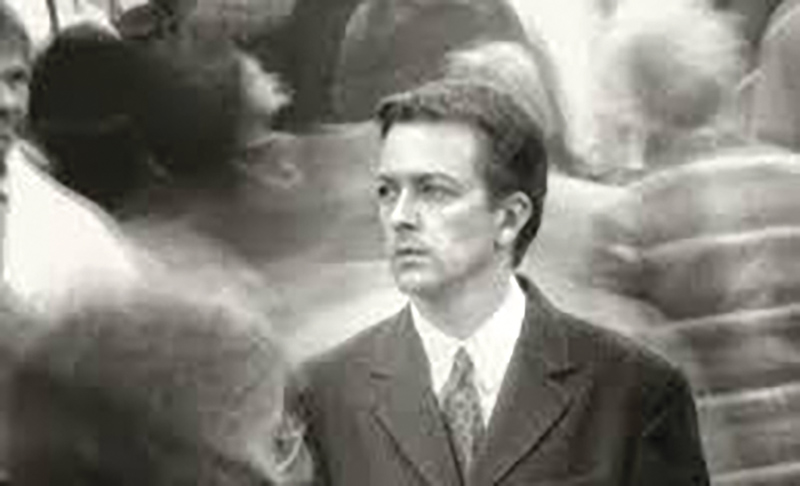
Following (1998) is Christopher Nolan’s first feature film. Set in London, it recounts the misadventures of an aspiring writer who, for the sake of a hypothetical novel project, follows strangers in the street. This activity will prove to be a dangerous game.
The film’s originality lies in the fact that this cinematic experience is built upon a temporal deconstruction of the story, which structures a new timeline composed of shocks and reconstructions. By playing to the extreme on the gap between fabula (the chronological order of events in the story) and plot (the order in which the events are recounted), as well as on discrepancies employing phenomena of anagnorisis (the belated discovery of a truth) and metabasis (the reversals of perspective generated by anagnorisis), the filmmaker provokes a sense of astonishment in the viewer. This forces them, in a state of cognitive disjunction, to re-examine the meanings of the story just presented, all while continuing to follow the film’s relentless flow of information.
Synthesis of the film
Through this experience of deconstructed time, the filmmaker plays on the viewer’s memory and their reconstruction of the fabula, producing narrative effects of a new kind. Indeed, the film’s emotional journey builds to a crescendo of persistent confusion, starting with increasingly stark inconsistencies and culminating in a state of shock that leaves the viewer completely disoriented. The film features five characters: Bill (the follower), Cobb (the burglar), the wife, the husband, and the detective. Only the first two have names.
Four temporal markers are organized around Bill’s appearance, acting as clues that allow the viewer to become aware of the temporal deconstruction of the narrative carried out by the director:

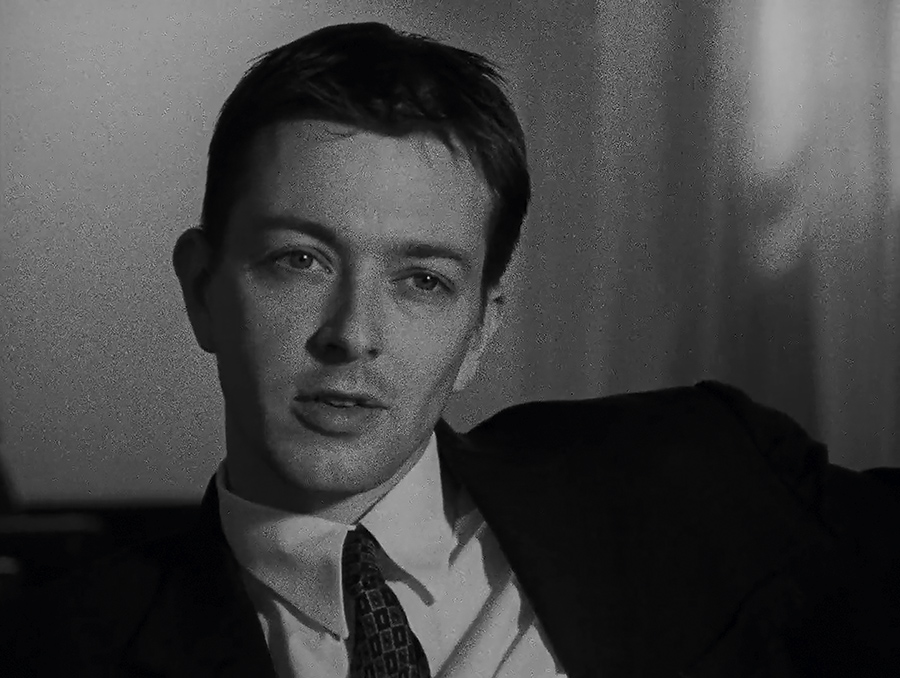
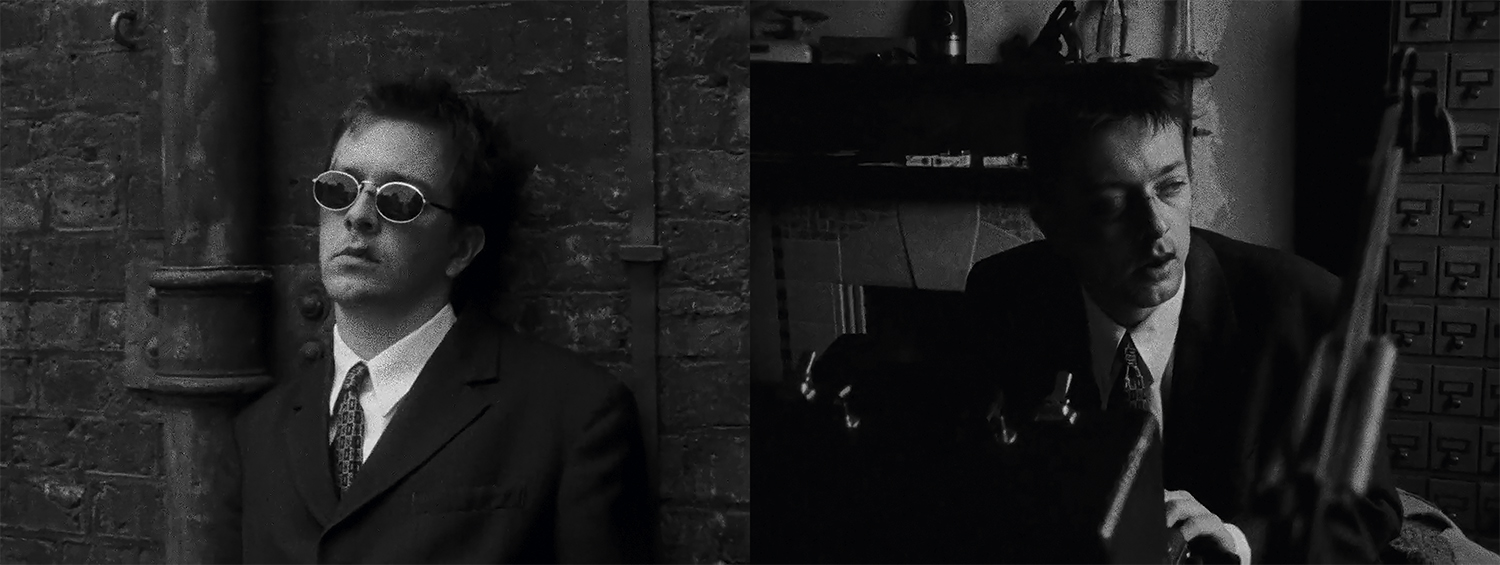
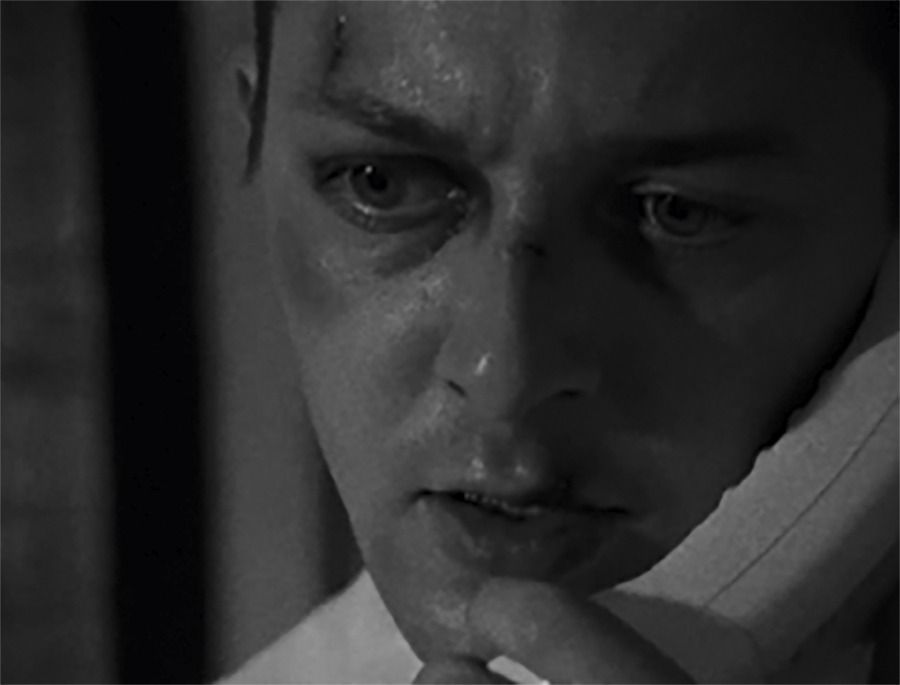
The story is narrated by the main character’s (the follower’s) voice-over, the very one being manipulated, in a long flashback that resolves in the present day at a police station, where Bill recounts his story to the detective in charge of the investigation. According to Michel Chion (2003), the voice-over carries the weight of truth. He suggests that the voice-over is reminiscent of parents whispering a bedtime story into a child’s ear. It is the voice of the one who knows how the story ends. The exact opposite of Christopher Nolan’s use of voice-over in his film is the main character caught up in the events, his desires, and the multiple manipulations. The voice-over here is not that of truth but that of appearances, lies, and manipulation. But, as is often the case in cinema, we were forewarned: the film’s truth is indeed stated in the very first line of the opening sequence by Bill’s voice-over: “What follows is my version of events, or rather, my account of what happened.”
The truth, therefore, emerges in Bill’s confrontation with the commissioner, from the shift in perspective. The viewer does not identify with the protagonist (despite the voice-over) but with the commissioner who seeks to reconstruct the truth. The film’s brilliant irony, however, lies in the fact that the commissioner, in his search for truth, only ends up constructing a new narrative, the one imagined by Cobb, making him the ultimate victim of manipulation in the story. The only one who, in the end, will not have access to this much sought-after truth.
The “Russian doll” effect (nesting) is fully at play; it is in the commissioner’s pronouncement of what he believes to be the truth (actually Cobb’s narrative) that both the protagonist and the viewer simultaneously discover the ultimate truth (the nested nature of the manipulations) since they possess information that the commissioner lacks.
The film consists of fifty-five scenes. The editing methodically deconstructs the story’s temporality by completely reorganising the plot through constant temporal jumps. The temporal reconstruction of the fabula would yield this sequence of scenes: 2, 10, 11, 12, 13, 19, 24, 1, 25, 32, 33, 34, 35, 42, 4, 16, 5, 14, 15, 20, 21, 26, 27, 28, 29, 30, 36, 37, 39, 40, 6, 7, 8, 18, 22, 23, 31, 38, 41, 43, 44, 46, 48, 50, 52, 3, 9, 45, 47, 49, 51, 53, 54, 55. These scenes could then be grouped by the number of scenes that follow the chronological order, thus giving...: 1, ((4, 1, 1, 1, 1), (4, 1, 1, 1, 1)), ((2, 2), 5, (2, 2), 3), ((1, 2), (1, 1), (1, 2)), (1, 1, 1, 1, 1, 1, 1, 1, 1, 1), 3.
A first look at the numerical structure of the temporal organization reveals a pattern that repeats twice at the beginning of the film (4, 1, 1, 1, 1) and a long corridor of ten scenes that do not follow chronological order (1, 1, 1, 1, 1, 1, 1, 1, 1, 1). The first pattern establishes a certain continuity (with four consecutive scenes), which is then disrupted by a series of four scenes without continuity. The long final corridor establishes an extreme deconstruction with ten consecutive scenes lacking temporal continuity, thus producing a climax of maximum astonishment.
In addition to this extreme deconstruction of time, one can note an untimely use of cuts (between shots) in the sound: a technique that allows the viewer to anticipate the next shot by letting the sound of the upcoming shot be heard in the previous one. The future then intrudes, in a way, into the present of the shot being shown.
Memento (2000)
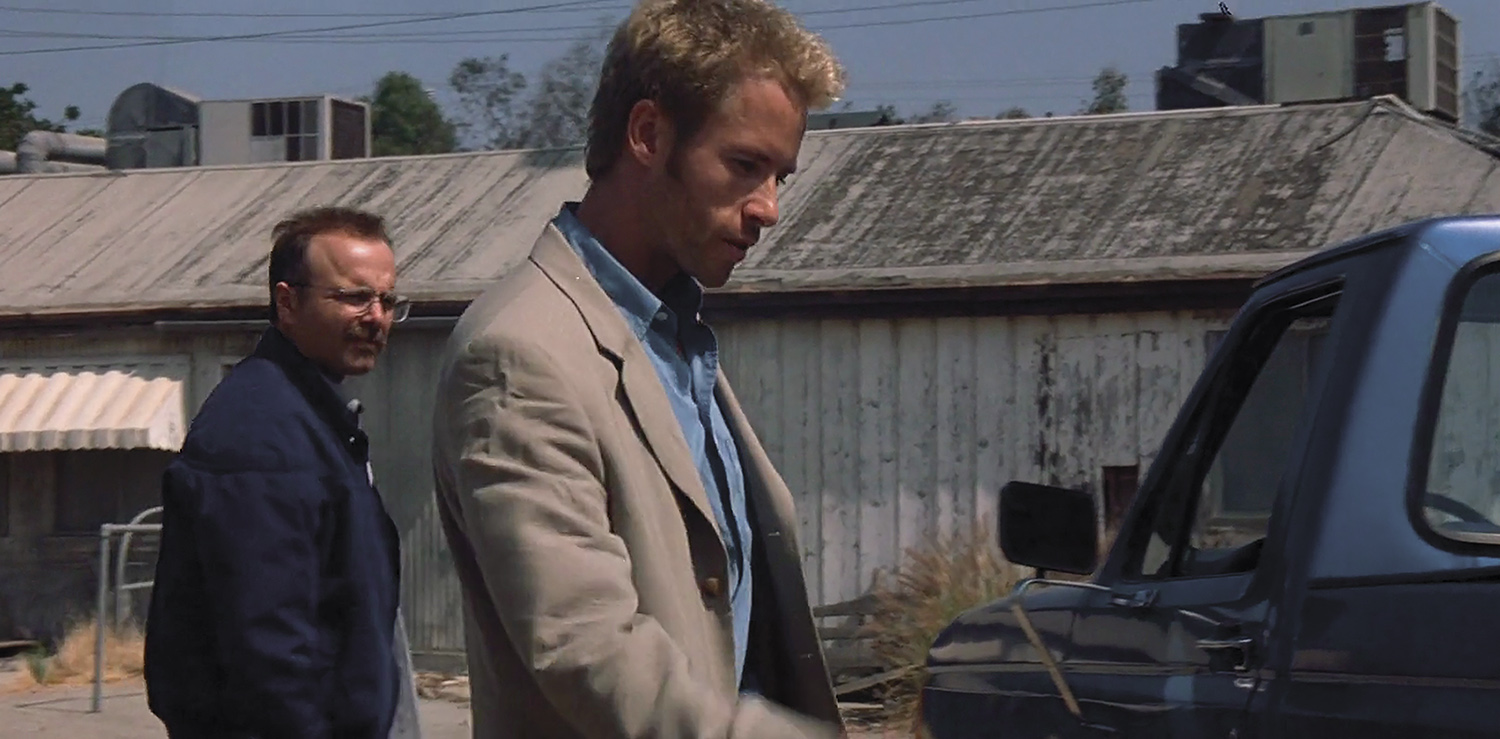
Memento (2000) tells the story of a man seeking revenge on his wife’s murderer. This premise is common across world cinema, where a man seeks revenge for his dead loved ones, especially a woman. The premise of Memento is similar to the rape-revenge thrillers that have been popular since the 1960s in Hollywood. However, what sets Memento apart is that it is not just a thriller, but a psychological thriller. Two aspects particularly highlight this distinction. First of all, the main character, Leonard Shelby, played by Guy Pearce, suffers from anterograde amnesia, a condition that prevents him from making new memories. This not only makes the hunt for the murderer of his wife more frustrating, but also poses the challenge that even if he gets his revenge, he will not be able to remember it.
This latter aspect is revealed dramatically in the film’s final act, where we, as the audience, learn that Leonard has achieved his revenge a year before the events of the film even started. The tragedy of the story is drawn from the fact that Leonard is now revealed to be an amnesiac serial killer who unknowingly manipulates himself into continuing his hunt for the murderer.
This means he does not remember that he has already taken revenge, has reached his goal, but he starts all over again. On the one hand: a neat paradox, perfect for tying the viewer into hermeneutic knots, but on the other hand, such a looped narrative also emulates or promotes a certain spectator engagement, namely insofar as Leonard’s over and over action in Memento resembles that of a gamer – but also of an addict. (Elsaesser 2017, 22)
The above content finds its match in form in the way Christopher Nolan arranges the film’s fabula. The opening scene is viewed in reverse (a technique that would become central to Tenet a few years later). Half the scenes are in color, the other half in black and white, thus emphasising the various shifts in time.
While it might appear confusing, this perplexity is key to how Nolan seeks to engage his audience. “Memento compels its viewers to be more engaged with linear reasoning than most classical Hollywood narratives” (Hven 2015, 94). The attempt to piece together the plot from the fabula is what makes Memento a cerebral experience for the audience. As Elsaesser explains,
A film like Memento also goes quite radically against our sense of chronology and causality, and again, the challenge is to figure out that even if we get used to part of the narrative being told backwards, while another part moves forward, there is still the question: where does the film’s action actually begin, and why is it constructed as a loop? (Elsaesser 2017, 22)
The reverse chronology is both simple as a concept and complex in the context of the phenomenological aspects of watching a film. In his book, The Fictional Christopher Nolan (2012), Todd McGowan articulates this confusion as a deception designed by the filmmaker. The very first line of the book is, “The lie plays a central role in every Christopher Nolan film” (McGowan 2012, 1). McGowan goes on to explain how, in each of his films, Nolan is hiding something crucial from the audience, and this deceit is central to his storytelling. “The typical Nolan film has the formal structure of a lie designed to deceive the spectator concerning the events that occur and the motivations of the characters” (McGowan 2012, 1).
As an example of this lie, McGowan writes about the opening scene of Memento,
The opening of Memento (2000) shows Leonard Shelby (Guy Pearce) shooting Teddy (Joe Pantoliano) for the murder of his wife… Leonard’s narration leads the spectator to believe that he has discovered that Teddy is the murderer of his wife. At the conclusion of the film, however, it becomes evident that Teddy did not murder Leonard’s wife. (McGowan 2012, 2)
This reversal is sacrosanct to the film’s deceit. This ‘twist’ creates a sense of gradual anagnorisis for the audience, in which they confront this deceit not as a revelation but actively participate in its unraveling. The audience becomes the detective trying to discern the lies from the truth, and Leonard Shelby no longer remains the relatable protagonist but turns into an object of the investigation.
The cerebral experience of the film, where the audience is compelled to rearrange the order of events as they watch, also has psychological effects that linger long after they finish watching the film. Nolan has admitted to the open-ended nature of the film’s ending.
The point of the ending is the storytelling in that we bring the audience to a place, like the protagonist, where they have to decide or believe about certain events… I didn’t want to put my interpretation of the film above other interpretations that are out there (Slayer767 2012)
This open-ended ending allows viewers to engage in their own readings of the film. This kind of participation in the film’s understanding is what makes it such a unique offering for the audience. However, certain scholars argue that the impact is not just limited to that. Öksüzoğlu argues that *Memento* derives much of its emotional and psychological impact from its complex narrative structure:
Memento was very successful because Christopher Nolan captured the scary extent of the human mind’s complexity and its unconsciousness. Through complex narrative structures, he created associations between audiences’ unconsciousness and negative emotions of repression and stress associated with it, such as helplessness, fear of having no purpose, misjudgment, or unfair treatment. (Öksüzoğlu 2023, 319)
Öksüzoğlu here speaks of the alignment of the audience with Leonard Shelby’s frustration at being unable to remember what needs to be remembered. Leonard’s internal struggles are not at all a point of character growth as Syd Field suggests in his many books on screenplays and the three-act structure of storytelling. In Memento, the protagonist’s inner struggles are challenged by his inability to make new memories and to move beyond the time of his personal tragedy, once again tying back to Nolan’s usage of time as a narrative tool. As the director explores the character’s frustrations, the negative emotions come to the fore. Even his actions at the end of the film are driven by these negative emotions and inadequacies. One particular reading can suggest that he manipulates himself into forgetting that his revenge is accomplished, to continue giving himself a sense of purpose. This is exactly the tragedy that makes the film so seminal.
To convey to the viewer the protagonist’s state of mental confusion, condemned to live in an eternal present, the editing is constructed around the concept of time loops. The same sequences recur multiple times over varying durations. Like Russian nesting dolls, the loops fit within larger loops, creating a layered structure of time loops.
Andy Klein, in his article Everything You Wanted to Know About Memento (2001), lists the number of scenes in the film as well as the relational arrangement between the fabula and the plot:
If we give letters to the backward color scenes and numbers to the monochrome scenes, then what Nolan presents us with is this: Credits, 1, V, 2, U, 3, T, 4, S, 5, R, 6, Q … all the way to 20, C, 21, B, and, finally, a scene I’m going to call 22/A, for reasons I’ll explain in a minute. What is beautifully clever here is that black-and-white scene 22, the last sequence in the film, almost imperceptibly slips into colour and, in an almost vertiginous intellectual loop, becomes (in real-world order) scene A, the first of the colour scenes: This then serves as the link between the forward progression of black-and-white material and the backwardly presented color stuff. (Klein 2001)
The temporal structure Nolan employs here is clearly visible. While in Following the director sought to deconstruct the fabula to the extreme, in Memento, it is a careful reconstruction; the film starts at the beginning and at the end, and reaches its climax right in the middle. This final revelation shows us that the main character is exploiting his own amnesia to endlessly replay his quest for revenge. As Nolan explains:
It was mapped out in the script stage. The film was always conceived that way… You referred to the film as non-linear, but in fact, it’s very linear, just in reverse chronology. Because of the way the film is presented, you really can’t remove any scenes. (Slayer767 2012)
The meticulous restructuring of the plot and the symmetrical presentation of its fabula are unparalleled in their impact on the audience’s psyche and in their experimentation with storytelling.
Tenet (2020)
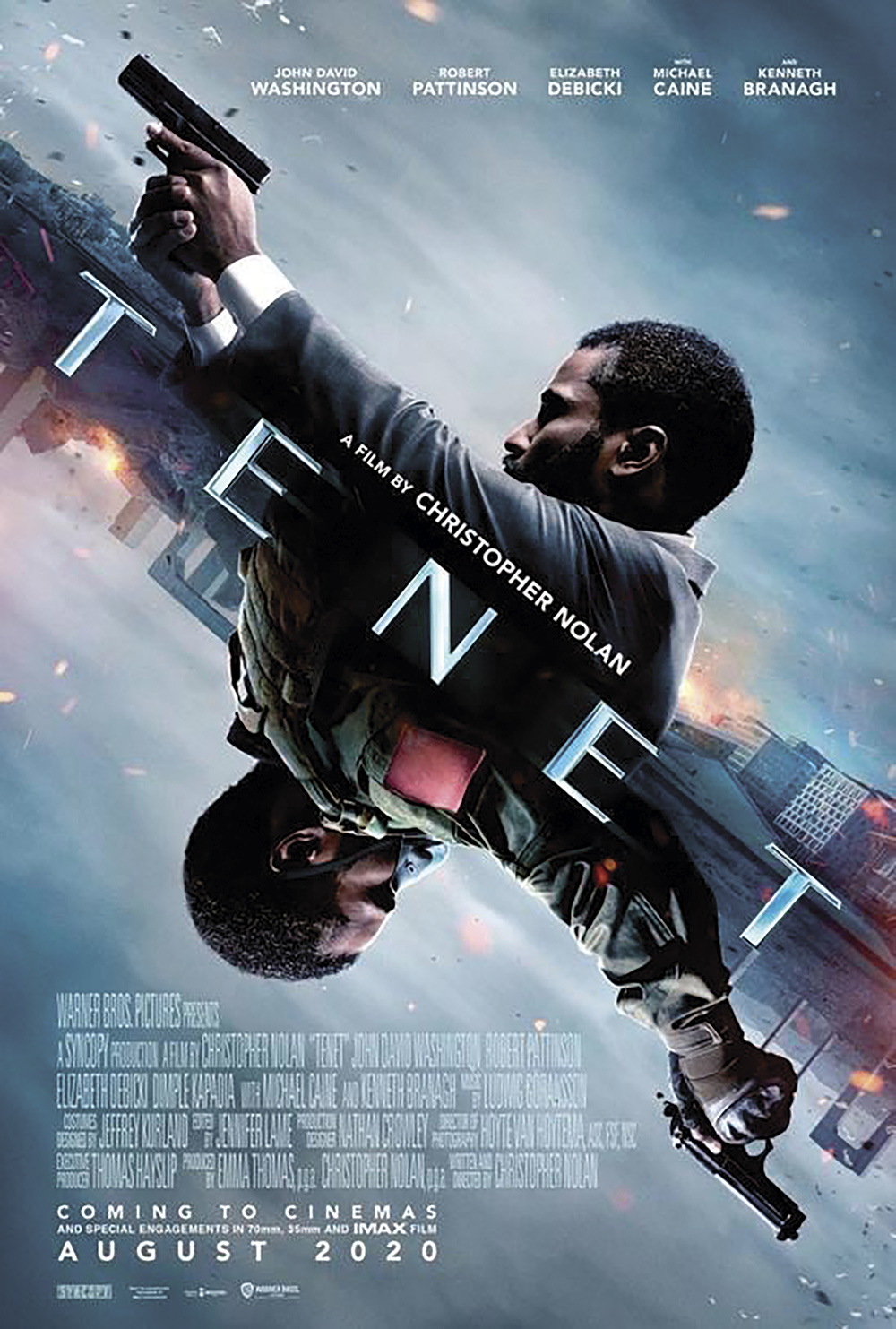
Unlike Following and Memento, both of which were made at the beginning of Christopher Nolan’s career, Tenet was released in 2020, during the height of the worldwide COVID-19 pandemic. At this point, Nolan had not only created the well-received The Dark Knight trilogy (2005, 2008, 2012), but had also made original blockbusters in the 2010s, a phenomenon that had become rare by this particular era in Hollywood that mostly witnessed big-budget cinema to be only driven by existing intellectual properties, e.g., Marvel, DC, Star Wars, etc. Nolan’s Inception (2010), Interstellar (2015), and Dunkirk (2017) were all commercial successes with multiple Academy Award nominations. In the two decades following Memento, Nolan moved from independent low-budget ventures to high-budget genre films. “We witness complex narrative structures being transformed to resemble more classical narrative storytelling” (Virginás 2019, 32).
It is at this time that he decided to make his most unconventional film. Arguably the most complex film analysed for this article, Tenet is “indeed an attempt at creating a Bond-like spy thriller with a temporal twist” (Singh 2023, 3). The film explores the idea that the arrow of time, as the palindromic title and poster already suggest, can flow in both directions: from past to future and from future to past.
This principle is illustrated on two levels: the visual and the narrative. On the visual level, Nolan literally reverses the direction of projection in certain scenes. On the narrative level, the film’s two protagonists travel through history in both directions simultaneously, crossing paths in several scenes. This phenomenon is named inversion in the film. “Unlike conventional time travel, inversion renders causality bidirectional, allowing effects to precede their causes. This mechanism is not merely a narrative device but a philosophical provocation” (Anti and Rosalinah 2025, 904).
Tenet has a complex and non-linear narrative structure that intentionally obscures and manipulates the viewer’s understanding of time and events. This means Nolan incorporates the concept of unreliable narration through time inversion, dual protagonists, multiple layers of reality, misleading information, non-linear storytelling, character motivations, and audience engagement. (Curuţiu and Indolean 2024, 108-09)
The two layers of reversal set Tenet apart from Nolan’s previous works, where it is not just the fabula that is deconstructed, but the perceived flow of time is challenged.
This development of ‘type 2’ reversal in T allows Nolan to create disorientating effects using differently composed architectonic planes of content. Hence, by the second half of the film, the appreciator comes to the ‘catastrophic’ realisation that they are re-watching scenes from the first half. Now, however, they view from the perspective of the time-reversed main protagonist as they swim, as it were, against the standard one-way flow of irreversible time (risking encounters with their normal entropic other self). The protagonist does not simply go back in time but goes forward in a time now shown in reverse direction. (Stenner and Zittoun 2026, 135)
The arrow of time is altered for objects or people whose entropy is reversed; the effect of an event precedes its cause. However, the film’s premise is not simply time travel, but rather a parallel unfolding of two opposing timelines. A person traveling back in time can therefore interact with elements that modify both their past and their future. “Tenet’s bullet, blasting back into the Protagonist’s (John David Washington) revolver, is unlike Memento’s –– only aesthetically motivated –– reversed gunshot. Tenet’s inverted bullet is part of the diegetic possibilities that the fiction’s fantastical physical laws allow. In such a dystopian reality, scientists invent the ability to reverse entropy in objects and in people” (Kiss 2023, 88).
This phenomenon, called “temporal pincers” (with the aid of a technical device called a “temporal turnstile”), allows two versions of the same person to coexist in the same scene when the two timelines meet.
Several examples of this phenomenon are present in the film:
- At 30:30, Katherine (wife of the antagonist Sator, brilliantly portrayed by Kenneth Branagh) stands on the deck of her pleasure boat with her husband and son and sees a woman dive into the sea. This woman is none other than herself, who, in a later scene (much later at 2h18), flees the boat after killing her husband.
- At 45:30, in an iconic scene, the unnamed protagonist fights a version of himself from the future.
- In the gigantic final battle of the last part of the film, two teams of soldiers fight simultaneously but in reversed timelines. One team, moving from the past to the future, is informed of the battle’s outcome by the other team, moving from the future to the past.
Finally, the name of the film’s antagonist (Sator) is laden with meaning. It explicitly references the magic square known as the “Sator Square,” containing the Latin palindrome SATOR AREPO TENET OPERA ROTAS, meaning “The plowman skillfully guides the wheels with the plow,” or more symbolically, “The creator maintains the work of rotation.”
These five five-letter words are arranged in a square that allows them to be read in any orientation. Thus, each of the five words is repeated four times, making them readable both horizontally and vertically.
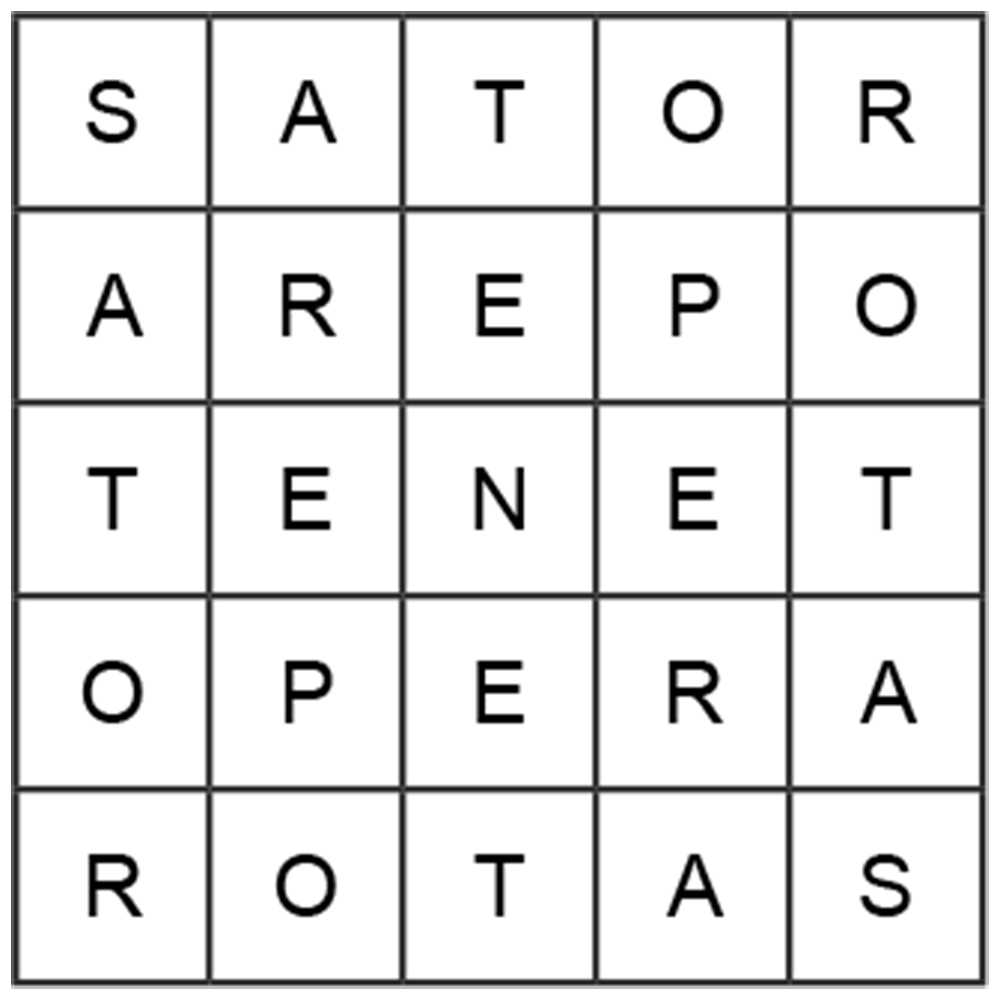
SATOR is the name of the film’s antagonist, AREPO is the name of the forger who sold the fake Goya to Katherine (Sator’s wife), TENET (besides the film’s title) is the name of the organization the protagonist will create to fight in the future, the attack on the Kiev OPERA House is the film’s opening scene, and ROTAS is the name of Sator’s private company.
Let’s look more closely at how all of this is staged. From the opening credits, it’s noticeable that some musical elements are played backward. After that, the film keeps reintroducing reverse time in many scenes across its runtime:
- At the 6-minute mark, the first inverted time effect is presented: the opening scene of the attack on the Kyiv Opera House, where a pistol shot that makes a hole in the leg of a seat is shown in reverse.
- At 13:00, we see a scene in which a scientist explains the phenomenon. After a pseudo-philosophical dialogue about time, the scientist gives the viewer the actual instructions: “According to you, you caught it (the bullet), according to her, you dropped it… Don’t try to understand, just feel it.”
- 44:30, we see traces of unfired bullets on a glass partition separating two spaces in the room containing the “time machine” (a reference to the attack on the Kiev Opera House at 6 minutes).
- 45:30, a lengthy fight scene unfolds as the protagonist faces an opponent (later revealed to be his future self). Several movements of the fight are shown in reverse, resulting in an unusual and compelling martial arts choreography.
- At 48:15, the protagonist explains to his teammate that this is a time war and that technology allows him to reverse the entropy of objects, creating an inverted timeline.
- 49:30, a dialogue between the protagonist and the woman, who will be revealed as his leader, explains that it’s a time war from the future and that Sator is an ally of the attackers.
- 1:13:00, a long car chase unfolds, with several elements presented in reverse-chronological order. We hear radio messages in Estonian played backward.
- 1:24:00, Sator splits into two by passing through a window, and the entire previous scene is replayed in reverse. The hero is saved by the Tenet brigade’s intervention.
- 1:26:30, the officer explains the temporal dynamics to him (50% of Sator’s team advances, then attacks in reverse, revealing the end of the scene).
- 1:29:40, Briefing by the soldier who describes the outside world as being completely inverted (not just the weather but the temperature: “Fire covers you with ice”).
- 1:31:00, The protagonist steps into the inverted world: birds fly upside down, footprints resolve.
- 1:34:00, The protagonist’s double recovers the plutonium. It’s interesting to note that it’s impossible to recognize the double at normal speed (visible only in freeze-frame), which suggests that Nolan is trying to convey information on a subliminal level.
- 1:50:00, Interrogation of the protagonist in the “time turnstile” room on the other side (in inverted time). Sator is holding his wife, Katherine, at gunpoint. On one side of the glass pane, Sator speaks in reverse Estonian; on the other, we hear his voice in English, slightly out of sync with the original.
- 02:06:22, Gigantic battle scenes. The two teams fight in opposite directions in an incredible scene in which a building is being simultaneously destroyed and rebuilt in reverse time.
Tenet, like Memento, ends with a “mise en abyme” in the final revelation: the protagonist comes from the future, where he created the Tenet brigade to save humanity. He arrives in the film’s timeline to try to alter the future by fighting Sator. He is ultimately the true instigator of the entire story and the real leader of this mission.
Time loops, loops within loops, flashbacks, the coexistence of multiple timelines within a single scene — Christopher Nolan has never gone so far in the complexity of the story and its presentation. This is especially true since the story is built on the notion of time paradoxes, whose very nature is that they are inaccessible to reason; they are inherently incomprehensible.
Hence, the numerous warnings throughout the film:
“Don’t try to understand, feel.”
“This is a time war.”
“We are under attack from the future.”
“If you kill your grandfather in the past, how can you be born?”
“We can’t understand it with reason because these are paradoxes, but it’s okay not to understand.”
“If you knew it was us, why didn’t you say so? What’s done is done. If I had told you, you could have acted differently.”
“Don’t get in the helicopter if you can only think linearly.”
(Tenet 2020)
Tenet puts forward these theories without scientifically fitting them, but uses them more as a pretext to fascinate. First, to fascinate cinematically—by rhythm-montage, by rhythm idea, by rhythm-thought; then to fascinate structurally—fitting the facts together, seemingly randomly. It is difficult for an untrained eye to extract a clearly stated intention on a first viewing. (Curuţiu and Indolean 2024, 108)
Thus, the extremely complex form of the enunciation serves a content that is by nature inaccessible to comprehension. The film’s ultimate paradox would be to present such a singular and incomprehensible object as a globalized mass-market consumer product (upon its release, the film was presented as the biggest-budget production of the time).
In order to comprehend Tenet, some or all of it, viewers are faced with a significant challenge. The narrative is structured in an unusual way. While the syuzhet is linear in an achronic way, for time indicators are not precisely provided, the fabula is non-linear. Due to time inversion, the characters are able to move backwards in time while maintaining their presence in (a regular) forward time. Hence, in an attempt to save the future, the Protagonist (John David Washington), Neil (Robert Pattinson) and the rest of the cavalry move in reverse temporal directions, often operating within the same spaces and (re)living the same events. The complexity and unconventionality of such a fabula hinder the viewer’s story-following even when the storytelling proceeds in an unambiguous style. (Djamila Houamdi 2024, 88)
Film analyst Elroy Rosenberg posits the idea that the complexity of Tenet is not one to unravel, unlike films like Following or Tenet. The experience of Nolan’s art with respect to Tenet is not about comprehending it, but rather enjoying it, much as the dialogue in the film suggests, “Don’t try to understand it. Feel it” (Tenet 2020).
The more educated about art we become, the more we try to look for the hidden meaning, connect the dots, intellectualise. The mist will never clear until we feel we understand the artwork’s true nature. Somewhere behind this fog lies the pure and unadulterated experience of art, playing out solely on the level of instinct and emotion. Perhaps, then, it is fortuitous that Tenet has come along, ready to teach us, in its own thunderous way, to more viscerally live our art. (Rosenberg 2020)
Tenet’s reconstruction of the fabula, combined with some objects moving back in time and some objects moving forward, makes this film the most unique in Nolan’s filmography. Unlike the others, there is no anagnorisis that awaits the audience at the end of the film. The reversal of perspectives, the twists and revelations, at the climax, are incidental to the film’s narrative. What Nolan intends to highlight is the experience of watching something that is beyond understanding.
Cognitive Effects and Memory Games
These temporal manipulations, achieved through editing (deconstructions, loops, reversal of the reading direction, etc.), produce specific cognitive effects and memory games. Indeed, viewers find themselves in an unstable position, reconstructing the narrative’s chronology with each scene. In fact, Nolan’s films, the ones where he deconstructs the fabula, do not have any scenes, at least not conventional ones. What the audience perceives to be a scene might have more to it, only to be added to or recontextualised later. What the audience assumes to be the truth can later be revealed to be a “lie” (McGowan 2012, 1). The combination of confusion, uncertainty, deliberate obfuscation, and the fragmented arrangement of the fabula makes it impossible for Nolan’s scenes to adhere to the definition of a scene as a “mini-story” (Truby 2007, 373).
Every scene must reveal one element of necessary story information to the reader or audience; remember, the purpose of the scene is to either move the story forward or to reveal information about the character. (Field 2005, 165)
But in Nolan’s films, the audience cannot make sense of the scenes until they arrive at the anagnorisis. The scene never “unfolds in linear time” (Field 2005, 165). The engagement for the viewers is the process of figuring out how and where the fragments fit together, like pieces in a jigsaw puzzle. They must therefore simultaneously re-evaluate everything they have seen previously in light of the new information presented and continue to follow the flow of images. Thus, a cognitive disjunction occurs: the mind is turned both towards the past and open to the future of the narrative.
To this cognitive difficulty of reconstructing the temporal linearity of the story is added a second level of difficulty linked to the complexity of the narrative itself (in Following, the interlocking of three levels of manipulation; in Memento, perceiving the protagonist’s state of confusion in the face of their amnesia; in Tenet, understanding a story based on paradox).
We ultimately have two levels of reconstruction here: the reconstruction of chronological order on the one hand, and the reconstruction of the narrative’s truth on the other.
In these three films, the director pushes the classic notions of anagnorisis (the belated discovery of a truth) and metabasis (the reversals of perspective engendered by anagnorisis) to extremes, refining the device by applying these two concepts to the two levels outlined above (temporal continuity and narrative truth).
The effect produced in the viewer is a series of increasingly intense and frequent shocks, making it difficult to stabilize any intermediate understanding of the narrative. It should be noted that the greater the cognitive effort required to construct an understanding of the narrative, the more difficult it will be for the viewer to abandon it through a new anagnorisis. These increasingly significant cognitive efforts (the growing impact of anagnorisis/metabasis pairs at each stage) enable Christopher Nolan to construct a new type of climax based on deconstruction and astonishment. The question of time is central to his concerns and the subject of several of his films. As Paul Sullivan posits,
Across the Christopher Nolan films themselves, the characters are resurrected into different time-spaces through the devices outlined by Stenner and Zittoun (e.g., dream machine in Inception, body technology of memory in Memento, backward time in Tenet, doubles and electric transportation in Prestige, cross-examination of different versions of Oppenheimer across space-time in Oppenheimer), signaled by filmic devices such as the use of color and black and white, and of hairpin temporalities. (Sullivan 2026, 158)
The films’ subjects are therefore not so much the stories as, in the face of this temporal deconstruction, the viewer’s cognitive processes in their attempt to reconstruct meaning.
We can refer here to the relevance theory (Sperber and Wilson 1986) for aesthetic analysis (Zénouda 2019). Relevance theory emerged within the framework of pragmatic thinking, which shifts our understanding of communication from a code-based model (communicating implies encoding and decoding messages) to an inferential model (communicating implies producing and interpreting cues). Pragmatic thinking emphasises that communication occurs not only by transmitting a code but also by presenting a set of cues that the receiver must infer and interpret based on context and a set of references, only some of which are shared by both parties.
Relevance theory highlights the notions of costs and cognitive effects. The first refers to the effort required for interpretation; the second, to the set of propositions that can be inferred from an initial proposition within a given context. The effort expended (its cost) in interpreting the clues is directly dependent on recognising the sender’s informative intention. The relevance rate is therefore a balance between costs and cognitive effects. What cognitive cost is the receiver willing to invest, and for what effects? To what extent can Christopher Nolan complicate his narrative without losing his audience? The director deliberately makes his story opaque so that the film partially eludes comprehension. The object is thus resistant to grasping, thereby sustaining the viewer’s desire. The difficulty of this enunciative gamble lies in maintaining a strong informative intention. The viewer must be assured that the effort expended (its cost) in reconstructing the meaning is worthwhile, that the film contains something not immediately apparent but that more than justifies this effort. This promise of a delicious nectar, made of clues, seduction, but also projections, is the very essence of Christopher Nolan’s talent, which could be described as his ability to produce desire.
It’s worth recalling that in Tenet, Christopher Nolan pushes this technique to its extreme. Understanding the narrative remains challenging even after multiple viewings. Conversely, the plot of Following is relatively simple once laid bare; it’s the director’s deliberate complexity in its enunciation. Memento, finally, falls somewhere between these two examples. Nolan thus constructs a “paradoxical communication” (Žižek n.d.), where the act of communicating is diverted from its primary function of transmitting a message to generate a question. The film thus retains its aura of mystery and its dynamic dimension by producing multiple cognitive inferences (or effects) that guarantee its renewed relevance.
Nolan has consistently demonstrated an uncanny ability to render accessible some of the most complicated metaphysical concepts cinema has ever been tasked with approaching. The common themes of his oeuvre — time, memory, human contradiction, nostalgia, physics, and epistemology — do not ordinarily manifest in the physical world, much less in a form communicable to and digestible for a mass audience. The memory tesseract sequence in Interstellar (2014), in which memory becomes a four-dimensional space through which the protagonist can float at will, is the prime example of Nolan’s particular skill. Memento (2000) and Inception (2010) are also notably rich with similar moments; genius recognises no barriers too overwhelming to prevent the vision being achieved. (Rosenberg 2020)
In Nolan’s films, the director’s informative intent is always preserved despite the complexity of the narratives and their delivery. For that, Nolan relies on clear, conventional genre conventions (espionage, investigation, etc.). This strong grounding in established genres allows the director to counterbalance the narrative’s constant blurring and avoid completely losing the viewer. For example, the extreme complexity of Tenet is offset by breathtaking and virtuoso fight scenes and car chases.
In this regard, let’s revisit what Nolan said in his 2023 interview with Première magazine:
I started with genre. It served as a springboard; it’s a launching pad that allows me to project viewers into places they’ve never been before. Without these conventions, viewers probably wouldn’t have accessed these places so smoothly. In the case of Tenet, espionage is my guiding thread…
The laws of physics are always symmetrical. Time moves forward or backward… But the real question I ask myself is how to transform these concepts into a narrative matrix? Because these films must first and foremost function as spy thrillers. I’m not forcing anyone to ask existential questions about time. I use these questions that obsess me to involve the viewer a little more.
(Golhen 2023)
Nolan’s use of different genres, as well as his approaches to playing with time, are in service of his effort to engage his viewers, to have them ask questions, to make them wonder about the truth in the narrative, to surprise them in ways that they do not see coming. At the end, he is looking for a deeper form of engagement than other stories in the similar genres, be it neo-noir thrillers like Following or Memento, or science fiction heist stories like Tenet.
Conclusion
A shared theme (time), temporal deconstruction through editing, an attempt to harmonize form and content, a desire to make the protagonist’s psychological experience coincide with that of the viewer, and a significant risk taken in the form of narration through innovative editing techniques unite these three films by Nolan. The experience thus becomes more important than the representation. Instead of the Hollywood adage of the three rules for making a good film (a good story + a good story + a good story), Christopher Nolan offers a powerful cognitive experience.
In a second interview, given on The Late Show with Stephen Colbert in 2024, Nolan reaffirms his cinema as a sensory experience in which ambiguity (“a valid and productive ambiguity”) plays a central role and where understanding takes a back seat. He thus affirms his cinema as post-modern, inspired by the experiences of contemporary art and performance, thereby enriching the classical narrative of traditional Hollywood cinema (The Late Show with Stephen Colbert 2024).
Despite the scale, budget, or genre of each film, Nolan continues to deconstruct and reconstruct the fabula to engage his audience on a cerebral level. This is the key element that makes Nolan’s films not only immersive and entertaining experiences in the theater but also thought experiments where the viewer is invited, manipulated, coerced, and even deceived into participating in the unraveling of the plot. Thus, the anagnorisis is no longer an observable element of the story, but rather a subjective experience for the individual audience. Nolan is known to encourage his audience to interpret his films. By not providing his own interpretation of the anagnorisis, Nolan ensures the longevity of the mysteries he crafts through his temporal deconstruction.
Endnotes
1 Radhika Khanna, PhD
2 Hervé Zénouda, PhD
Authors’ Note
This article draws on and builds upon an earlier article on the film Following (Zénouda and Khanna, 2025, 260-68).
Bibliography
Anti, Upi, and Yanti Rosalinah. 2025. “Temporal Ethics And The Paradox Of Scientific Responsibility In Christopher Nolan’s Tenet.” In Language Literacy: Journal of Linguistics, Literature, and Language Teaching 9 (2): 903–13. https://doi.org/10.30743/ll.v1i1.12364.
Brislin, Tom. 2016. “Time, Ethics, and the Films of Christopher Nolan.” In Visual Communication Quarterly 23 (4): 199–209. https://doi.org/10.1080/15551393.2016.1252655.
Chion, Michel. 2003. Un art sonore, le cinéma. Paris: Les Cahiers du Cinéma.
Curuțiu, Horațiu, and Ion Indolean. 2024. “‘See You In The Next Life’—Playing with Time in Sci-Fi Movies: Source Code, Edge of Tomorrow, Tenet.” In Ekphrasis. Images, Cinema, Theory, Media 32 (2): 97–113. https://doi.org/10.24193/ekphrasis.32.6.
Field, Syd. 2005. Screenplay: The Foundations of Screenwriting. New York, N.Y.: Delta Trade Paperbacks.
Djamila Houamdi. 2024. “Time between Storytelling and Story-Following: A Cognitive and Affective View of Christopher Nolan’s Dunkirk (2017) and Tenet (2020).” In University of Bucharest Review Literary and Cultural Studies Series 14 (2): 82–93. https://doi.org/10.31178/UBR.14.2.7.
Deleuze, Gilles. 1989. Cinema 2: The Time-Image. Translated by Hugh Tomlinson and Robert Galeta. Minneapolis: University of Minnesota Press.
Elsaesser, Thomas. 2017. “Contingency, Causality, Complexity: Distributed Agency in the Mind-Game Film.” New Review of Film and Television Studies..
Grimaud, Manon. 2022. Nolan, le temps et Bergson. Paris: L’Harmattan.
Houamdi, Djamila. 2024. “Time between Storytelling and Story-following: A Cognitive and Affective View of Christopher Nolan’s Dunkirk (2017) and Tenet (2020).” In University of Bucharest Review Literary and Cultural Studies Series 14(2):82-93. https://doi.org/10.31178/UBR.14.2.7
Hven, Steffen. 2015. “Memento and the Embodied Fabula: Narrative Comprehension Revisited.” In Acta Universitatis Sapientiae, Film and Media Studies 11(1): 93-110. https://doi.org/10.1515/ausfm-2015-0017
Hven, Steffen. 2017. Cinema and Narrative Complexity: Embodying the Fabula. London: Routledge. https://doi.org/10.5117/9789462980778
Joy, Stuart. 2020. The Traumatic Screen: The Films of Christopher Nolan. Intellect. https://doi.org/10.2307/j.ctv36xvvvx.
Kovács, András Bálint. 2000. “The Film History of Thought”. In The Brain Is the Screen: Deleuze and the Philosophy of Cinema, edited by Gregory Flaxman, translated by Sandor Hervey, 153-170. Minneapolis, MN: University of Minnesota Press.
Kiss, Miklós. 2023. Complex Film Narratives. In Introduction to Screen Narrative: Perspectives on Story Production and Comprehension, edited by Paul Taberham, and Catalina Iricinschi, 71–92. London: Routledge. https://doi.org/10.4324/9781003197911-7.
Öksüzolu, Gökhan. 2023. “Psychoanalytical Approach to Complex Narrative in Moving Image: Nolan’s Memento.” In The Turkish Online Journal of Design Art and Communication 14(1): 317-328..
Goh, Robbie B. H. 2021. Christopher Nolan: Filmmaker and Philosopher. Bloomsbury Publishing.
Sperber, Dan, and Deirdre Wilson. 1986. La pertinence, communication et cognition. Paris: Éditions de Minuit.
Stenner, Paul, and Tania Zittoun. 2026. “Analysing Films to Rethink the Psychology of Time.” In Theory & Psychology 36(2): 115-149. https://doi.org/10.1177/09593543251381273.
Virginás, Andrea. 2019. “Film Genre Patterns and Complex Narrative Strategies in the Service of Authorship.” In Literatura i Kultura Popularna. 24:25-37. https://doi.org/10.19195/0867-7441.24.3
McGowan, Todd. 2012. The Fictional Christopher Nolan. Austin: University Of Texas Press.
Singh, Amar. 2023. “A Foreshortened Future and the Trauma of a Dying Earth in Christopher Nolan’s Tenet.” In Humanities 12 (2): 1-11. https://doi.org/10.3390/h12020022.
Sullivan, Paul. 2026. “The Triptych of the Mirror, the Portal, and the Resurrection: Re-Thinking the Psychology of Time through Stenner and Zittoun’s Academic Chronotopic Artistry.” In Theory & Psychology 36(2): 150-62. https://doi.org/10.1177/09593543251401126.
Truby, John. 2007. The Anatomy of Story: 22 Steps to Becoming a Master Storyteller. New York: Farrar, Straus And Giroux.
Zénouda, Hervé. 2019. “Comment le musical capte le social? Théorie de la pertinence comme outil d’analyse esthétique.” In LINKS series Musique. 3: 47-52. (hal-02650090).
Zénouda, Hervé, and Radhika Khanna. 2025. “Déconstructions temporelles et effets de sidération. À propos du film Following de Christopher Nolan.” In Hermès, La Revue 96(2): 260–68. https://shs.cairn.info/revue-hermes-la-revue-2025-2-page-260?lang=fr
Filmography
Following. 1998., Directed by Christopher Nolan., USA: Momentum Pictures.
Memento. 2000., Directed by Christopher Nolan., USA: Newmarket.
Tenet. 2020., Directed by Christopher Nolan., USA: Warner Bros. Pictures.
Webgraphy
ACTISCE Patronage Laique Jules Vallès. 2019. “Does the future already exist in the future? | Étienne Klein” YouTube.
AlloCiné. 2020. “Christopher Nolan et le temps: comment Tenet s’inscrit dans son cinéma.”
AlloCiné. 2023. “Christopher Nolan et la question du temps...” YouTube. https://www.youtube.com/watch?v=smL_di-myaQ.
BNP Paribas We Love Cinema. n.d. “Christopher Nolan ou une intime histoire du temps.”.
Criterion Collection. 2012. Scott Foundas, “Following: Nolan Begins.”.
Facebook Watch. n.d. “Christopher Nolan, 5 films about time.”.
Huygens, Ils. 2007. ‘Deleuze and Cinema: Moving Images and Movements of Thought.’ Image & Narrative 18. http://www.imageandnarrative.be/thinking_pictures/huygens.htm
Klein, Andy. 2001. “Everything You Wanted to Know about Memento.” Salon. June 28. https://www.salon.com/2001/06/28/memento_analysis/.
Kursaal Besançon. n.d. “Christopher Nolan, le temps a-t-il un sens?”.
Le Temps. 2020. “Tenet, à la recherche du temps perdu.”.
Golhen, Gaël. 2023. “Tenet Synthesizes Everything That Has Fascinated Me for Years.” Première. June 1. https://www.premiere.fr/Cinema/News-Cinema/Christopher-Nolan-Tenet-synthetise-tout-ce-qui-m-obsede-depuis-des-annees.
SensCritique. n.d. “Une question d’espace et de temps pour Christopher Nolan.” https://www.senscritique.com/liste/une_question_d_espace_et_de_temps_pour_christopher_nolan/3397948.
Slayer767. 2012. “Christopher Nolan: A Visionary’s Memento Pt. 1” Moviesoothsayer. June 27. https://roughcutfilm.com/2020/12/29/the-joys-of-not-understanding-tenet/.
ProjetsVentilo. 2024. “Le Temps selon Christopher Nolan.” YouTube. https://www.youtube.com/watch?v=mv W0VeK24LY.
Rosenberg, Elroy. 2020. “The Joys of Not Understanding ‘Tenet.’” Rough Cut. December 29. https://roughcutfilm.com/2020/12/29/the-joys-of-not-understanding-tenet/.
Žižek & So On Podcast. 2022. “Slavoj Žižek on the ideology of fascism and Laibach.” YouTube. https://www.youtube.com/watch?v=928xzUomF0A.