Abstract
This qualitative study examines the role of cinema in enhancing communication skills among English as a Foreign Language (EFL) learners. The research employs a thematic analysis of film-based pedagogical approaches within EFL classrooms, emphasizing how cinema can facilitate interactive and meaningful language use. Literature indicates that using films not only motivates students but also serves as a springboard for developing crucial communication competencies (Sánchez-Auñón et al., 2023). Notably, the integration of cinematic content aligns with contemporary teaching methodologies, such as Project-Based Learning and collaborative learning strategies, which have been shown to positively influence students’ speaking skills and overall linguistic confidence (Ntakarutimana & Fazilatfar, 2022). The study sheds light on how films provide authentic contexts for language use, allowing learners to practice and refine their communication skills in real-life scenarios.
Keywords: Communication skills, Cinema, Films, EFL, Teaching methods.
Introduction
Recent research indicates that watching English movies can significantly enhance vocabulary mastery among English as a Foreign Language (EFL) learners. Sari and Aminatun found that exposure to English films, particularly with subtitles, provides learners with the contextual clues that aid vocabulary acquisition more effectively than non-subtitled films (Sari and Aminatun, 2021). The combination of visual and auditory stimuli in films helps learners internalize vocabulary through contextual usage, thus improving recall and application in their speaking and writing (Sari and Aminatun, 2021). This approach helps in understanding idiomatic expressions and colloquial language, which are often not adequately addressed in traditional language classrooms.
Cinema serves as a vital tool for improving listening and speaking skills among EFL learners. Liando et al. reported that engaging with English films not only bolsters learners’ oral skills but also decreases anxiety associated with speaking activities (Liando et al, 2018). By familiarizing students with various accents, intonations, and speech patterns, films provide a rich auditory landscape that can better prepare learners for real-life interactions in English. The immersive experience allows learners to practice pronunciation and conversational skills in a less formal setting, encouraging more confident engagement in speaking tasks (Liando et al., 2018).
In addition to vocabulary and oral proficiency, cinema is instrumental in strengthening cultural awareness, which is paramount for effective communication. Understanding cultural nuances is crucial for EFL learners to navigate conversations appropriately. Films offer a window into cultural contexts, social norms, and values associated with the English language, which elevate learners pragmatic competence - an essential component of communication skills (Alhadidi, 2017). This exposure builds linguistic abilities and develops intercultural sensitivity, enabling for more meaningful interactions with native speakers.
Motivation and engagement are critical factors influencing language acquisition. Kuppens noted that incidental foreign language acquisition from media exposure, films included, tends to be higher when learners are motivated and enjoying the content they consume (Kuppens, 2010). THe entertainment value of cinema can increase learner motivation, making language learning a more enjoyable experience. This engagement leads to deeper cognitive processes that could promote vocabulary retention and language fluency over time (Roslim et al., 2021).
However, despite the many advantages, teachers must be mindful of implementing cinema in EFL classrooms appropriately. The selection of films should consider learners cultural backgrounds and language proficiency levels to optimize relevance and comprehensibility. Effective variables such as language self-confidence and willingness to communicate can significantly influence learners’ proficiency, which must be nurtured within a supportive learning environment that includes appropriate cinematic materials (Elshahawy, 2020).
Methods
This study investigates the role of cinema in developing English communication skills among university EFL learners in Morocco. The methodological framework consists of a sequential two-phase design, incorporating a questionnaire followed by a series of semi-structured interviews, allowing for a more comprehensive understanding and analysis of students perceptions and the impact of cinematic exposure on their language skills.
Participants
The participants consisted of 38 Moroccan undergraduate students enrolled in EFL classes. They were selected through stratified random sampling from a pool of students across various moroccan universities, and different fields of study, ensuring a diversified representation of backgrounds and English proficiency levels.
Inclusion criteria required participants to be over 18 years of age, have completed at least one semester of formal English language instruction at their university, and to possess a basic understanding of English.
Informed consent was obtained prior to both the questionnaire and interview stages, ensuring that participating students were aware of the research’s aims and purposes.
Table 1 features the age and gender distribution of the participating students. Among a total of 38 participants, students presented as 20 males and 18 females of ages between 18 to 30.
| Age | Male participants | Female participants |
|---|---|---|
| 18 to 21 | 4 | 7 |
| 22 to 25 | 14 | 10 |
| 26 to 30 | 2 | 1 |
| Total | 20 | 18 |
Research design
The research employed a mixed-methods design, combining quantitative and qualitative approaches. The first phase involved administering a structured questionnaire with Likert scale items to quantitatively assess students’ experiences with cinema as a language learning tool, focusing specifically on its impact on their communication skills. The second phase consisted of semi-structured interviews to gather in-depth qualitative data regarding the participants’ perceptions, insights, and experiences on the use of cinema in their language learning process.
Data collection
Phase 1: Questionnaire
The questionnaire comprised two main sections:
Demographic information: this section collected data on participants’ age, gender, major and year of study.
Cinema and communication skills: This section contained 7 Likert scale items assessing participants’ perceptions of the effects of watching English films on various facets of their communication skills, such as vocabulary, listening comprehension, speaking fluency, and overall language confidence.
Phase 2: Semi-structured interviews
Following the quantitative survey, a subset of 15 students was selected for semi-structured interviews. The interviews, approximately 10 minutes each, aimed to delve deeper into how students perceive the role of cinema in communication skills development.
Questions addressed the following themes:
Personal experiences with using films in learning the English language.
Insights on how cinematic exposure has influenced their verbal communication and vocabulary use.
Suggestions for integrating cinema more effectively in EFL curricula.
Procedure
The questionnaire was administered either in class or online using Google Forms, depending on course modality and student availability. It took approximately 10 minutes to complete. Interviews were later conducted face-to-face and online using whatsapp calls in cases where it was more practical. Data collection was completed throughout the course of March 2025.
Data Analysis
Questionnaire data were analyzed using descriptive statistics (percentages and means) to summarize the students’ responses. Qualitative responses from the semi-structured interviews were subjected to thematic analysis to identify common patterns and recurring themes and ideas related to the perceived benefits and limitations of using cinema in EFL learning.
Findings and discussion
Quantitative findings
The quantitative phase of the study aimed to gather students’ general perceptions of the use of film as a tool for developing English communication skills.
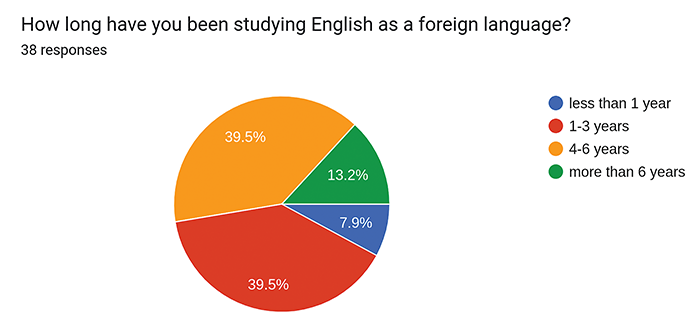
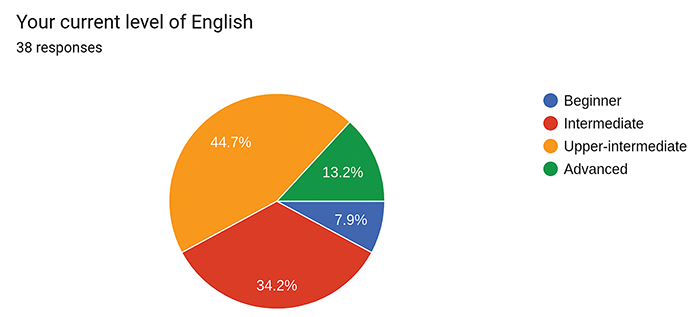
Almost 53% of the students (20 out of 38) confirmed having studied English as a Foreign Language for at least 4 years up the the date of the study, and 92% (35 out of 38) self-labeled their level of English as intermediate to advanced.
When questioned to assess their exposure to English language cinema, almost half of the participating students, 42% (16 out of 38) admitted to watching English films “several times a week”, while further 26% do it “once a week”. On the other hand, only 1 student (making a percentage of 2.6%) reported “never” viewing, proving that the great majority have at least weekly contact with audiovisual input.
Gaining insight on the students’ preferred viewing contexts of these films, 31% participating students (a percentage of 82%) reported using online platforms such as Netflix and Youtube, and 27 (71%) simply watch “at home”. Classroom screenings are rare (3 learners only out of 38), reflecting limited curricular integration in Moroccan classrooms.
Although 84% (32 out of 38) claimed their teachers have used video clips in class, only a minority experience systematic film-based lessons. open-ended comments and responses collected from phase 2 revealed that these activities are mainly discussion post film viewing in class, or listening questions sets.
An important section from the questionnaire was dedicated to the perceptions of participating students on the learning benefits of watching English language films. Table 2 summarizes the mean scores for the 7 LIkert items of this section from the questionnaire.
| mean | |
|---|---|
| Watching movies helps improve my listening skills | 4.21 |
| I learn new vocabulary from watching English-language films | 4.32 |
| Movies help me understand native speaker pronunciation and accents | 4.24 |
| Watching films increases my speaking confidence | 3.97 |
| Watching characters interact helps me learn how to express emotions | 4.00 |
| I prefer watching movies with subtitles in English | 4.08 |
| I would like my teacher to use movies more often in class | 4.18 |
Vocabulary growth (m = 4.32) is the highest rated benefit reported, followed closely by listening skill development (m = 4.21) and better comprehension of native pronunciation (m = 4.24).
Expressive interpersonal communication skills in English; “learning how to express emotions” also scores highly (m = 4.0).
Speaking confidence is positive but slightly lower (m = 3.97), suggesting that learners still feel a gap between receptive gains and productive performance.
The quantitative results corroborate a growing body of literature (Vanderplank, 2016) that positions cinema as a rich, valuable source of language exposure. High agreement on vocabulary, listening and native accent comprehension indicates that films provide authentic lexical clusters and speech rhythms that EFL classrooms often lack. The weekly exposure recorded magnifies these benefits through sheer volume of input. Only 3 respondents reported in-class film screenings, highlighting a missed pedagogical opportunity. Learners’ strong preference for subtitles in English (m = 4.08) suggests that captions in the same language of the movie a learner would watch, helps them better break words into meaningful parts, and more easily connect spoken words to spelling.
The overwhelming call for “more English movies in class” (m = 4.18) signals students’ motivation and interest.
Qualitative findings
To complement the data obtained through the questionnaire, semi-structured interviews were conducted with 15 students who demonstrated a willingness to share more insights from their experiences. Thematic analysis revealed rich, layered perspectives into the students’ understanding of the role of cinema in developing their English communication skills. Three primary themes emerged: personal learning experiences with English language films, perceived linguistic and communicative benefits, and pedagogical recommendations for integrating cinema productions in English into curricula in Morocco.
Personal experiences with films in English language learning
Interviewed students described their cinematic encounters as both a leisure activity and a language learning strategy. Watching films outside of class stimulated their internal motivation and interest.
participant 5:
“I remember watching The Devil Wears Prada and being fascinated with the fashion of it. The next time I rewatched it I started noticing the sarcasm and missed jokes I didn’t understand at first.”
participant 2:
“I watched Harry Potter many times, and I would say I have it to thank for my pronunciation today.”
Students also valued the emotional and cultural depth that films offer them. They saw cinema as a window into the sociocultural norms of native English speaking communities.
participant 11:
“The movie that moved me the most in my life is The Pursuit of Happyness.”
participant 8:
“I think that when you feel the story, the language has to stick with you more.”
Impact on verbal communication and vocabulary use
Participants frequently cited acquiring vocabulary incidentally, especially colloquial and idiomatic language, through repeated exposure in varying contexts.
participant 1:
“I learned how to use expressions like ‘take it easy’ and ‘hang in there’ by hearing it in movies many times. I wouldn’t get that from classes or textbooks.”
participant 14:
“Forrest Gump showed me how people talk differently depending on where they are in the US. That was interesting.”
Students admitted to mimicking accents, intonation patterns and expressions they’d heard in films.
participant 6:
“I copied how the actors talked in Mean Girls for so long. Until one day I didn’t need to anymore.”
Suggestions for curriculum integration
While most participating students were positive about using films to develop their English communication skills on their own, many emphasized the need for structured guidance to maximize learning.
participant 12:
“sometimes the slang is too much or the topic is hard to relate to. choosing the right movie and having someone to discuss it with matters a lot I think.”
Participants recommended selecting films that are age-appropriate, culturally relevant, and thematically rich to maintain motivation and ensure linguistic accessibility. Further suggestions included role-play, dialogue reenactment, and short film critiques as ways to extend cinematic input into productive language learning and use.
participant 4:
“I suggest choosing movies depending on the unit we’re studying. If we’re learning about emotions, we could watch something like Inside Out.”
Conclusion
The study set out to explore the pedagogical potential of cinema in the development of English communication skills among Moroccan EFL learners through a mixed-methods approach. The combination of qualitative data from a structured questionnaire administered to 38 students, and qualitative insights from follow-up semi-structured interviews with 15 participants provided a nuanced understanding of students’ engagement with English language films, their perceived linguistics benefits, and their suggestions for curricular integration.
Quantitative findings demonstrated that most participants positioned themselves in intermediate to advanced levels of English language proficiency, with considerable exposure to English films outside the classroom, primarily through digital platforms. Although in-class cinematic use remains infrequent, students reported high levels of perceived benefits, especially in vocabulary acquisition (m = 4.32), listening skills (m = 4.21), and comprehension of native accents (m = 4.24). The preference for English subtitles (m = 4.08) further suggests that learners value support mechanisms that help their understanding of authentic spoken language. On the other hand, slightly lower scores on speaking confidence (m = 3.97) imply a need for more structured, output oriented activities to complement the receptive gains English films can provide.
Qualitative findings complemented and extended these insights. Conducted interviews revealed that students view English movies not only as enjoyable and “fun” but also as emotionally resonant and culturally rich tools that promote real-world language use. Participating students admitted to mimicking actors’ speech, acquiring idiomatic expressions, and so perfectionning their pronunciation through repeated viewing. Importantly, students expressed a strong desire for guided film-based activities in Moroccan classrooms for EFL classes, such as discussions post film viewings, role-plays, and thematically selected screenings aligned with ongoing course content. These recommendations point to a gap between learners’ demonstrated enthusiasm and current classroom practices in Morocco.
Together, these findings reinforce the pedagogical relevance of cinema in EFL instruction in Morocco. Films offer not only exposure to authentic lexical sequences and native speech rhythms and patterns, but also serve as motivational tools that can transform passive exposure into active learning when appropriately mediated. As such, integrating film in EFL curricula and implementing it within Moroccan universities in more intentional and interactive ways could bridge the dividing gap between receptive language exposure and communicative performance.
Future research should investigate the comparative effects of different genres, subtitling strategies, and classroom assignments on English language learning outcomes. Meanwhile, EFL teachers are encouraged to leverage students’ existing motivation and interest for English language cinema and channel it into structured pedagogical interventions.
Bibliography
Alhadidi, A. H. (2017). Investigating the effect of L1 pragmatic transfer on the acquisition of English language by Saudi speakers. International Journal of Linguistics, 9(4), 63. https://doi.org/10.5296/ijl.v9i4.10911
Elshahawy, K. E. M. (2020). Affective Variables from the Applied Linguistics Perspective: A Study of the Saudi Undergraduate Students Majoring in English Language. Journal for the Study of English Linguistics, 8(1), 70. https://doi.org/10.5296/jsel.v8i1.16357
Kuppens, A. H. (2010). Incidental foreign language acquisition from media exposure. Learning Media and Technology, 35(1), 65–85. https://doi.org/10.1080/17439880903561876
Liando, N. V., Sahetapy, R. J., & Maru, G. (2018). ENGLISH MAJOR STUDENTS’ PERCEPTIONS TOWARDS WATCHING ENGLISH MOVIES IN LISTENING AND SPEAKING SKILLS DEVELOPMENT. Advances in Social Sciences Research Journal. https://doi.org/10.14738/assrj.56.4627
Ntakarutimana, J., & Fazilatfar, A. M. (2022). Burundian Teachers’ conceptualisations of Philosophy-Based Language Teaching Approach in developing EFL students’ speaking skill. SSRN Electronic Journal. https://doi.org/10.2139/ssrn.4281211
Roslim, N., Azizul, A. F., Nimehchisalem, V., & Abdullah, M. H. T. (2021). Exploring movies for language teaching and learning at the tertiary level. Asian Journal of University Education, 17(3), 271. https://doi.org/10.24191/ajue.v17i3.14520
Sánchez-Auñón, E., Férez-Mora, P. A., & Monroy-Hernández, F. (2023). The use of films in the teaching of English as a foreign language: a systematic literature review. Asian-Pacific Journal of Second and Foreign Language Education, 8(1). https://doi.org/10.1186/s40862-022-00183-0
Sari, S. N., & Aminatun, D. (2021). STUDENTS’ PERCEPTION ON THE USE OF ENGLISH MOVIES TO IMPROVE VOCABULARY MASTERY. Journal of English Language Teaching and Learning, 2(1), 16–22. https://doi.org/10.33365/jeltl.v2i1.757
Vanderplank, R. (2016). Captioned Media in Foreign Language Learning and Teaching. In Palgrave Macmillan UK eBooks. https://doi.org/10.1057/978-1-137-50045-8
Filmography
Forrest Gump. (1994)., Directed by Robert Zemeckis, United States: Paramount Pictures.
Harry Potter and the Chamber of Secrets. (2002)., Directed by Chris Columbus, United States: Warner Bros.
Inside Out. (2015)., Directed by Pete Docter, Ronnie Del Carmen, United States: Walt Disney Studios Motion Pictures
Mean Girls. (2009)., Directed by Mark S. Waters, United States: Paramount Home Entertainment.
The Devil Wears Prada. (2006)., Directed by David Frankel, United States: Fox 2000 Pictures.
The Pursuit of Happyness. (2006)., Directed by Gabriele Muccino, United States: Columbia Pictures.