Abstract
This paper critically reflects on a mixed-methods approach to animation using Generative AI (Gen-AI) tools within the project “AI.D - Artificial Intelligence and the Shaping of Democracy”. In dialogue with notions from Bernard Stiegler’s philosophy of technology, as well as ideas related to decolonial thinking such as “data colonialism”, “re-existence” and the Brazilian Antropophagic movement, this paper explores the current context in which animation artists interact with digital technology. Drawing on Stiegler’s notions of technics and individuation, we discuss how the use of Gen-AI in animation reveals both the pharmacological nature of technology - its capacity to be both remedy and poison - and the challenges of maintaining artistic agency in an era of increasing automation and technocentric propaganda. Through the use of free and open-source software such as Blender and Krita, the project also adopted sustainable technological practices, advocating for tools that are freely accessible and support, rather than replace, creative autonomy, allowing for diverse modes of artistic creation. While Gen-AI tools provided satisfactory results in supporting basic narration, simple music composition and transcription, their results in crucial tasks such as scriptwriting and image generation remained largely inadequate for use. For example, essential creative aspects of animation from writing the scripts, to creating character designs, maintaining the consistency of style and character animation required complete human artistic oversight and craftsmanship. The findings contribute to the ongoing discourse on the role of AI in artistic production, where these tools can support human creativity rather than automate it.
Keywords: Animation, Generative AI, Free and Open Source Software, Philosophy of Technology, Decolonial thinking.
Introduction
This work results from a practice-led reflection on animation practices and methodologies in the context of creating four educational animation shorts for the project AI.D – Artificial Intelligence and the Shaping of Democracy, coordinated by the Institute for Didactics of Democracy at Leibniz University Hannover and funded by the Erasmus+ programme between 2024 and 2026. These short films are part of a broader set of outcomes that also includes webinars, training concepts, and policy recommendations addressing the challenges posed by diverse applications of Artificial Intelligence and automated decision-making systems in society. Within this consortium, researchers from LUCA School of Arts were primarily responsible for the creation of the animations, which are embedded in the artistic research cluster Critical Reflections of and through Animation.
The animated shorts were designed to offer a critical yet lighthearted presentation of various aspects of AI, introducing themes that are further developed in the project’s webinars and other educational materials. Each short addresses a specific topic related to the societal effects of AI and is titled accordingly: Fundamentals of AI, Generative AI, Impacts on Working Life, and Inclusive Artificial Intelligence. As these educational films are intended for a broad international audience—including viewers from the consortium partners’ countries (Austria, Belgium, and Germany)—they are available with narration and subtitles in English, as well as in Dutch and German.
The project also provided an opportunity to conduct both a critical socio-technical analysis of current trends in the integration of AI tools into animation workflows and a practice-led critique of the applicability of these tools in the production of the animation shorts. In artistic research, conceptual and practice-led reflections are deeply intertwined and mutually influential. Therefore, theoretical insights from fields such as Philosophy of Technology and Decolonial Thinking were fundamental in informing our reflections and guiding the development of our animation practices.
AI: Animation and Individuation
Animation, as Photography and Cinema, is a form of artistic expression highly mediated by what Gilbert Simondon (2017) defined as technical objects. Through this mediation, these objects actively shape our relationships with the world: from their material limitations and potentialities, to their conditions of possibility and their interconnected network of social and cultural meanings, which can also be related to the foucauldian notion of dispositif. Although the resulting objects of animation practice are usually films, the different mediation possibilities for their creation motivate artists, studios and schools to approach and organize their work around two main categories: from analogue to digital techniques (with varied intensities for mixed approaches between them); and from two to three dimensions, to create sequences of images (charcoal, paint, pencil, vectors, raster graphics…) or volumes (stop motion, pixilation, digital 3D, VR...). In the production of the shorts in AI.D, for example, our team used only digital techniques, and a mix of 2D and 3D images.
Yet beyond the limitations and possibilities directly linked to the materiality of technical objects, the emergence and development of contemporary animation methodologies have been significantly shaped by the social and cultural practices of modern, industrialized, market-oriented societies. The laborious and costly process of hand-crafting the movement of characters, backgrounds, and other elements – frame by frame – to create the illusion of movement was a key driver behind the development of industrial practices aimed at automation and efficiency. These practices sought to reduce costs and accelerate production timelines, and they can be understood through Bernard Stiegler’s (2013) concept of the pharmacology of technics, which emphasizes the ambivalent nature of technical objects as both poison and cure. On the one hand, automation and efficiency measures in profit-driven animation studios enabled cheaper and faster productions; on the other, they often contributed to the degradation of working conditions and the erosion of artists’ rights. But, simultaneously, these same developments facilitated access to tools for individual artists, enabling independent expression and experimentation with new, more accessible technologies.
For examples in this ambivalent pharmacology of animation, Moore (2020) and Perea (2018) describe how early 20th-century animation studios in the United States – whose practices became foundational to the industry – established auxiliary roles such as ink-and-paint departments and in-betweeners. These positions were often characterized by lower wages, limited recognition, and gendered labor divisions, all in service of enabling the efficient production of increasingly complex animations. Once these foundational practices became standardized, scholars such as Stahl (2010) and McRobbie (2015) documented how contemporary, neoliberal strategies, were implemented across the animation and creative industries. These included the offshoring of production to countries with cheaper labor and weaker regulatory protections, as well as the rise of precarious, short-term contract work in developed economies. These developments, alongside the adoption of digital technologies such as vector interpolation and digital 3D animation, form part of a continuous set of systemic processes and iterations that can be linked to Stiegler’s (1998) understanding of individuation, in which technical objects – both the tools themselves and the social practices and methods surrounding them – shape the cybernetic processes that affect individuals, collectives, and the objects they engage with.
The developments in communication and automation technologies marked, in the early 2000’s, a shift in the number of animated productions towards digital techniques. In terms of style, these digital productions ranged from the adoption of CGI’s photorealistic simulations for shading and texturing, to the remediation and simulation of traditional analogue aesthetics in digital form, as well as hybrid approaches that combined both. In adopting and developing these technologies, the animation industry not only perpetuated neoliberal practices that disenfranchise artists, but also significantly expanded the global reach of its cultural products, in what Stiegler (2014) identified as a transformation of Adorno and Horkheimer’s Culture Industry into what he termed the Program Industries.
This brief analysis provides the context through which we understand the adoption of tools broadly associated with the term Generative Artificial Intelligence (Gen-AI) in the field of animation. While the emergence and public availability of machine learning tools capable of generating text, images, and sound represent a technical innovation, they do not diverge from the historical trajectories that have shaped the collective socio-technical individuation of the animation field. As authors such as Lisa Gitelman (2008) and Pierre Bourdieu (2011) have argued in their analyses of earlier media innovations – such as radio, television, and digital communications – new technologies should not be seen as entirely unprecedented (so as not to overlook historical and social continuities), nor as merely “more of the same” (so as not to ignore their specific characteristics and implications). This dual perspective allows us to filter out both technocentric hype and technophobic fears, enabling more nuanced analyses of Gen-AI.
For instance, Gen-AI methods of automation rely on inference and statistical approximation to reproduce elements from existing bodies of work – referred to as “training data” – which often include large and varied datasets of texts, images, or sounds that were either created digitally or remediated into digital form. A significant portion of this training data consists of copyrighted material (Buick, 2025), raising legal and ethical concerns for individuals and organisations whose digitized content is used to train proprietary AI systems. This reliance on pre-existing data renders Gen-AI a retrograde technology, in the sense that it is fundamentally oriented toward looking backward – mimicking and repeating established patterns. This characteristic invites a pharmacological reading of this technology: while pattern recognition can be very useful in fields such as medical diagnostics, its exclusive reliance on repetition can be problematic in poietic activities – those that seek to create new and different modes of expression, such as artistic practices. Similar conclusions were reached by Latikka et al. (2023), whose survey in Finland indicated that people view the use of AI in “culture and the arts” less favorably than in fields like medicine or engineering.
Again, the cultural implications of retrograde systems are not new, but the scale and reach of these systems are. They reflect a broader socio-technical alignment with late capitalist tendencies, which Fredric Jameson (2013) described as an “eternal present” – a condition in which contemporary culture undergoes a process of de-historicization, privileging aesthetic form over content and context, often resulting in stylistic expressions such as pastiche. In a similar vein, Mark Fisher (2022, p. 3) successfully summarized the idea that “a culture that is merely preserved is no culture at all.” Then, from a technological standpoint, Stiegler (2017) extended Simondon’s concepts of individuation and metastability to describe what he called the proletarianization of sensibility – a condition produced by hyper-industrial societies under which AI systems are developed.
A recent example are the public debates in early 2025, following an internet trend of generating images in the style of Studio Ghibli (Ayres, 2025). Beyond the issues of stylistic appropriation, a deeper concern lies in the superficial aestheticization of these AI-powered, Jamesonian pastiches. From the machinic perspective, what matters are only the quantifiable elements that can be remediated into bits – pastel colours, stylized lines, and visual motifs. In contrast, everything else that cannot be transformed into one and zeroes, but holds the real artistic value in Studio Ghibli’s works is lost: the careful blending of socially conscious narratives, Japanese cultural heritage, and Western influences to create unique films.
Finally, building on these reflections that focus on the technological and cultural dimensions of late capitalism – and in connection with the historical processes in which they are embedded – it is also relevant to relate the discussions surrounding Gen-AI to decolonial thinking. As Quijano (2007) argues, the modernity/rationality paradigm of knowledge was established with the colonial project at the end of the 15th century, a period that Moore (2017) describes as the genesis of “early capitalism’s technics,” which were “specifically organized to treat the appropriation of global space as the basis for the accumulation of wealth.” In alignment with this perspective, Couldry and Mejias (2018) introduced the term data colonialism to describe not only the massive remediation of human activities into quantifiable data, but also the systemic appropriation and commodification of these digitized and globalized resources by large, centralized corporations such as Alphabet, Microsoft, and Meta.
Post-digital cracks
But within the pharmacological aspects that allow us to move beyond techno-dystopian narratives, it is also possible to look at past events to find examples that enable a re-territorialization (Deleuze & Guattari, 2023) of similar centralizing technological practices. For instance, before the popularization of Gen-AI tools such as ChatGPT and Stable Diffusion in 2022, many other actions sought to strenghen heterotopic spaces (Vasconcelos, 2019) within the digital space. As personal computers were introduced and became more widespread and accessible from the late 1970s, various activist movements proposed practices such as copyleft licences and FOSS (Free and Open-Source Software) as countermeasures to the increasing privatization and centralization of digital platforms, software, and services. Copyleft licences, by employing existing legal frameworks to enforce openness, ensured that software released under them - such as Blender or Krita – can be freely used by artists and users with minimal restrictions, while also remaining open to further development by a global networked community. In the context of data colonialism, a similar countermeasure could involve specific licences for texts, images and sounds to enforce the applications trained on them to also remain freely and openly accessible.
Drawing further from photography and decoloniality, we are able to not only identify historical and contextual foundations to analyse current trends, but also to find alternative, heterotopic spaces from which to draw inspiration. Photography, for example, is a medium whose emergence liberated painting from its representational function, enabling new artistic directions. Yet it is also a field that was simultaneously expanded and deeply disrupted by the rise of digital photography and sharing platforms in the 2000s. From that perspective, Openshaw (2015) described a growing skepticism among “postdigital artisans” toward the all-encompassing discourses surrounding digital technologies, and highlights artistic practices that embrace and hybridize analogue techniques to create “something that digital technology cannot offer” (Vrancken, 2019, p. 91).
Similarly, ideas linked to post- and decolonial thinking offer important perspectives from non-Western cosmologies. This field offers a framework for interrogating the matrix of social hierarchies – including but not limited to class, race, gender, epistemology, and ecology – that structures contemporary Western societies. It offers clear perspectives for both critically identifying their pharmacological “poisonous” aspects and exploring ways to overcome them. Specifically, critical artistic practices and ideas such as “decolonial cracks” (Walsh, 2023) and “re-existence” (Achinte, 2013), enable the questioning and deconstruction of universalist promises of AI, while also highligting modes of expression that cannot be remediated. Re-existing, then, becomes more than a reactive and negatively defined push to resist AI: it is a process that affirms ways of knowing and creating without being othered or commodified.
To conclude this section with the key ideas that inform our practice-led reflections in the AI.D project, we also draw inspiration from the Brazilian Anthropophagic artistic movement. As noted by Islam (2011), this movement offers a metaphor for the Brazilian paradoxical response to colonialism through a dynamic of hybridization that embraces and rejects the colonizing force at the same time. Beatriz Azevedo (2025) further connects this movement to the concept of Amerindian perspectivism, developed by anthropologist Eduardo Viveiros de Castro (2017) through his studies of Amazonian indigenous cosmologies. In this light, our approach does not seek to reject Gen-AI outright, but rather to critically assess its possibilities and selectively “cannibalize” and “digest” its elements for creating distinct, open, pluralistic, and sustainable artistic practices.
Project AI.D
For creating the 4 animated shorts for AI.D, we adopted a mixed-methods approach where the main tools are free and open-source software such as Blender and Krita, while critically experimenting with Gen-AI applications through every stage of production. The goal was to test the applicability of AI-generated content using publicly available platforms regarded as capable of creating high quality content, such as ChatGPT, DALL-E, Runway or Google Gemini. Although different platforms were used, a comparison between them was out of the scope of this work.
Scripts
In April 2024, following discussions with all partners in the consortium to define the content requirements for each short, we initiated the first experiment with Generative AI by asking ChatGPT to provide suggestions for scriptwriting. Given our objective to produce four animated shorts – each between three and five minutes in length – with a very small team (comprising the two authors of this paper), we needed to strike a careful balance in the scripts. This involved presenting a feasible minimum of animated elements while maximizing the presentation of educational content. Along with it, to help the production schedule, we aimed to reuse visual and narrative assets whenever possible, without compromising the coherence or clarity of the storytelling.
Although we repeatedly provided to ChatGPT prompts with a complete list of story points, structure, elements and production needs, its responses were below our team’s expectations of quality, with generic, verbose constructions, filled with unnecessary adjectives and literal relations between the scenes’ visual descriptions and the voice-over narration. Also, we noticed that the tool generates text that is very similar in form to a script, but without the specific tacit knowledge that is needed for animated productions. Therefore, the scene descriptions often portrayed generic elements with little connection to the intended story objectives, such as one proposed closing scene for Video 1: “Fade out with a contemplative shot of a person gazing at a city skyline dominated by towering AI structures”.
This scene proposed by Gen-AI portrayed the opposite of our team’s intentions, by suggesting an ending where undefined “AI structures” are the visually dominating symbols. Although there were similar cases on the AI-generated responses, this example reflects the general inadequacy of these systems for creative writing. That aligns to what has been called “slop” to refer to low quality AI-generated content (Hoffman, 2024) in a similar way to what “spam” does for the phenomenon of massively sent and unwanted email.
Therefore, the final scripts were completely written and discussed by the consortium members, who adopted a “layered” approach to the narrative, where what is visually shown does not always repeat what is heard: sometimes the images complement or even contradict the narrative, adding layers of interpretation and information to critically address the topic while ensuring that its message is simple but not simplistic, informative but not boring, entertaining but not alienating. Since none of the team members are native English speakers, one positive application of AI tools at this stage was in providing minor corrections and stylistic adjustments to the text. This helped us avoid inconsistencies between British and American spellings and refine certain sentences to sound more natural and fluent.
Visual elements
Having a character designer in our team, we did not rely on Gen-AI for creating characters designs. Rather, we chose to employ her drawing style for keeping consistency between characters, backgrounds and objects, which is a current known limitation of these systems. Also, considering the size of the animation team and the short time limit to produce 4 animated shorts, artistic direction was fundamental to not only adopting a simplified style, but actively employing artistic choices to define which elements should be shown and which could be omitted, or which aspects could be made simpler and which should be more complex in function of the story.
For example, some scenes included only a single background element to convey a sense of scale and perspective. In one scene, where both a bird and an airplane are visible, the only other visual elements were clouds – used strategically to clarify the spatial distance between the two. Similarly, some character’s limbs were designed to allow their temporary omission, streamlining the animation process in moments where just body poses and facial expressions were enough to convey visual ideas in motion (Images 1 and 2).
Additionally, due to concerns about the training data behind Gen-AI image systems – particularly on replicating the style of works protected by copyright – no final frame of the animations was entirely generated using AI tools.
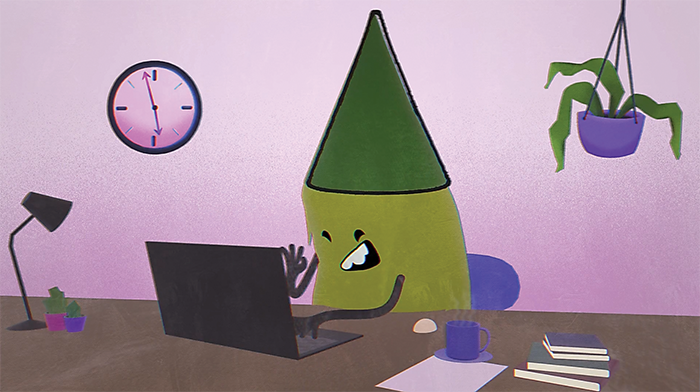
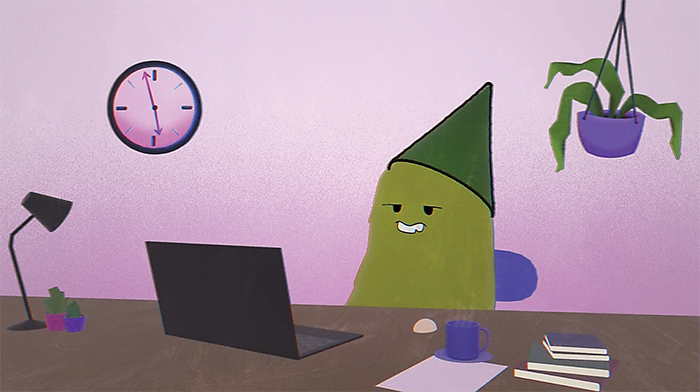
Apart from a few exceptions, AI-generated imagery accounted for only a very small portion of the production assets in AI.D, with just five images used across the four videos. In contrast, more than 150 images were manually painted using Krita, serving as objects and backgrounds throughout the animations. Examples of AI-generated images created with DALL·E include textures mapped onto 3D objects – such as one generated with the prompt “an image of a pizza slice with tomatoes, cheese and mushrooms, seen from above” – or visual representations of story elements based on public domain references, like the prompt “give me an image of a pizza as if it was painted by Van Gogh.”
Although images generated by AI were not a significant part of all assets, there were cases where features of a Large Language Model – such as ChatGPT – proved useful in supporting the creation of visuals. A notable example was on assisting the creation of Python code to be used inside of Blender to automate a repetitive task. In one scene from Video 2, we needed to display two 3D text objects representing an increasing number of “likes” and “loves” to a piece of false information viewed by a character. Since Blender does not natively support animating the internal value of a 3D text object over time, we asked ChatGPT to suggest code that would allow us to set keyframes for the text content. After some iterations and debugging steps, the resulting script was functional and enabled us to achieve the desired effect – something that would have otherwise required manually creating and switching multiple text objects frame by frame.
Another positive use of ChatGPT was on Video 3, where we aimed to visually repersent how a text might be perceived by someone with dyslexia. First, we asked the platform to provide a general definition of dyslexia, which was used as the text to be “read” by one character on its laptop. Then, to simulate visual distortions such as variations in letter thickness, bluriness, scale and shape, we asked ChatGPT to generate the HTML and CSS code for a webpage for applying these effects to the text. While we acknowledge that dyslexia manifests in different ways and cannot be correctly simulated in an single image, the intended metaphor of making the text difficult to read was made easier with the aid of AI-generated code.
Finally, another example of this mixed-method was on generating news headlines to be read by the character on its smartphone on Video 1. In the narrative, the character was confused after seeing many sensationalist and contradictory news articles about AI, so we asked ChatGPT to “generate 10 news articles with extreme views about AI: 5 with a positive and 5 with a negative tone”. These headlines were then manually incorporated to an image designed to resemble a smartphone interface to represent the character’s confusion through the information overload.
Animation
Once the characters and general style of animation were defined, we conducted a serie of tests for creating movements. Given the promotional efforts around platforms such as Runwayml.com or Kaiber.ai, our team experimented with feeding images, videos and text descriptions into each of them to evaluate if they could be used – at least partially – as part of the animation workflow. We tried each of those platforms, even though with a reasonable degree of skepticism, particularly due to the prevalence of promotional short clips of simulated live-action footage that often fall into the unsettling terrain of the “uncanny valley” of computer-generated imagery.
We tested those platforms with three main approaches: (1) providing a static image and a text prompt describing the elements and actions in a scene; (2) providing a video with hand-made rough animation and a style description, to see if the tool could successfully apply the style to an already timed scene; and (3) a finished frame from an already animated scene, together with its description, to compare the AI-generated results with the hand crafted version. In all cases, the results were largely unsuitable for use, and all platforms offered negligible control over fundamental elements such as style consistency, camera placement and character body movement.
For example, when given an image of the character design, a layout sketch of a scene, and a corresponding description, Kaiber.ai produced a generic “cartoon” that failed to match the input style. It also introduced visual elements that were not requested, such as a large yellow shape behind the character and a small green object in front of it. Additionally, one of the key props – a laptop – was rendered as a realistic object, breaking the intended visual coherence and style consistency of the scene.

In Runwayml.com, we tested the platform by providing a rough animation video along with a style description. While the tool was able to generate some shapes and recognize character expressions from the original footage, it failed to maintain the intended visual style. It also lacked consistency across frames, causing the character’s appearance to vary significantly throughout the sequence. Additionally, it introduced unwanted elements – such as the word “BLOP” (which had been described as the character’s name in the prompt) – randomly across different frames of the scene.
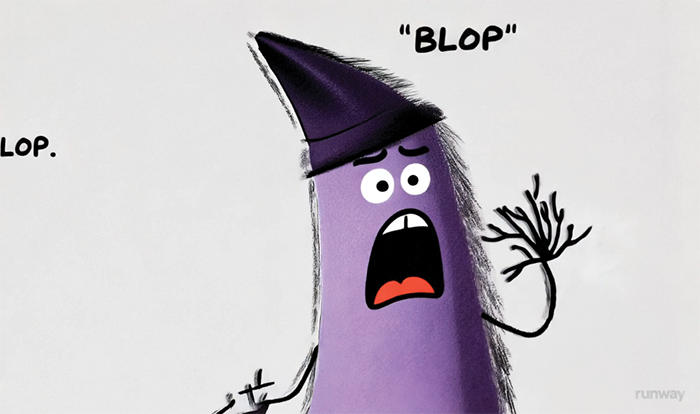
The final test involved retroactively using finished frames from the animations to compare them with AI-generated results. While this provided slightly better outcomes, when compared to the final animation the results were still inadequate. The tool was successful in animating some secondary elements, such as the clock pointers and the steam rising from a coffee mug. However, it failed to maintain consistency and coherence in the character animation. For instance, it could not preserve the colour nor the style of the character’s arm, mouth, and eyes. It also misinterpreted the computer mouse, incorporating it into the character’s limbs.
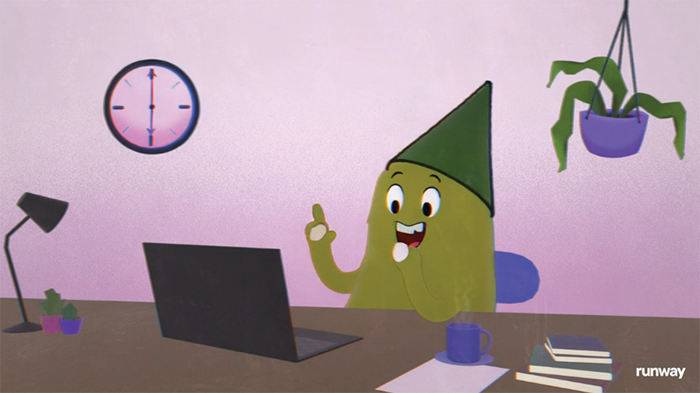
Narration and music
One area where Gen-AI proved particularly useful was in the creation of the soundtrack and narration for the videos. For the soundtrack, our team used the Suno.com platform to generate electronic music loops based on generic prompts such as “digital calm electronic,” deliberately avoiding any explicit references to existing songs. The goal was to produce short, adaptable loops that could then be manually edited and sequenced to fit the rhythm and tone of each video. We chose electronic sounds for two main reasons: first, their conceptual alignment with the theme of digital AI platforms; and second, the use of synthetic, instrumental tracks helped avoid stylistic associations with specific artists or copyrighted material. After 11 attempts with varied prompts, our team was able to select a few excerpts to manually edit, sequence and include in the videos.
For the narrations, we used the ElevenLabs.io platform, which allows for the creation of multilingual voiceovers based on provided text and a range of licenced voices. Considering that the voices are legally licenced and the narration style required for the videos did not involve complex acting choices, the AI-generated results proved satisfactory. Other positive aspects included the ability of adjusting the text to obtain small variations to better fit the videos, and the automatic translation from the original English narration into Dutch and German with the same voice profiles. For each video, we chose different voices to endure a diversity of accents and gender representation.
Although the narration results were satisfactory, the specific context in which they were created played a significant role. After all, the scripted narrations did not require expressive voice acting, so the “linear” delivery style was mostly adequate. In some cases, the generated voices applied emphasis to certain words, but they were often out of context and required regeneration. For nuanced voice acting, the platform proved largely inadequate as it lacks flexible options to creating pauses, adjusting emphasis, or conveying emotional tone. Specifically in the Dutch and German versions, the synthetic quality of the voices was more noticeable than in the English version.
Final considerations
By combining critical analysis – drawing on insights from Philosophy of Technology and Decolonial thinking – with a practice-led approach to assess how contemporary Generative AI tools relate to animation practices, we were able to confirm our prior understanding: their impact does not currently support technochratic utopian aspirations of independent creative machines, nor does it justify it’s technophobic counterpoint. In line with a pharmacolotical understanding of technics, their results are heavily dependent on the socio-technical, ethical, and artistic frameworks within which they are deployed. Through our work on the AI.D project, we adopted a mixed-methods approach that allowed us to assess Gen-AI not as a replacement for creative practices, but as a tool with the potential to contribute to them.
Our findings reaffirm the centrality of human agency in creative processes. While Gen-AI tools offered limited support in areas such as basic narration, music loops, and code generation, they consistently fell short in tasks requiring nuanced judgment, cultural sensitivity, and aesthetic coherence – such as scriptwriting, character design, and animation. These limitations underscore the importance of maintaining human oversight and craftsmanship in artistic production, particularly in educational and socially engaged contexts.
Moreover, we find it fundamental to relate current developments to contextual and historical factors, which enable a nuanced understanding of the particular issues of this new technology. At the same time, we look to heterotopias that can point us to different and better outcomes. The ethical and political stakes of AI integration – such as data colonialism, stylistic appropriation, and the commodification of cultural expression – demand critical scrutiny and the “re-existence” through practices such as adopting open-source tools, enforcing the accountability and open access to Gen-AI systems, and collaborative models to promote pluralistic, inclusive, and sustainable alternatives.
By embedding these reflections into the broader goals of the AI.D project, we aim to contribute to a more critical literacy around AI technologies and their societal implications. The animated shorts serve not only as educational tools but also as practice-led artistic interventions to invite viewers to engage with AI from multiple perspectives.
Looking forward, we advocate for continued experimentation with Gen-AI under frameworks that prioritize ethical responsibility, creative autonomy, and cultural diversity. Rather than rejecting these tools, we propose a selective and critical engagement – a form of “cannibalization” inspired by the Anthropophagic movement – where elements of Gen-AI are digested and reimagined to serve distinct, context-aware, and human-centered artistic practices.
Notes
1Virgilio Vasconcelos (virgilio.vasconcelos@luca-arts.be)
2Suryara Bernardi (suryara.bernardi@luca-arts.be)
Bibliography
AI.D - Artificial Intelligence and the Shaping of Democracy – Institute of Didactics of Democracy – Leibniz University Hannover. (n.d.). Leibniz Universität Hannover. https://www.idd.uni-hannover.de/en/research/translate-to-english-projekte/aid-artificial-intelligence-and-the-shaping-of-democracy
Albán Achinte, A. (2013). Pedagogías de la re-existencia: Artistas indígenas y afrocolombianos. In C. E. Walsh (Ed.), Pedagogías decoloniales: Prácticas insurgentes de resistir, (re)existir y (re)vivir: Vol. I (pp. 443–468). Ediciones Abya-Yala.
Ayres, C. (2025, March 27). Everything is Ghibli. Good Graf! https://carly.substack.com/p/everything-is-ghibli
Bernardi Rocha, S. (2019). Pastiche e resgate de historicidade em Over the Garden Wall [MA Thesis, Universidade Federal de Minas Gerais]. https://repositorio.ufmg.br/handle/1843/LOMC-BELHY9
Bourdieu, P. (2011). On television.
Buick, A. (2024). Copyright and AI training data—transparency to the rescue? Journal of Intellectual Property Law & Practice. https://doi.org/10.1093/jiplp/jpae102
Couldry, N., & Mejias, U. A. (2018). Data Colonialism: Rethinking big data’s relation to the contemporary subject. Television & New Media, 20(4), 336–349. https://doi.org/10.1177/1527476418796632
De Castro, E. V. (2017). Cannibal Metaphysics. Univocal.
Deleuze, G. (1987). A thousand plateaus: Capitalism and Schizophrenia. U of Minnesota Press.
Fisher, M. (2009). Capitalist realism: Is there no alternative? John Hunt Publishing.
Gitelman, L. (2008). Always already new: Media, History, and the Data of Culture. MIT Press.
Hoffman, B. (2024, November 6). Is Slop A.I.’s Answer to Spam? A Phrase Emerges for Bad Search. The New York Times. https://www.nytimes.com/2024/06/11/style/ai-search-slop.html
Jameson, F. (2014). A singular modernity: Essay on the Ontology of the Present. Verso Books.
Latikka, R., Bergdahl, J., Savela, N., & Oksanen, A. (2023). AI as an Artist? A Two-Wave Survey Study on Attitudes Toward Using Artificial Intelligence in Art. Poetics, 101, 101839. https://doi.org/10.1016/j.poetic.2023.101839
McRobbie, A. (2016). Be creative: Making a Living in the New Culture Industries. John Wiley & Sons.
Moore, B. E. (2020). “In-Betweening” Disney: An Animated History of Hollywood Labor and Ideological Imagineering, 1935-1947 [Master of Arts (MA), Old Dominion University]. https://doi.org/10.25777/wdw1-yk94
Openshaw, J. (2015). PostDigital Artisans: craftsmanship with a new aesthetic in fashion, art, design and architecture. http://ci.nii.ac.jp/ncid/BB19440837
Perea, K. (2018). Gender and Cartoons from Theaters to Television: Feminist Critique on the Early Years of Cartoons. Animation, 13(1), 20–34. https://doi.org/10.1177/1746847718755591
Simondon, G. (2017). On the Mode of Existence of Technical Objects.
Stahl, M. (2010). Cultural Labor’s “Democratic Deficits”: Employment, Autonomy and Alienation in US Film animation. Journal for Cultural Research, 14(3), 271–293. https://doi.org/10.1080/14797581003791495
Stiegler, B. (1998). Technics and Time, 1: The Fault of Epimetheus. Stanford University Press.
Stiegler, B. (2013). What Makes Life Worth Living: On Pharmacology (D. Ross, Trans.). Polity Press.
Stiegler, B. (2016). Symbolic Misery, Volume 1: The Hyperindustrial Epoch. Polity.
Stiegler, B. (2017). The proletarianization of sensibility. Boundary 2, 44(1), 5–18. https://doi.org/10.1215/01903659-3725833
Vasconcelos, V. (2019). Assimetrias de poder e heterotopias na escrita do meio digital [PhD Dissertation, Universidade Federal de Minas Gerais]. https://repositorio.ufmg.br/handle/1843/BUOS-BBQHNF
Vasconcelos, V. (2024). Existing with and re-existing against AI animation: a pharmacological approach towards changing technical landscapes. Ecstatic Truth VIII - Animation and Documentary in Times of Artificial Intelligence, Lisbon, Portugal. https://ecstatictruth2024.ulusofona.pt/
Vrancken, K. (n.d.). Photography against the Anthropocene: The Anthotype as a Call for Action. In J. Ellis & N. Hall (Eds.), Hands on Media History (pp. 91–109). Routledge. https://doi.org/10.4324/9781351247412-9
Walsh, C. E. (2022). Rising up, living on: Re-Existences, Sowings, and Decolonial Cracks. Duke University Press.
Final notes
This research was partially supported by the European Union’s Erasmus+ programme under grant agreement number 2023-1-DE02-KA220-VET-00016537.